Yonas Ghebrekristos, Aysha Ahmed, Natalie Beylis, Sarishna Singh, Christoffel Opperman, Fahd Naufal, Megan Folkerts, David Engelthaler, Erick Auma, Rouxjeane Venter, Ghowa Booley, John Metcalfe, Robin Warren, Grant Theron
{"title":"结核病患者的超耐药和MTBDR +敏感利福平结果:氟型MTBDR和深度测序的效用","authors":"Yonas Ghebrekristos, Aysha Ahmed, Natalie Beylis, Sarishna Singh, Christoffel Opperman, Fahd Naufal, Megan Folkerts, David Engelthaler, Erick Auma, Rouxjeane Venter, Ghowa Booley, John Metcalfe, Robin Warren, Grant Theron","doi":"10.1128/aac.01671-24","DOIUrl":null,"url":null,"abstract":"<p><p>Xpert MTB/RIF Ultra (Ultra)-detected rifampicin-resistant tuberculosis (TB) is often programmatically confirmed using MTBDR<i>plus</i>. There are limited data on discordant results, including when re-tested using newer methods, like FluoroType MTBDR (FT-MTBDR) and targeted deep sequencing. MTBDR<i>plus</i> rifampicin-susceptible isolates from people with Ultra rifampicin-resistant sputum were identified from a South African programmatic laboratory. FT-MTBDR and single molecule-overlapping reads (SMOR; <i>rpoB</i>, <i>inhA</i>, <i>katG</i>) on isolate DNA were done (SMOR was used as a reference standard). Between 1 April 2021 and 30 September 2022, 8% (109/1347) of Ultra rifampicin-resistant specimens were MTBDR<i>plus</i>-susceptible. Of 89% (97/109) isolates with a sequenceable <i>rpoB</i>, SMOR resolved most in favor of Ultra (79% [77/97]). Sputum with lower mycobacterial load was associated with Ultra false-positive resistance (46% [11/24] of \"very low\" Ultra had false resistance vs 12% [9/73; <i>P</i> = 0.0004] of ≥\"low\"), as were Ultra heteroresistance calls (all wild-type probes, ≥1 mutant probe) (62% [23/37 vs 25% 15/60] for Ultra without heteroresistance calls; <i>P</i> = 0.0003). Of the 91% (88/97) of isolates successfully tested by FT-MTBDR, 55% (48/88) were FT-MTBDR rifampicin-resistant and 45% (40/88) susceptible, translating to 69% (47/68) sensitivity and 95% (19/20) specificity. In the 91% (99/109) of isolates with <i>inhA</i> and <i>katG</i> sequenced, 62% (61/99) were SMOR isoniazid-susceptible. When Ultra and MTBDR<i>plus</i> rifampicin results are discordant, Ultra is more likely to be correct, and FT-MTBDR agrees more with Ultra than MTBDR<i>plus</i>; however, lower load and the Ultra heteroresistance probe pattern were risk factors for Ultra false rifampicin-resistant results. Most people with Ultra-MTBDR<i>plus</i> discordant resistance results were isoniazid-susceptible. These data have implications for drug-resistant TB diagnosis.</p>","PeriodicalId":8152,"journal":{"name":"Antimicrobial Agents and Chemotherapy","volume":" ","pages":"e0167124"},"PeriodicalIF":4.5000,"publicationDate":"2025-03-05","publicationTypes":"Journal Article","fieldsOfStudy":null,"isOpenAccess":false,"openAccessPdf":"https://www.ncbi.nlm.nih.gov/pmc/articles/PMC11881552/pdf/","citationCount":"0","resultStr":"{\"title\":\"Xpert MTB/RIF Ultra-resistant and MTBDR<i>plus-</i>susceptible rifampicin results in people with tuberculosis: utility of FluoroType MTBDR and deep sequencing.\",\"authors\":\"Yonas Ghebrekristos, Aysha Ahmed, Natalie Beylis, Sarishna Singh, Christoffel Opperman, Fahd Naufal, Megan Folkerts, David Engelthaler, Erick Auma, Rouxjeane Venter, Ghowa Booley, John Metcalfe, Robin Warren, Grant Theron\",\"doi\":\"10.1128/aac.01671-24\",\"DOIUrl\":null,\"url\":null,\"abstract\":\"<p><p>Xpert MTB/RIF Ultra (Ultra)-detected rifampicin-resistant tuberculosis (TB) is often programmatically confirmed using MTBDR<i>plus</i>. There are limited data on discordant results, including when re-tested using newer methods, like FluoroType MTBDR (FT-MTBDR) and targeted deep sequencing. MTBDR<i>plus</i> rifampicin-susceptible isolates from people with Ultra rifampicin-resistant sputum were identified from a South African programmatic laboratory. FT-MTBDR and single molecule-overlapping reads (SMOR; <i>rpoB</i>, <i>inhA</i>, <i>katG</i>) on isolate DNA were done (SMOR was used as a reference standard). Between 1 April 2021 and 30 September 2022, 8% (109/1347) of Ultra rifampicin-resistant specimens were MTBDR<i>plus</i>-susceptible. Of 89% (97/109) isolates with a sequenceable <i>rpoB</i>, SMOR resolved most in favor of Ultra (79% [77/97]). Sputum with lower mycobacterial load was associated with Ultra false-positive resistance (46% [11/24] of \\\"very low\\\" Ultra had false resistance vs 12% [9/73; <i>P</i> = 0.0004] of ≥\\\"low\\\"), as were Ultra heteroresistance calls (all wild-type probes, ≥1 mutant probe) (62% [23/37 vs 25% 15/60] for Ultra without heteroresistance calls; <i>P</i> = 0.0003). Of the 91% (88/97) of isolates successfully tested by FT-MTBDR, 55% (48/88) were FT-MTBDR rifampicin-resistant and 45% (40/88) susceptible, translating to 69% (47/68) sensitivity and 95% (19/20) specificity. In the 91% (99/109) of isolates with <i>inhA</i> and <i>katG</i> sequenced, 62% (61/99) were SMOR isoniazid-susceptible. When Ultra and MTBDR<i>plus</i> rifampicin results are discordant, Ultra is more likely to be correct, and FT-MTBDR agrees more with Ultra than MTBDR<i>plus</i>; however, lower load and the Ultra heteroresistance probe pattern were risk factors for Ultra false rifampicin-resistant results. Most people with Ultra-MTBDR<i>plus</i> discordant resistance results were isoniazid-susceptible. These data have implications for drug-resistant TB diagnosis.</p>\",\"PeriodicalId\":8152,\"journal\":{\"name\":\"Antimicrobial Agents and Chemotherapy\",\"volume\":\" \",\"pages\":\"e0167124\"},\"PeriodicalIF\":4.5000,\"publicationDate\":\"2025-03-05\",\"publicationTypes\":\"Journal Article\",\"fieldsOfStudy\":null,\"isOpenAccess\":false,\"openAccessPdf\":\"https://www.ncbi.nlm.nih.gov/pmc/articles/PMC11881552/pdf/\",\"citationCount\":\"0\",\"resultStr\":null,\"platform\":\"Semanticscholar\",\"paperid\":null,\"PeriodicalName\":\"Antimicrobial Agents and Chemotherapy\",\"FirstCategoryId\":\"3\",\"ListUrlMain\":\"https://doi.org/10.1128/aac.01671-24\",\"RegionNum\":2,\"RegionCategory\":\"医学\",\"ArticlePicture\":[],\"TitleCN\":null,\"AbstractTextCN\":null,\"PMCID\":null,\"EPubDate\":\"2025/2/7 0:00:00\",\"PubModel\":\"Epub\",\"JCR\":\"Q2\",\"JCRName\":\"MICROBIOLOGY\",\"Score\":null,\"Total\":0}","platform":"Semanticscholar","paperid":null,"PeriodicalName":"Antimicrobial Agents and Chemotherapy","FirstCategoryId":"3","ListUrlMain":"https://doi.org/10.1128/aac.01671-24","RegionNum":2,"RegionCategory":"医学","ArticlePicture":[],"TitleCN":null,"AbstractTextCN":null,"PMCID":null,"EPubDate":"2025/2/7 0:00:00","PubModel":"Epub","JCR":"Q2","JCRName":"MICROBIOLOGY","Score":null,"Total":0}
Xpert MTB/RIF Ultra-resistant and MTBDRplus-susceptible rifampicin results in people with tuberculosis: utility of FluoroType MTBDR and deep sequencing.
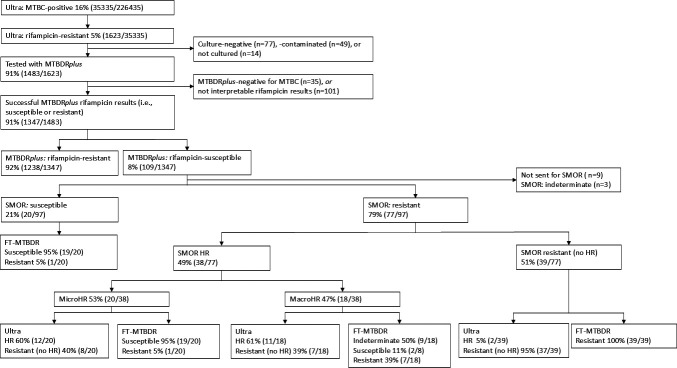
Xpert MTB/RIF Ultra (Ultra)-detected rifampicin-resistant tuberculosis (TB) is often programmatically confirmed using MTBDRplus. There are limited data on discordant results, including when re-tested using newer methods, like FluoroType MTBDR (FT-MTBDR) and targeted deep sequencing. MTBDRplus rifampicin-susceptible isolates from people with Ultra rifampicin-resistant sputum were identified from a South African programmatic laboratory. FT-MTBDR and single molecule-overlapping reads (SMOR; rpoB, inhA, katG) on isolate DNA were done (SMOR was used as a reference standard). Between 1 April 2021 and 30 September 2022, 8% (109/1347) of Ultra rifampicin-resistant specimens were MTBDRplus-susceptible. Of 89% (97/109) isolates with a sequenceable rpoB, SMOR resolved most in favor of Ultra (79% [77/97]). Sputum with lower mycobacterial load was associated with Ultra false-positive resistance (46% [11/24] of "very low" Ultra had false resistance vs 12% [9/73; P = 0.0004] of ≥"low"), as were Ultra heteroresistance calls (all wild-type probes, ≥1 mutant probe) (62% [23/37 vs 25% 15/60] for Ultra without heteroresistance calls; P = 0.0003). Of the 91% (88/97) of isolates successfully tested by FT-MTBDR, 55% (48/88) were FT-MTBDR rifampicin-resistant and 45% (40/88) susceptible, translating to 69% (47/68) sensitivity and 95% (19/20) specificity. In the 91% (99/109) of isolates with inhA and katG sequenced, 62% (61/99) were SMOR isoniazid-susceptible. When Ultra and MTBDRplus rifampicin results are discordant, Ultra is more likely to be correct, and FT-MTBDR agrees more with Ultra than MTBDRplus; however, lower load and the Ultra heteroresistance probe pattern were risk factors for Ultra false rifampicin-resistant results. Most people with Ultra-MTBDRplus discordant resistance results were isoniazid-susceptible. These data have implications for drug-resistant TB diagnosis.
期刊介绍:
Antimicrobial Agents and Chemotherapy (AAC) features interdisciplinary studies that build our understanding of the underlying mechanisms and therapeutic applications of antimicrobial and antiparasitic agents and chemotherapy.





 京公网安备 11010802042870号
京ICP备2023020795号-1
京公网安备 11010802042870号
京ICP备2023020795号-1

 分享
分享
 求助内容:
求助内容: 应助结果提醒方式:
 扫码关注我们
