Lara Cabezas, Pierre Letourneau, Aurélie De Mul, Justine Bacchetta, Laurence Chardon, Laurence Derain Dubourg, Sandrine Lemoine
{"title":"提高吸收性高钙尿症的诊断:间隔2小时和4小时钙负荷试验的比较分析","authors":"Lara Cabezas, Pierre Letourneau, Aurélie De Mul, Justine Bacchetta, Laurence Chardon, Laurence Derain Dubourg, Sandrine Lemoine","doi":"10.1093/ckj/sfae399","DOIUrl":null,"url":null,"abstract":"<p><strong>Introduction: </strong>The calcium load test (CLT) was developed by Pak <i>et al.</i> in 1974 to better discriminate hypercalciuria. Absorptive hypercalciuria (AH) is defined by an increase of the difference between urinary calcium/creatinine ratio (ΔUCa/Cr) of more than 0.5 mmol/mmol with a 4-hour CLT. In clinical practice and more recent studies, CLT is a 2-hour test. We hypothesized that the 4 h timepoint is more efficient in AH diagnosis.</p><p><strong>Methods: </strong>We report a single-centre retrospective study including all patients who underwent CLT because of hypercalciuria or hyperparathyroidism. After a 3-day low-calcium diet and a 12-hour fast, 24-hour urines were collected. Blood and urinary samples were done at arrival and after 2 h and 4 h of oral ingestion of 1 g of calcium. AH was diagnosed by ΔUCa/Cr between baseline and 2 h or 4 h of more than 0.05 mmol/mmol.</p><p><strong>Results: </strong>We included 328 patients. Baseline UCa/Cr ratio was 0.3 ± 0.2 mmol/mmol and increased significantly after 2 h and 4 h (0.6 ± 0.3 and 0.8 ± 0.4 mmol/mmol, <i>P</i> < 0.001). ΔUCa/Cr was significantly different between baseline and 2 h or 4 h (0.2 ± 0.2 versus 0.5 ± 0.4, <i>P</i> < 0.001). AH was diagnosed in 35 (10.7%) patients after 2 h, 84 (25.6%) more were diagnosed at 4 h (<i>P</i> < 0.001).</p><p><strong>Conclusions: </strong>The 4 h CLT improves the diagnosis of AH with more than 50% of AH diagnosed within 4 h of calcium ingestion. It seems that there are cases of AH of later diagnosis with a similar clinical and biological profile depending on enteral absorption.</p>","PeriodicalId":10435,"journal":{"name":"Clinical Kidney Journal","volume":"18 2","pages":"sfae399"},"PeriodicalIF":4.6000,"publicationDate":"2024-12-09","publicationTypes":"Journal Article","fieldsOfStudy":null,"isOpenAccess":false,"openAccessPdf":"https://www.ncbi.nlm.nih.gov/pmc/articles/PMC11799772/pdf/","citationCount":"0","resultStr":"{\"title\":\"Improving the diagnostic of absorptive hypercalciuria: a comparative analysis of calcium load tests at 2-hour and 4-hour intervals.\",\"authors\":\"Lara Cabezas, Pierre Letourneau, Aurélie De Mul, Justine Bacchetta, Laurence Chardon, Laurence Derain Dubourg, Sandrine Lemoine\",\"doi\":\"10.1093/ckj/sfae399\",\"DOIUrl\":null,\"url\":null,\"abstract\":\"<p><strong>Introduction: </strong>The calcium load test (CLT) was developed by Pak <i>et al.</i> in 1974 to better discriminate hypercalciuria. Absorptive hypercalciuria (AH) is defined by an increase of the difference between urinary calcium/creatinine ratio (ΔUCa/Cr) of more than 0.5 mmol/mmol with a 4-hour CLT. In clinical practice and more recent studies, CLT is a 2-hour test. We hypothesized that the 4 h timepoint is more efficient in AH diagnosis.</p><p><strong>Methods: </strong>We report a single-centre retrospective study including all patients who underwent CLT because of hypercalciuria or hyperparathyroidism. After a 3-day low-calcium diet and a 12-hour fast, 24-hour urines were collected. Blood and urinary samples were done at arrival and after 2 h and 4 h of oral ingestion of 1 g of calcium. AH was diagnosed by ΔUCa/Cr between baseline and 2 h or 4 h of more than 0.05 mmol/mmol.</p><p><strong>Results: </strong>We included 328 patients. Baseline UCa/Cr ratio was 0.3 ± 0.2 mmol/mmol and increased significantly after 2 h and 4 h (0.6 ± 0.3 and 0.8 ± 0.4 mmol/mmol, <i>P</i> < 0.001). ΔUCa/Cr was significantly different between baseline and 2 h or 4 h (0.2 ± 0.2 versus 0.5 ± 0.4, <i>P</i> < 0.001). AH was diagnosed in 35 (10.7%) patients after 2 h, 84 (25.6%) more were diagnosed at 4 h (<i>P</i> < 0.001).</p><p><strong>Conclusions: </strong>The 4 h CLT improves the diagnosis of AH with more than 50% of AH diagnosed within 4 h of calcium ingestion. It seems that there are cases of AH of later diagnosis with a similar clinical and biological profile depending on enteral absorption.</p>\",\"PeriodicalId\":10435,\"journal\":{\"name\":\"Clinical Kidney Journal\",\"volume\":\"18 2\",\"pages\":\"sfae399\"},\"PeriodicalIF\":4.6000,\"publicationDate\":\"2024-12-09\",\"publicationTypes\":\"Journal Article\",\"fieldsOfStudy\":null,\"isOpenAccess\":false,\"openAccessPdf\":\"https://www.ncbi.nlm.nih.gov/pmc/articles/PMC11799772/pdf/\",\"citationCount\":\"0\",\"resultStr\":null,\"platform\":\"Semanticscholar\",\"paperid\":null,\"PeriodicalName\":\"Clinical Kidney Journal\",\"FirstCategoryId\":\"3\",\"ListUrlMain\":\"https://doi.org/10.1093/ckj/sfae399\",\"RegionNum\":2,\"RegionCategory\":\"医学\",\"ArticlePicture\":[],\"TitleCN\":null,\"AbstractTextCN\":null,\"PMCID\":null,\"EPubDate\":\"2025/2/1 0:00:00\",\"PubModel\":\"eCollection\",\"JCR\":\"Q1\",\"JCRName\":\"UROLOGY & NEPHROLOGY\",\"Score\":null,\"Total\":0}","platform":"Semanticscholar","paperid":null,"PeriodicalName":"Clinical Kidney Journal","FirstCategoryId":"3","ListUrlMain":"https://doi.org/10.1093/ckj/sfae399","RegionNum":2,"RegionCategory":"医学","ArticlePicture":[],"TitleCN":null,"AbstractTextCN":null,"PMCID":null,"EPubDate":"2025/2/1 0:00:00","PubModel":"eCollection","JCR":"Q1","JCRName":"UROLOGY & NEPHROLOGY","Score":null,"Total":0}
引用次数: 0
摘要
简介:钙负荷试验(CLT)是由Pak等人于1974年发明的,用于更好地鉴别高钙尿症。吸收性高钙尿症(AH)定义为4小时CLT时尿钙/肌酐比值(ΔUCa/Cr)差值增加超过0.5 mmol/mmol。在临床实践和最近的研究中,CLT是一个2小时的测试。我们假设4h时间点在AH诊断中更有效。方法:我们报告了一项单中心回顾性研究,包括所有因高钙尿症或甲状旁腺功能亢进而接受CLT的患者。低钙饮食3天,禁食12小时后,收集24小时尿液。在到达时、口服1克钙2小时和4小时后分别采集血液和尿液样本。基线至2 h或4 h期间ΔUCa/Cr≥0.05 mmol/mmol诊断AH。结果:纳入328例患者。基线UCa/Cr比值为0.3±0.2 mmol/mmol,在2 h和4 h后显著升高(0.6±0.3和0.8±0.4 mmol/mmol, P P P P)。结论:4 h CLT提高了AH的诊断,超过50%的AH在补钙4 h内诊断。似乎有一些后来诊断为AH的病例具有相似的临床和生物学特征,这取决于肠内吸收。
Improving the diagnostic of absorptive hypercalciuria: a comparative analysis of calcium load tests at 2-hour and 4-hour intervals.
Introduction: The calcium load test (CLT) was developed by Pak et al. in 1974 to better discriminate hypercalciuria. Absorptive hypercalciuria (AH) is defined by an increase of the difference between urinary calcium/creatinine ratio (ΔUCa/Cr) of more than 0.5 mmol/mmol with a 4-hour CLT. In clinical practice and more recent studies, CLT is a 2-hour test. We hypothesized that the 4 h timepoint is more efficient in AH diagnosis.
Methods: We report a single-centre retrospective study including all patients who underwent CLT because of hypercalciuria or hyperparathyroidism. After a 3-day low-calcium diet and a 12-hour fast, 24-hour urines were collected. Blood and urinary samples were done at arrival and after 2 h and 4 h of oral ingestion of 1 g of calcium. AH was diagnosed by ΔUCa/Cr between baseline and 2 h or 4 h of more than 0.05 mmol/mmol.
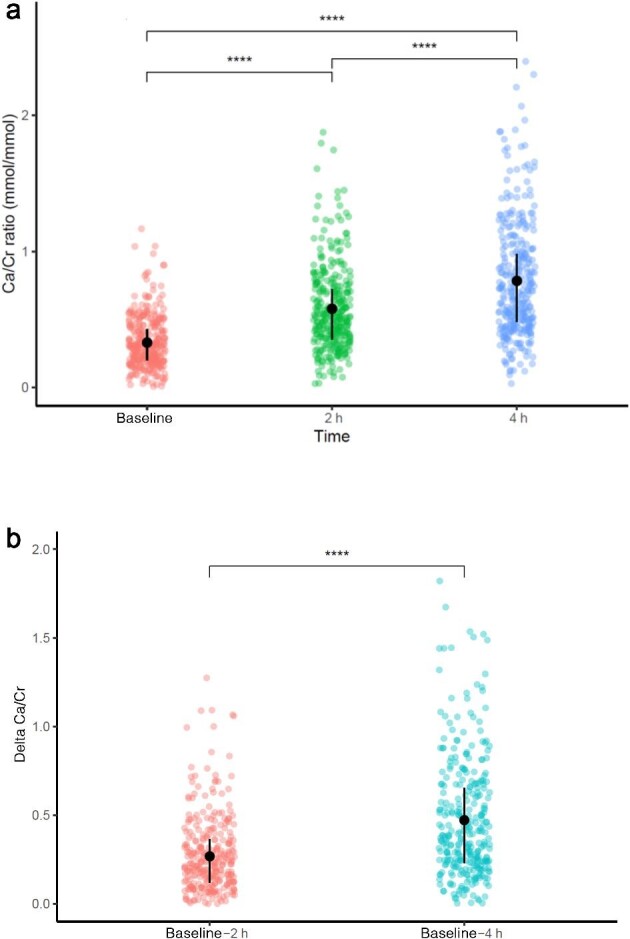
Results: We included 328 patients. Baseline UCa/Cr ratio was 0.3 ± 0.2 mmol/mmol and increased significantly after 2 h and 4 h (0.6 ± 0.3 and 0.8 ± 0.4 mmol/mmol, P < 0.001). ΔUCa/Cr was significantly different between baseline and 2 h or 4 h (0.2 ± 0.2 versus 0.5 ± 0.4, P < 0.001). AH was diagnosed in 35 (10.7%) patients after 2 h, 84 (25.6%) more were diagnosed at 4 h (P < 0.001).
Conclusions: The 4 h CLT improves the diagnosis of AH with more than 50% of AH diagnosed within 4 h of calcium ingestion. It seems that there are cases of AH of later diagnosis with a similar clinical and biological profile depending on enteral absorption.
期刊介绍:
About the Journal
Clinical Kidney Journal: Clinical and Translational Nephrology (ckj), an official journal of the ERA-EDTA (European Renal Association-European Dialysis and Transplant Association), is a fully open access, online only journal publishing bimonthly. The journal is an essential educational and training resource integrating clinical, translational and educational research into clinical practice. ckj aims to contribute to a translational research culture among nephrologists and kidney pathologists that helps close the gap between basic researchers and practicing clinicians and promote sorely needed innovation in the Nephrology field. All research articles in this journal have undergone peer review.






 京公网安备 11010802042870号
京ICP备2023020795号-1
京公网安备 11010802042870号
京ICP备2023020795号-1

 分享
分享
 求助内容:
求助内容: 应助结果提醒方式:
 扫码关注我们
