Juan Caceres, Abdulbaset Sulaiman, Mark Edwards, Shiwei Zhou, Sarah Kurz, Zoe Raglow, Barbara Hamilton, Andrew W Harris
{"title":"主动脉根部脓肿模拟鉴定多学科影像学回顾:一个病例报告。","authors":"Juan Caceres, Abdulbaset Sulaiman, Mark Edwards, Shiwei Zhou, Sarah Kurz, Zoe Raglow, Barbara Hamilton, Andrew W Harris","doi":"10.1093/ehjcr/ytaf004","DOIUrl":null,"url":null,"abstract":"<p><strong>Background: </strong>While echocardiography and cardiac positron emission tomography (PET) can aid in the diagnosis of prosthetic valve endocarditis (PVE), post-operative changes can lead to false-positive imaging findings. We report a case of a patient with an aortic valve prosthesis with remnant BioGlue deposits mimicking a para-valvular abscess on imaging in the setting of suspected PVE.</p><p><strong>Case summary: </strong>A 67-year-old man presented with 2 days of fever, chills, and altered mentation. He had a history of two prior aortic root replacements-19 and 4 years prior to his presentation. He had blood cultures that were persistently positive for <i>Pseudomonas aeruginosa</i>. Initial transoesophageal echocardiogram (TEE) was notable for a thickening of the posterior aortic root thought to be consistent with post-surgical changes. Cardiac PET showed significant uptake around the prosthetic aortic valve, concerning for a para-valvular abscess. However, given the patient's high risk for re-do surgery, clearance of blood cultures, and preserved valve function, our multi-disciplinary endocarditis team (MET) recommended non-surgical management and close follow-up. After 6 weeks of appropriate antibiotics, a TEE demonstrated concern for an evolving para-valvular abscess. The MET performed extensive review of his prior surgical interventions and cardiac imaging, revealing the previous use of surgical BioGlue and stability in the aortic root on imaging, consistent with non-infectious post-surgical changes, and conservative management was recommended.</p><p><strong>Discussion: </strong>Thorough review of prior interventions and serial imaging in patients with suspected PVE through a multi-disciplinary team approach is essential in elucidating the complete, often complex, clinical picture and recommending the most appropriate management.</p>","PeriodicalId":11910,"journal":{"name":"European Heart Journal: Case Reports","volume":"9 2","pages":"ytaf004"},"PeriodicalIF":0.8000,"publicationDate":"2025-01-15","publicationTypes":"Journal Article","fieldsOfStudy":null,"isOpenAccess":false,"openAccessPdf":"https://www.ncbi.nlm.nih.gov/pmc/articles/PMC11799943/pdf/","citationCount":"0","resultStr":"{\"title\":\"An aortic root abscess mimic identified by multi-disciplinary imaging review: a case report.\",\"authors\":\"Juan Caceres, Abdulbaset Sulaiman, Mark Edwards, Shiwei Zhou, Sarah Kurz, Zoe Raglow, Barbara Hamilton, Andrew W Harris\",\"doi\":\"10.1093/ehjcr/ytaf004\",\"DOIUrl\":null,\"url\":null,\"abstract\":\"<p><strong>Background: </strong>While echocardiography and cardiac positron emission tomography (PET) can aid in the diagnosis of prosthetic valve endocarditis (PVE), post-operative changes can lead to false-positive imaging findings. We report a case of a patient with an aortic valve prosthesis with remnant BioGlue deposits mimicking a para-valvular abscess on imaging in the setting of suspected PVE.</p><p><strong>Case summary: </strong>A 67-year-old man presented with 2 days of fever, chills, and altered mentation. He had a history of two prior aortic root replacements-19 and 4 years prior to his presentation. He had blood cultures that were persistently positive for <i>Pseudomonas aeruginosa</i>. Initial transoesophageal echocardiogram (TEE) was notable for a thickening of the posterior aortic root thought to be consistent with post-surgical changes. Cardiac PET showed significant uptake around the prosthetic aortic valve, concerning for a para-valvular abscess. However, given the patient's high risk for re-do surgery, clearance of blood cultures, and preserved valve function, our multi-disciplinary endocarditis team (MET) recommended non-surgical management and close follow-up. After 6 weeks of appropriate antibiotics, a TEE demonstrated concern for an evolving para-valvular abscess. The MET performed extensive review of his prior surgical interventions and cardiac imaging, revealing the previous use of surgical BioGlue and stability in the aortic root on imaging, consistent with non-infectious post-surgical changes, and conservative management was recommended.</p><p><strong>Discussion: </strong>Thorough review of prior interventions and serial imaging in patients with suspected PVE through a multi-disciplinary team approach is essential in elucidating the complete, often complex, clinical picture and recommending the most appropriate management.</p>\",\"PeriodicalId\":11910,\"journal\":{\"name\":\"European Heart Journal: Case Reports\",\"volume\":\"9 2\",\"pages\":\"ytaf004\"},\"PeriodicalIF\":0.8000,\"publicationDate\":\"2025-01-15\",\"publicationTypes\":\"Journal Article\",\"fieldsOfStudy\":null,\"isOpenAccess\":false,\"openAccessPdf\":\"https://www.ncbi.nlm.nih.gov/pmc/articles/PMC11799943/pdf/\",\"citationCount\":\"0\",\"resultStr\":null,\"platform\":\"Semanticscholar\",\"paperid\":null,\"PeriodicalName\":\"European Heart Journal: Case Reports\",\"FirstCategoryId\":\"1085\",\"ListUrlMain\":\"https://doi.org/10.1093/ehjcr/ytaf004\",\"RegionNum\":0,\"RegionCategory\":null,\"ArticlePicture\":[],\"TitleCN\":null,\"AbstractTextCN\":null,\"PMCID\":null,\"EPubDate\":\"2025/2/1 0:00:00\",\"PubModel\":\"eCollection\",\"JCR\":\"Q4\",\"JCRName\":\"CARDIAC & CARDIOVASCULAR SYSTEMS\",\"Score\":null,\"Total\":0}","platform":"Semanticscholar","paperid":null,"PeriodicalName":"European Heart Journal: Case Reports","FirstCategoryId":"1085","ListUrlMain":"https://doi.org/10.1093/ehjcr/ytaf004","RegionNum":0,"RegionCategory":null,"ArticlePicture":[],"TitleCN":null,"AbstractTextCN":null,"PMCID":null,"EPubDate":"2025/2/1 0:00:00","PubModel":"eCollection","JCR":"Q4","JCRName":"CARDIAC & CARDIOVASCULAR SYSTEMS","Score":null,"Total":0}
An aortic root abscess mimic identified by multi-disciplinary imaging review: a case report.
Background: While echocardiography and cardiac positron emission tomography (PET) can aid in the diagnosis of prosthetic valve endocarditis (PVE), post-operative changes can lead to false-positive imaging findings. We report a case of a patient with an aortic valve prosthesis with remnant BioGlue deposits mimicking a para-valvular abscess on imaging in the setting of suspected PVE.
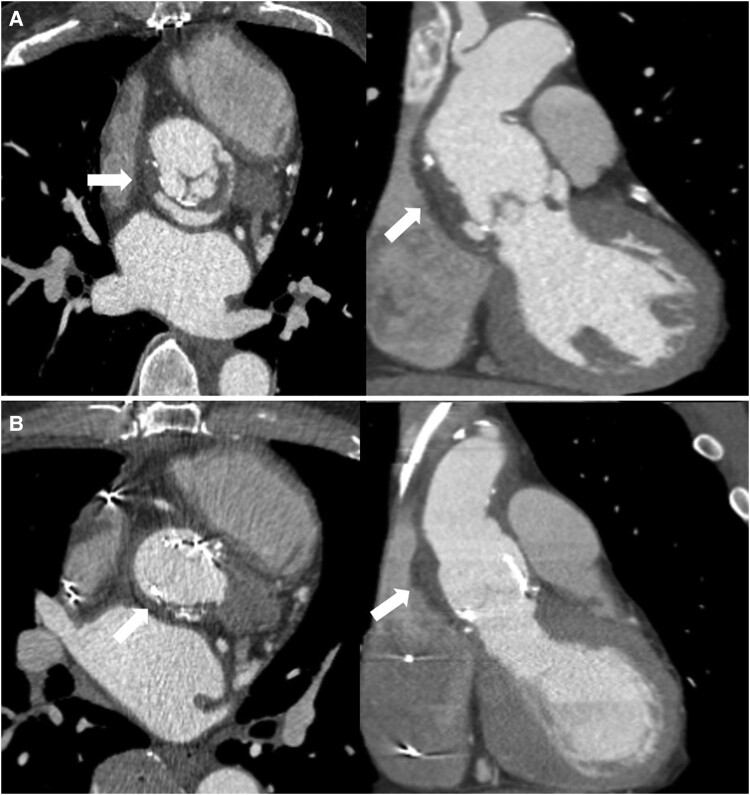
Case summary: A 67-year-old man presented with 2 days of fever, chills, and altered mentation. He had a history of two prior aortic root replacements-19 and 4 years prior to his presentation. He had blood cultures that were persistently positive for Pseudomonas aeruginosa. Initial transoesophageal echocardiogram (TEE) was notable for a thickening of the posterior aortic root thought to be consistent with post-surgical changes. Cardiac PET showed significant uptake around the prosthetic aortic valve, concerning for a para-valvular abscess. However, given the patient's high risk for re-do surgery, clearance of blood cultures, and preserved valve function, our multi-disciplinary endocarditis team (MET) recommended non-surgical management and close follow-up. After 6 weeks of appropriate antibiotics, a TEE demonstrated concern for an evolving para-valvular abscess. The MET performed extensive review of his prior surgical interventions and cardiac imaging, revealing the previous use of surgical BioGlue and stability in the aortic root on imaging, consistent with non-infectious post-surgical changes, and conservative management was recommended.
Discussion: Thorough review of prior interventions and serial imaging in patients with suspected PVE through a multi-disciplinary team approach is essential in elucidating the complete, often complex, clinical picture and recommending the most appropriate management.







 京公网安备 11010802042870号
京ICP备2023020795号-1
京公网安备 11010802042870号
京ICP备2023020795号-1

 分享
分享
 求助内容:
求助内容: 应助结果提醒方式:
 扫码关注我们
