{"title":"白色念珠菌增强铁摄取以维持氟康唑耐药性。","authors":"Rishabh Sharma, Anubhav Nahar, Sumant Puri","doi":"10.1128/iai.00002-25","DOIUrl":null,"url":null,"abstract":"<p><p>Widespread use of fluconazole has led to the emergence of fluconazole-resistant (FR) <i>Candid</i>a spp. causing challenges in clinical treatment. Iron, an essential nutrient, affects the levels of ergosterol (a fluconazole target) in fungal membranes. Our lab-generated FR strain (fluconazole minimum inhibitory concentration [MIC] >125 µg/mL) showed a twofold lower MIC (4.66 µg/mL) for the iron chelator deferasirox (DFX), compared to its patent strain CAI4 (DFX MIC 9.34 µg/mL), suggesting a greater sensitivity to iron chelation. A sublethal dose of DFX (2.33 µg/mL) was able to effectively synergize with 125 µg/mL fluconazole to kill the FR strain. Iron estimation revealed significantly enhanced intracellular iron accumulation in the FR strain compared to CAI4. Expression of iron-uptake genes (<i>FRP1</i>, <i>FRE10</i>, and <i>RBT5</i>) was also significantly upregulated in the FR strain, particularly under high iron. FR strain also showed an increase in the levels of cellular ergosterol, along with an increase in the expression of ergosterol biosynthesis genes (<i>ERG11</i> and <i>ERG9</i>), compared to CAI4, under both low and high iron. The strain further showed increased β-glucan levels and exposure. Additionally, FR strain showed significantly higher survival in high-iron mice compared to low-iron mice, during fluconazole treatment. Finally, we observed a synergistic fungicidal response between 2.33 µg/mL DFX and 125 µg/mL fluconazole, for FR clinical strains. Overall, this suggests that FR <i>C. albicans</i> actively uptakes more iron to maintain cellular conditions needed to support its resistance against fluconazole; and that DFX alone or in conjugation with fluconazole has the potential to overcome fluconazole drug resistance.</p>","PeriodicalId":13541,"journal":{"name":"Infection and Immunity","volume":" ","pages":"e0000225"},"PeriodicalIF":3.4000,"publicationDate":"2025-03-11","publicationTypes":"Journal Article","fieldsOfStudy":null,"isOpenAccess":false,"openAccessPdf":"https://www.ncbi.nlm.nih.gov/pmc/articles/PMC11895461/pdf/","citationCount":"0","resultStr":"{\"title\":\"<i>Candida albicans</i> enhances iron uptake to maintain fluconazole resistance.\",\"authors\":\"Rishabh Sharma, Anubhav Nahar, Sumant Puri\",\"doi\":\"10.1128/iai.00002-25\",\"DOIUrl\":null,\"url\":null,\"abstract\":\"<p><p>Widespread use of fluconazole has led to the emergence of fluconazole-resistant (FR) <i>Candid</i>a spp. causing challenges in clinical treatment. Iron, an essential nutrient, affects the levels of ergosterol (a fluconazole target) in fungal membranes. Our lab-generated FR strain (fluconazole minimum inhibitory concentration [MIC] >125 µg/mL) showed a twofold lower MIC (4.66 µg/mL) for the iron chelator deferasirox (DFX), compared to its patent strain CAI4 (DFX MIC 9.34 µg/mL), suggesting a greater sensitivity to iron chelation. A sublethal dose of DFX (2.33 µg/mL) was able to effectively synergize with 125 µg/mL fluconazole to kill the FR strain. Iron estimation revealed significantly enhanced intracellular iron accumulation in the FR strain compared to CAI4. Expression of iron-uptake genes (<i>FRP1</i>, <i>FRE10</i>, and <i>RBT5</i>) was also significantly upregulated in the FR strain, particularly under high iron. FR strain also showed an increase in the levels of cellular ergosterol, along with an increase in the expression of ergosterol biosynthesis genes (<i>ERG11</i> and <i>ERG9</i>), compared to CAI4, under both low and high iron. The strain further showed increased β-glucan levels and exposure. Additionally, FR strain showed significantly higher survival in high-iron mice compared to low-iron mice, during fluconazole treatment. Finally, we observed a synergistic fungicidal response between 2.33 µg/mL DFX and 125 µg/mL fluconazole, for FR clinical strains. Overall, this suggests that FR <i>C. albicans</i> actively uptakes more iron to maintain cellular conditions needed to support its resistance against fluconazole; and that DFX alone or in conjugation with fluconazole has the potential to overcome fluconazole drug resistance.</p>\",\"PeriodicalId\":13541,\"journal\":{\"name\":\"Infection and Immunity\",\"volume\":\" \",\"pages\":\"e0000225\"},\"PeriodicalIF\":3.4000,\"publicationDate\":\"2025-03-11\",\"publicationTypes\":\"Journal Article\",\"fieldsOfStudy\":null,\"isOpenAccess\":false,\"openAccessPdf\":\"https://www.ncbi.nlm.nih.gov/pmc/articles/PMC11895461/pdf/\",\"citationCount\":\"0\",\"resultStr\":null,\"platform\":\"Semanticscholar\",\"paperid\":null,\"PeriodicalName\":\"Infection and Immunity\",\"FirstCategoryId\":\"3\",\"ListUrlMain\":\"https://doi.org/10.1128/iai.00002-25\",\"RegionNum\":3,\"RegionCategory\":\"医学\",\"ArticlePicture\":[],\"TitleCN\":null,\"AbstractTextCN\":null,\"PMCID\":null,\"EPubDate\":\"2025/2/7 0:00:00\",\"PubModel\":\"Epub\",\"JCR\":\"Q3\",\"JCRName\":\"IMMUNOLOGY\",\"Score\":null,\"Total\":0}","platform":"Semanticscholar","paperid":null,"PeriodicalName":"Infection and Immunity","FirstCategoryId":"3","ListUrlMain":"https://doi.org/10.1128/iai.00002-25","RegionNum":3,"RegionCategory":"医学","ArticlePicture":[],"TitleCN":null,"AbstractTextCN":null,"PMCID":null,"EPubDate":"2025/2/7 0:00:00","PubModel":"Epub","JCR":"Q3","JCRName":"IMMUNOLOGY","Score":null,"Total":0}
引用次数: 0
摘要
氟康唑的广泛使用导致了氟康唑耐药念珠菌的出现,给临床治疗带来了挑战。铁是一种必需的营养物质,影响真菌膜中麦角甾醇(氟康唑的靶标)的水平。我们实验室生成的FR菌株(氟康唑最低抑制浓度[MIC] >125µg/mL)对铁螯合剂去铁酸铁(DFX)的MIC(4.66µg/mL)比其专利菌株CAI4 (DFX MIC 9.34µg/mL)低两倍,表明其对铁螯合的敏感性更高。亚致死剂量的DFX(2.33µg/mL)能够与125µg/mL氟康唑有效协同杀死FR菌株。铁估计显示,与CAI4相比,FR菌株的细胞内铁积累显著增加。铁摄取基因(FRP1, FRE10和RBT5)的表达在FR菌株中也显著上调,特别是在高铁条件下。在低铁和高铁条件下,FR菌株与CAI4相比,细胞麦角甾醇水平升高,麦角甾醇生物合成基因(ERG11和ERG9)表达增加。菌株进一步显示β-葡聚糖水平和暴露增加。此外,在氟康唑治疗期间,FR菌株在高铁小鼠中的存活率明显高于低铁小鼠。最后,我们观察到2.33µg/mL DFX和125µg/mL氟康唑对FR临床菌株的协同杀真菌反应。总的来说,这表明FR白色念珠菌主动吸收更多的铁来维持细胞条件,以支持其对氟康唑的耐药性;并且DFX单独或与氟康唑结合具有克服氟康唑耐药的潜力。
Candida albicans enhances iron uptake to maintain fluconazole resistance.
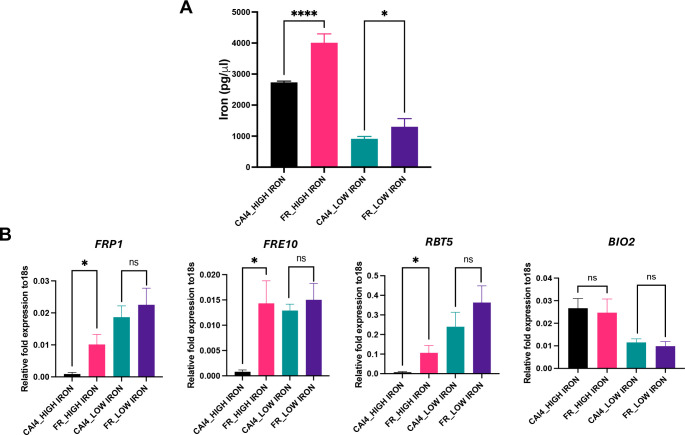
Widespread use of fluconazole has led to the emergence of fluconazole-resistant (FR) Candida spp. causing challenges in clinical treatment. Iron, an essential nutrient, affects the levels of ergosterol (a fluconazole target) in fungal membranes. Our lab-generated FR strain (fluconazole minimum inhibitory concentration [MIC] >125 µg/mL) showed a twofold lower MIC (4.66 µg/mL) for the iron chelator deferasirox (DFX), compared to its patent strain CAI4 (DFX MIC 9.34 µg/mL), suggesting a greater sensitivity to iron chelation. A sublethal dose of DFX (2.33 µg/mL) was able to effectively synergize with 125 µg/mL fluconazole to kill the FR strain. Iron estimation revealed significantly enhanced intracellular iron accumulation in the FR strain compared to CAI4. Expression of iron-uptake genes (FRP1, FRE10, and RBT5) was also significantly upregulated in the FR strain, particularly under high iron. FR strain also showed an increase in the levels of cellular ergosterol, along with an increase in the expression of ergosterol biosynthesis genes (ERG11 and ERG9), compared to CAI4, under both low and high iron. The strain further showed increased β-glucan levels and exposure. Additionally, FR strain showed significantly higher survival in high-iron mice compared to low-iron mice, during fluconazole treatment. Finally, we observed a synergistic fungicidal response between 2.33 µg/mL DFX and 125 µg/mL fluconazole, for FR clinical strains. Overall, this suggests that FR C. albicans actively uptakes more iron to maintain cellular conditions needed to support its resistance against fluconazole; and that DFX alone or in conjugation with fluconazole has the potential to overcome fluconazole drug resistance.
期刊介绍:
Infection and Immunity (IAI) provides new insights into the interactions between bacterial, fungal and parasitic pathogens and their hosts. Specific areas of interest include mechanisms of molecular pathogenesis, virulence factors, cellular microbiology, experimental models of infection, host resistance or susceptibility, and the generation of innate and adaptive immune responses. IAI also welcomes studies of the microbiome relating to host-pathogen interactions.






 京公网安备 11010802042870号
京ICP备2023020795号-1
京公网安备 11010802042870号
京ICP备2023020795号-1

 分享
分享
 求助内容:
求助内容: 应助结果提醒方式:
 扫码关注我们
