Fernando C Maluf, Cintia S K S de Oliveira, Patrícia K Ziegelmann
{"title":"资金来源对前列腺癌长期预后的影响:来自巴西圣保罗大型公共数据库的分析。","authors":"Fernando C Maluf, Cintia S K S de Oliveira, Patrícia K Ziegelmann","doi":"10.1200/GO-24-00271","DOIUrl":null,"url":null,"abstract":"<p><strong>Purpose: </strong>We investigated the impact of the funding source (public <i>v</i> private) on the overall survival (OS) of men with prostate cancer in Brazil.</p><p><strong>Methods: </strong>We retrospectively analyzed patients with prostate cancer from a large hospital registry from the state of São Paulo, Brazil. Patients age 50-99 years diagnosed with prostate acinar adenocarcinoma or adenocarcinoma not otherwise specified (NOS) between January 2014 and December 2017 were eligible. Demographic and clinical features were analyzed alongside the funding source. On the basis of clinical characteristics at diagnosis (lymph node status, distant metastasis, prostate-specific antigen [PSA], and Gleason score), patients were categorized into low-risk, intermediate-risk, high-risk, and metastatic groups.</p><p><strong>Results: </strong>Of 25,009 patients analyzed, 85% had a public funding source. These patients were slightly older, had greater proportion of adenocarcinoma NOS, and higher PSA levels and risk category. There was a significant difference in OS favoring patients with a private funding source (<i>P</i> < .0001). The estimated OS rates at 5 years were 76.2% (95% CI, 75.6 to 76.9) and 86.9% (95% CI, 85 to 88.7) for the public and private groups, respectively (<i>P</i> < .0001). The funding source was significantly associated with OS independent of age, educational level, and receipt of any treatment in the intermediate-risk (hazard ratio [HR], 2.28 [95% CI, 1.58 to 3.30]; <i>P</i> < .001) and high-risk (HR, 1.36 [95% CI, 1.02 to 1.80]; <i>P</i> = .04) groups, but not in the low-risk (HR, 0.85 [95% CI, 0.60 to 1.21]; <i>P</i> = .38) or metastatic groups (HR, 0.84 [95% CI, 0.64 to 1.11]; <i>P</i> = .23).</p><p><strong>Conclusion: </strong>The worse OS observed for patients with prostate cancer with a public source of funding underscores the need for actions directed to improve the standards of public health care in Brazil.</p>","PeriodicalId":14806,"journal":{"name":"JCO Global Oncology","volume":"11 ","pages":"e2400271"},"PeriodicalIF":3.0000,"publicationDate":"2025-02-01","publicationTypes":"Journal Article","fieldsOfStudy":null,"isOpenAccess":false,"openAccessPdf":"https://www.ncbi.nlm.nih.gov/pmc/articles/PMC11892614/pdf/","citationCount":"0","resultStr":"{\"title\":\"Impact of Funding Source on Long-Term Outcomes in Prostate Cancer: Analysis of a Large Public Database From Sao Paulo, Brazil.\",\"authors\":\"Fernando C Maluf, Cintia S K S de Oliveira, Patrícia K Ziegelmann\",\"doi\":\"10.1200/GO-24-00271\",\"DOIUrl\":null,\"url\":null,\"abstract\":\"<p><strong>Purpose: </strong>We investigated the impact of the funding source (public <i>v</i> private) on the overall survival (OS) of men with prostate cancer in Brazil.</p><p><strong>Methods: </strong>We retrospectively analyzed patients with prostate cancer from a large hospital registry from the state of São Paulo, Brazil. Patients age 50-99 years diagnosed with prostate acinar adenocarcinoma or adenocarcinoma not otherwise specified (NOS) between January 2014 and December 2017 were eligible. Demographic and clinical features were analyzed alongside the funding source. On the basis of clinical characteristics at diagnosis (lymph node status, distant metastasis, prostate-specific antigen [PSA], and Gleason score), patients were categorized into low-risk, intermediate-risk, high-risk, and metastatic groups.</p><p><strong>Results: </strong>Of 25,009 patients analyzed, 85% had a public funding source. These patients were slightly older, had greater proportion of adenocarcinoma NOS, and higher PSA levels and risk category. There was a significant difference in OS favoring patients with a private funding source (<i>P</i> < .0001). The estimated OS rates at 5 years were 76.2% (95% CI, 75.6 to 76.9) and 86.9% (95% CI, 85 to 88.7) for the public and private groups, respectively (<i>P</i> < .0001). The funding source was significantly associated with OS independent of age, educational level, and receipt of any treatment in the intermediate-risk (hazard ratio [HR], 2.28 [95% CI, 1.58 to 3.30]; <i>P</i> < .001) and high-risk (HR, 1.36 [95% CI, 1.02 to 1.80]; <i>P</i> = .04) groups, but not in the low-risk (HR, 0.85 [95% CI, 0.60 to 1.21]; <i>P</i> = .38) or metastatic groups (HR, 0.84 [95% CI, 0.64 to 1.11]; <i>P</i> = .23).</p><p><strong>Conclusion: </strong>The worse OS observed for patients with prostate cancer with a public source of funding underscores the need for actions directed to improve the standards of public health care in Brazil.</p>\",\"PeriodicalId\":14806,\"journal\":{\"name\":\"JCO Global Oncology\",\"volume\":\"11 \",\"pages\":\"e2400271\"},\"PeriodicalIF\":3.0000,\"publicationDate\":\"2025-02-01\",\"publicationTypes\":\"Journal Article\",\"fieldsOfStudy\":null,\"isOpenAccess\":false,\"openAccessPdf\":\"https://www.ncbi.nlm.nih.gov/pmc/articles/PMC11892614/pdf/\",\"citationCount\":\"0\",\"resultStr\":null,\"platform\":\"Semanticscholar\",\"paperid\":null,\"PeriodicalName\":\"JCO Global Oncology\",\"FirstCategoryId\":\"1085\",\"ListUrlMain\":\"https://doi.org/10.1200/GO-24-00271\",\"RegionNum\":0,\"RegionCategory\":null,\"ArticlePicture\":[],\"TitleCN\":null,\"AbstractTextCN\":null,\"PMCID\":null,\"EPubDate\":\"2025/2/6 0:00:00\",\"PubModel\":\"Epub\",\"JCR\":\"Q2\",\"JCRName\":\"ONCOLOGY\",\"Score\":null,\"Total\":0}","platform":"Semanticscholar","paperid":null,"PeriodicalName":"JCO Global Oncology","FirstCategoryId":"1085","ListUrlMain":"https://doi.org/10.1200/GO-24-00271","RegionNum":0,"RegionCategory":null,"ArticlePicture":[],"TitleCN":null,"AbstractTextCN":null,"PMCID":null,"EPubDate":"2025/2/6 0:00:00","PubModel":"Epub","JCR":"Q2","JCRName":"ONCOLOGY","Score":null,"Total":0}
Impact of Funding Source on Long-Term Outcomes in Prostate Cancer: Analysis of a Large Public Database From Sao Paulo, Brazil.
Purpose: We investigated the impact of the funding source (public v private) on the overall survival (OS) of men with prostate cancer in Brazil.
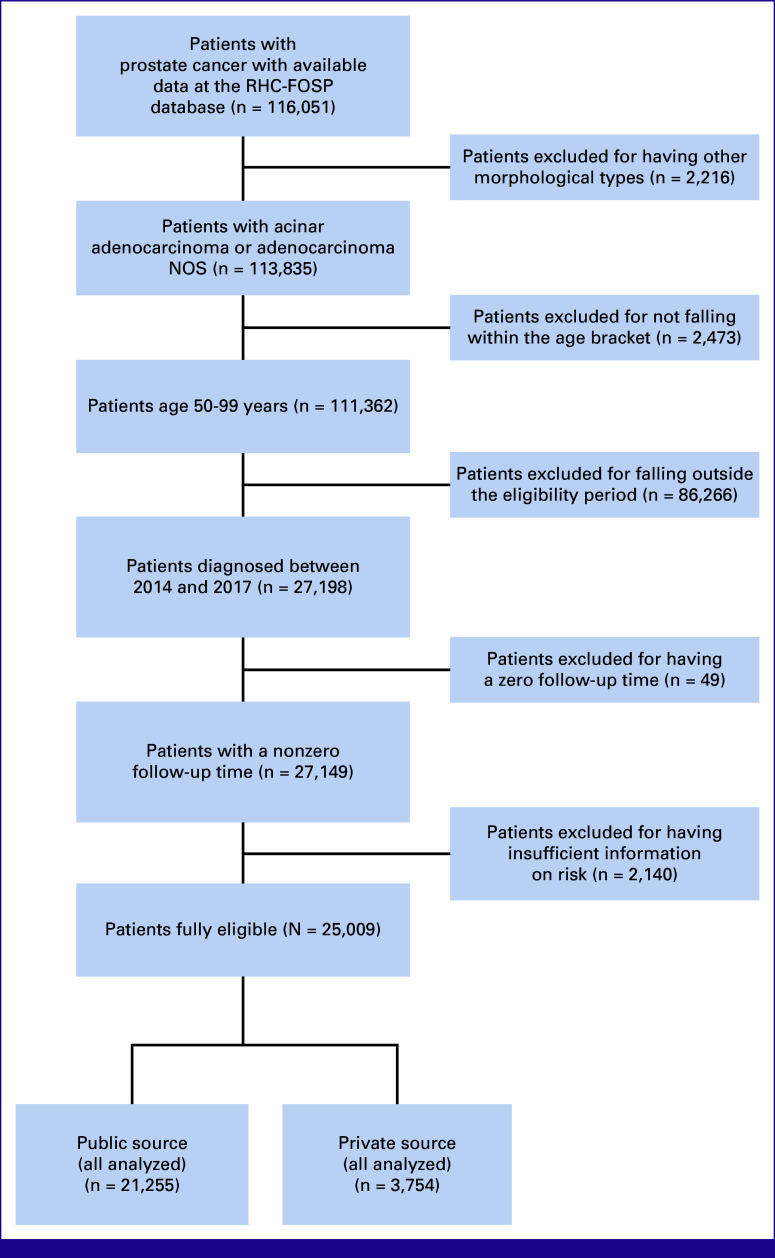
Methods: We retrospectively analyzed patients with prostate cancer from a large hospital registry from the state of São Paulo, Brazil. Patients age 50-99 years diagnosed with prostate acinar adenocarcinoma or adenocarcinoma not otherwise specified (NOS) between January 2014 and December 2017 were eligible. Demographic and clinical features were analyzed alongside the funding source. On the basis of clinical characteristics at diagnosis (lymph node status, distant metastasis, prostate-specific antigen [PSA], and Gleason score), patients were categorized into low-risk, intermediate-risk, high-risk, and metastatic groups.
Results: Of 25,009 patients analyzed, 85% had a public funding source. These patients were slightly older, had greater proportion of adenocarcinoma NOS, and higher PSA levels and risk category. There was a significant difference in OS favoring patients with a private funding source (P < .0001). The estimated OS rates at 5 years were 76.2% (95% CI, 75.6 to 76.9) and 86.9% (95% CI, 85 to 88.7) for the public and private groups, respectively (P < .0001). The funding source was significantly associated with OS independent of age, educational level, and receipt of any treatment in the intermediate-risk (hazard ratio [HR], 2.28 [95% CI, 1.58 to 3.30]; P < .001) and high-risk (HR, 1.36 [95% CI, 1.02 to 1.80]; P = .04) groups, but not in the low-risk (HR, 0.85 [95% CI, 0.60 to 1.21]; P = .38) or metastatic groups (HR, 0.84 [95% CI, 0.64 to 1.11]; P = .23).
Conclusion: The worse OS observed for patients with prostate cancer with a public source of funding underscores the need for actions directed to improve the standards of public health care in Brazil.







 京公网安备 11010802042870号
京ICP备2023020795号-1
京公网安备 11010802042870号
京ICP备2023020795号-1

 分享
分享
 求助内容:
求助内容: 应助结果提醒方式:
 扫码关注我们
