Ole Stoeter, Nikolaus C S Mezger, Tamara Koenig, Eric Chokunonga, Girum Tessema, Adugna Fekadu Damise, Alda Stevy Makouanzi, Esther Majaliwa, Mahine Ivanga, Bakarou Kamate, Franck Gnahatin, Sarah Nambooze, Ima-Obong A Ekanem, Toralf Bernig, Biying Liu, Sumit Gupta, Eva Johanna Kantelhardt
{"title":"撒哈拉以南非洲儿童癌症护理的自我认知障碍:一项横断面跨国研究。","authors":"Ole Stoeter, Nikolaus C S Mezger, Tamara Koenig, Eric Chokunonga, Girum Tessema, Adugna Fekadu Damise, Alda Stevy Makouanzi, Esther Majaliwa, Mahine Ivanga, Bakarou Kamate, Franck Gnahatin, Sarah Nambooze, Ima-Obong A Ekanem, Toralf Bernig, Biying Liu, Sumit Gupta, Eva Johanna Kantelhardt","doi":"10.1200/GO.24.00137","DOIUrl":null,"url":null,"abstract":"<p><strong>Purpose: </strong>The number of patients with childhood cancer (CC) in sub-Saharan Africa is expected to rise over the coming years. According to the WHO Initiative for Childhood Cancer, access to care is crucial and must be guided by the needs of patients and their families. Our study explored barriers to CC treatment from a patient's perspective to guide the health care providers.</p><p><strong>Methods: </strong>From February to September 2021, we conducted a multinational cross-sectional study with a sample from nine population-based cancer registries in nine sub-Saharan countries. Inclusion criteria comprised a cancer diagnosis according to the International Classification of Childhood Cancer, age 0-19 years, and year of diagnosis 2017-2019. A questionnaire was administered asking families about self-perceived barriers accessing surgery, radiotherapy, and chemotherapy. To assess associated factors, we conducted a multivariable regression analysis presenting the results as odds ratios (ORs).</p><p><strong>Results: </strong>A total of 224 patients with CC was included. The fear of treatment effects and the perceived (poor) health of the child were named most frequently as barriers for all treatment modalities (78.9% and 75.5%, respectively). For chemotherapy, respondents who indicated themselves as rich had lower odds of perceiving the (poor) health of the child as a barrier (OR, 0.06 [95% CI, 0.01 to 0.36]). For radiotherapy, long waiting time and (limited) availability in the country were more commonly barriers (OR, 7.53 [95% CI, 3.38 to 16.78]; OR, 11.11 [95% CI, 2.04 to 60.46], respectively) than for chemotherapy.</p><p><strong>Conclusion: </strong>Despite known barriers such as the availability of therapy, our study additionally indicates the importance of the patients' and families' perceptions of the disease and its treatment. Further expanding measures of social support for affected families should be regarded as one of the main pillars to assure access to care.</p>","PeriodicalId":14806,"journal":{"name":"JCO Global Oncology","volume":"11 ","pages":"e2400137"},"PeriodicalIF":3.0000,"publicationDate":"2025-02-01","publicationTypes":"Journal Article","fieldsOfStudy":null,"isOpenAccess":false,"openAccessPdf":"https://www.ncbi.nlm.nih.gov/pmc/articles/PMC11892616/pdf/","citationCount":"0","resultStr":"{\"title\":\"Self-Perceived Barriers to Pediatric Cancer Care in Sub-Saharan Africa: A Cross-Sectional Multinational Study.\",\"authors\":\"Ole Stoeter, Nikolaus C S Mezger, Tamara Koenig, Eric Chokunonga, Girum Tessema, Adugna Fekadu Damise, Alda Stevy Makouanzi, Esther Majaliwa, Mahine Ivanga, Bakarou Kamate, Franck Gnahatin, Sarah Nambooze, Ima-Obong A Ekanem, Toralf Bernig, Biying Liu, Sumit Gupta, Eva Johanna Kantelhardt\",\"doi\":\"10.1200/GO.24.00137\",\"DOIUrl\":null,\"url\":null,\"abstract\":\"<p><strong>Purpose: </strong>The number of patients with childhood cancer (CC) in sub-Saharan Africa is expected to rise over the coming years. According to the WHO Initiative for Childhood Cancer, access to care is crucial and must be guided by the needs of patients and their families. Our study explored barriers to CC treatment from a patient's perspective to guide the health care providers.</p><p><strong>Methods: </strong>From February to September 2021, we conducted a multinational cross-sectional study with a sample from nine population-based cancer registries in nine sub-Saharan countries. Inclusion criteria comprised a cancer diagnosis according to the International Classification of Childhood Cancer, age 0-19 years, and year of diagnosis 2017-2019. A questionnaire was administered asking families about self-perceived barriers accessing surgery, radiotherapy, and chemotherapy. To assess associated factors, we conducted a multivariable regression analysis presenting the results as odds ratios (ORs).</p><p><strong>Results: </strong>A total of 224 patients with CC was included. The fear of treatment effects and the perceived (poor) health of the child were named most frequently as barriers for all treatment modalities (78.9% and 75.5%, respectively). For chemotherapy, respondents who indicated themselves as rich had lower odds of perceiving the (poor) health of the child as a barrier (OR, 0.06 [95% CI, 0.01 to 0.36]). For radiotherapy, long waiting time and (limited) availability in the country were more commonly barriers (OR, 7.53 [95% CI, 3.38 to 16.78]; OR, 11.11 [95% CI, 2.04 to 60.46], respectively) than for chemotherapy.</p><p><strong>Conclusion: </strong>Despite known barriers such as the availability of therapy, our study additionally indicates the importance of the patients' and families' perceptions of the disease and its treatment. Further expanding measures of social support for affected families should be regarded as one of the main pillars to assure access to care.</p>\",\"PeriodicalId\":14806,\"journal\":{\"name\":\"JCO Global Oncology\",\"volume\":\"11 \",\"pages\":\"e2400137\"},\"PeriodicalIF\":3.0000,\"publicationDate\":\"2025-02-01\",\"publicationTypes\":\"Journal Article\",\"fieldsOfStudy\":null,\"isOpenAccess\":false,\"openAccessPdf\":\"https://www.ncbi.nlm.nih.gov/pmc/articles/PMC11892616/pdf/\",\"citationCount\":\"0\",\"resultStr\":null,\"platform\":\"Semanticscholar\",\"paperid\":null,\"PeriodicalName\":\"JCO Global Oncology\",\"FirstCategoryId\":\"1085\",\"ListUrlMain\":\"https://doi.org/10.1200/GO.24.00137\",\"RegionNum\":0,\"RegionCategory\":null,\"ArticlePicture\":[],\"TitleCN\":null,\"AbstractTextCN\":null,\"PMCID\":null,\"EPubDate\":\"2025/2/6 0:00:00\",\"PubModel\":\"Epub\",\"JCR\":\"Q2\",\"JCRName\":\"ONCOLOGY\",\"Score\":null,\"Total\":0}","platform":"Semanticscholar","paperid":null,"PeriodicalName":"JCO Global Oncology","FirstCategoryId":"1085","ListUrlMain":"https://doi.org/10.1200/GO.24.00137","RegionNum":0,"RegionCategory":null,"ArticlePicture":[],"TitleCN":null,"AbstractTextCN":null,"PMCID":null,"EPubDate":"2025/2/6 0:00:00","PubModel":"Epub","JCR":"Q2","JCRName":"ONCOLOGY","Score":null,"Total":0}
Self-Perceived Barriers to Pediatric Cancer Care in Sub-Saharan Africa: A Cross-Sectional Multinational Study.
Purpose: The number of patients with childhood cancer (CC) in sub-Saharan Africa is expected to rise over the coming years. According to the WHO Initiative for Childhood Cancer, access to care is crucial and must be guided by the needs of patients and their families. Our study explored barriers to CC treatment from a patient's perspective to guide the health care providers.
Methods: From February to September 2021, we conducted a multinational cross-sectional study with a sample from nine population-based cancer registries in nine sub-Saharan countries. Inclusion criteria comprised a cancer diagnosis according to the International Classification of Childhood Cancer, age 0-19 years, and year of diagnosis 2017-2019. A questionnaire was administered asking families about self-perceived barriers accessing surgery, radiotherapy, and chemotherapy. To assess associated factors, we conducted a multivariable regression analysis presenting the results as odds ratios (ORs).
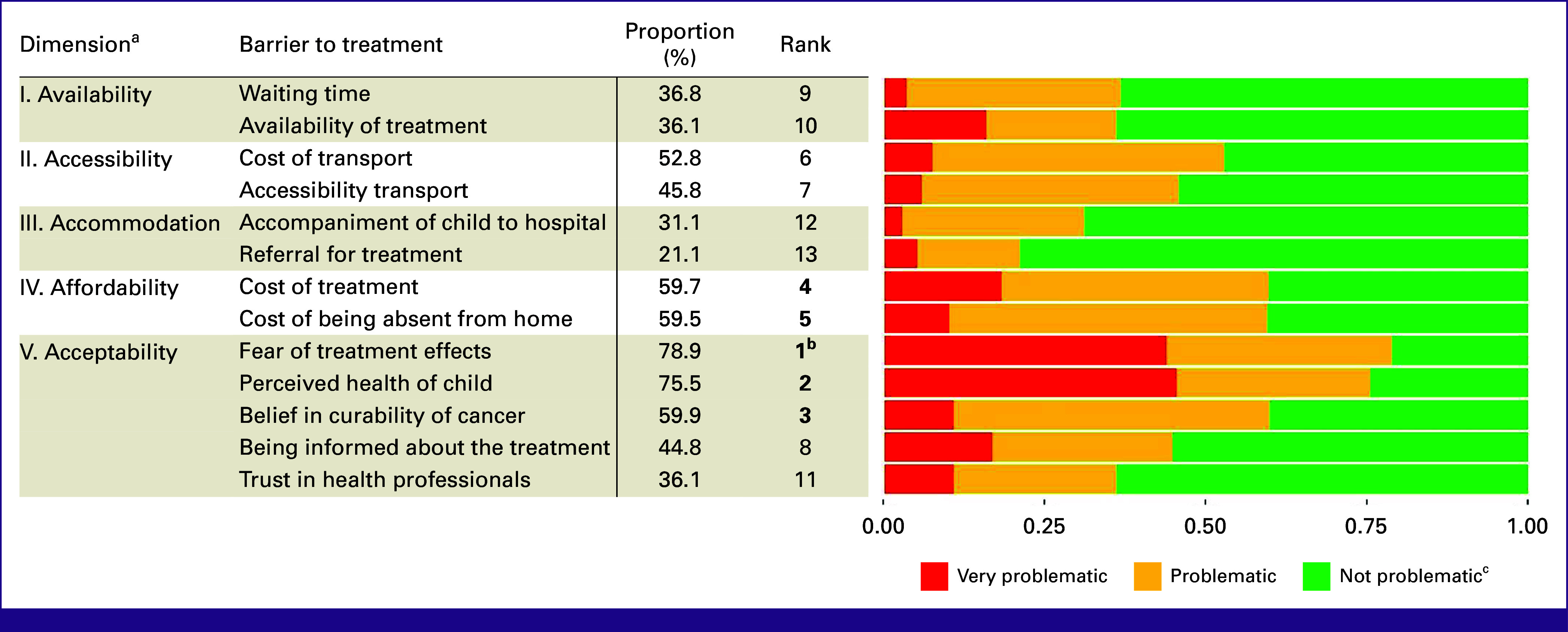
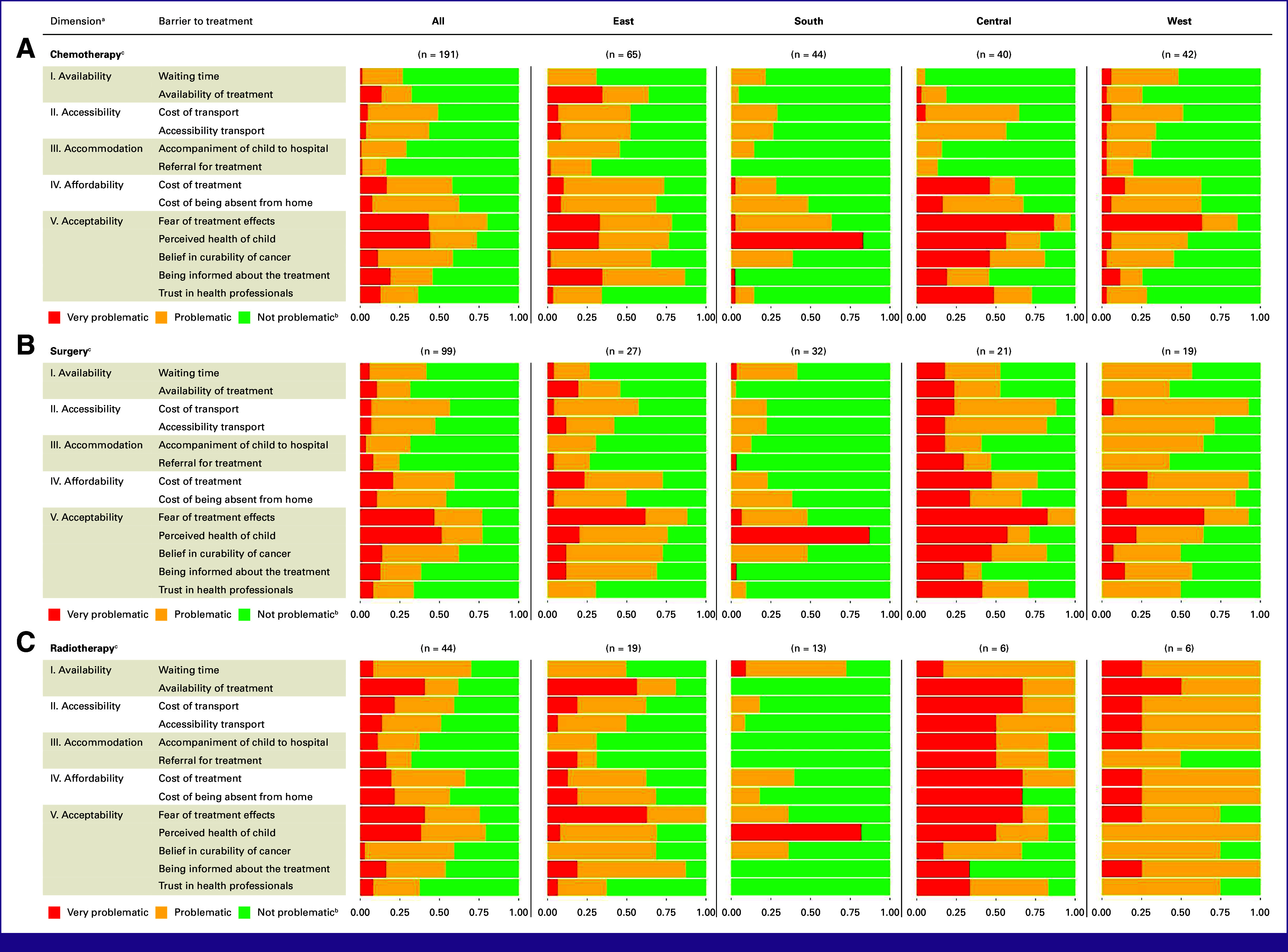
Results: A total of 224 patients with CC was included. The fear of treatment effects and the perceived (poor) health of the child were named most frequently as barriers for all treatment modalities (78.9% and 75.5%, respectively). For chemotherapy, respondents who indicated themselves as rich had lower odds of perceiving the (poor) health of the child as a barrier (OR, 0.06 [95% CI, 0.01 to 0.36]). For radiotherapy, long waiting time and (limited) availability in the country were more commonly barriers (OR, 7.53 [95% CI, 3.38 to 16.78]; OR, 11.11 [95% CI, 2.04 to 60.46], respectively) than for chemotherapy.
Conclusion: Despite known barriers such as the availability of therapy, our study additionally indicates the importance of the patients' and families' perceptions of the disease and its treatment. Further expanding measures of social support for affected families should be regarded as one of the main pillars to assure access to care.






 京公网安备 11010802042870号
京ICP备2023020795号-1
京公网安备 11010802042870号
京ICP备2023020795号-1

 分享
分享
 求助内容:
求助内容: 应助结果提醒方式:
 扫码关注我们
