Alejandro Mediavilla, Begoña Febrer-Sendra, Aroa Silgado, Patricia Martínez-Vallejo, Beatriz Crego-Vicente, Arlette Nindia, Carles Rubio Maturana, Lidia Goterris, Joan Martínez-Campreciós, Sandra Aixut, Pedro Fernández-Soto, María Luisa Aznar, Antonio Muro, Inés Oliveira-Souto, Israel Molina, Elena Sulleiro
{"title":"评价安哥拉农村地区用于实时聚合酶链反应疟疾诊断的干血点取样。","authors":"Alejandro Mediavilla, Begoña Febrer-Sendra, Aroa Silgado, Patricia Martínez-Vallejo, Beatriz Crego-Vicente, Arlette Nindia, Carles Rubio Maturana, Lidia Goterris, Joan Martínez-Campreciós, Sandra Aixut, Pedro Fernández-Soto, María Luisa Aznar, Antonio Muro, Inés Oliveira-Souto, Israel Molina, Elena Sulleiro","doi":"10.1186/s13071-025-06685-3","DOIUrl":null,"url":null,"abstract":"<p><strong>Background: </strong>Malaria is the parasitic disease with the highest morbidity and mortality worldwide. Angola is one of the five sub-Saharan African countries with the highest malaria burden. Real-time PCR diagnosis in endemic areas has not been implemented due to its high cost and the need for adequate infrastructure. Dried blood spots (DBSs) are an alternative for collecting, preserving, and transporting blood samples to reference laboratories. The objective of the study was to assess the efficacy of DBS as a sampling method for malaria research studies employing real-time PCR.</p><p><strong>Methods: </strong>The study was divided into two phases: (i) prospective study at the Hospital Universitario Vall d'Hebron (HUVH) to compare real-time PCR from whole blood or DBS, including 12 venous blood samples from patients with positive real-time PCR for Plasmodium spp. and 10 quality control samples (nine infected samples and one negative control). Samples were collected as DBSs (10, 20, 50 µl/circle). Samples from both phases of the study were analyzed by generic real-time PCR (Plasmodium spp.) and the subsequent positive samples underwent species-specific real-time PCR (Plasmodium species) and (ii) cross-sectional study conducted at the Hospital Nossa Senhora da Paz, Cubal (Angola), including 200 participants with fever. For each patient, a fresh capillary blood specimen [for thin and thick blood films and rapid diagnostic test (RDT)] and venous blood, collected as DBSs (two 10-µl circles were combined for a total volume of 20 µl of DBS), were obtained. DBSs were sent to HUVH, Barcelona, Spain.</p><p><strong>Results: </strong>(i) Real-time PCR from whole blood collection was positive for 100% of the 21 Plasmodium spp.-infected samples, whereas real-time PCR from DBSs detected Plasmodium spp. infection at lower proportions: 76.19% (16/21) for 10 µl, 85.71% (18/21) for 20 µl, 88.24% (15/17) for 50 µl and 85.71% (18/21) for 100 µl DBSs. (ii) Field diagnosis (microscopy and/or RDT) showed a 51.5% (103/200) positivity rate, while 50% (100/200) of the DBS samples tested positive by real-time PCR. Using field diagnosis as the reference method, the sensitivity of real-time PCR in DBS samples was 77.67% with a specificity of 79.38%. Plasmodium species were identified in 86 samples by real-time PCR: 81.40% (16/86) were caused by Plasmodium falciparum, 11.63% (10/86) were coinfections of P. falciparum + P. malariae, 4.65% (4/86) were P. falciparum + P. ovale, and 2.33% (2/86) were triple coinfections.</p><p><strong>Conclusions: </strong>The DBS volume used for DNA extraction is a determining factor in the performance of real-time PCR for Plasmodium DNA detection. A DBS volume of 50-100 µl appears to be optimal for malaria diagnosis and Plasmodium species determination by real-time PCR. DBS is a suitable method for sample collection in Cubal followed by real-time PCR analysis in a reference laboratory.</p>","PeriodicalId":19793,"journal":{"name":"Parasites & Vectors","volume":"18 1","pages":"44"},"PeriodicalIF":3.5000,"publicationDate":"2025-02-07","publicationTypes":"Journal Article","fieldsOfStudy":null,"isOpenAccess":false,"openAccessPdf":"https://www.ncbi.nlm.nih.gov/pmc/articles/PMC11803990/pdf/","citationCount":"0","resultStr":"{\"title\":\"Evaluation of dried blood spot sampling for real-time PCR malaria diagnostics in a rural setting in Angola.\",\"authors\":\"Alejandro Mediavilla, Begoña Febrer-Sendra, Aroa Silgado, Patricia Martínez-Vallejo, Beatriz Crego-Vicente, Arlette Nindia, Carles Rubio Maturana, Lidia Goterris, Joan Martínez-Campreciós, Sandra Aixut, Pedro Fernández-Soto, María Luisa Aznar, Antonio Muro, Inés Oliveira-Souto, Israel Molina, Elena Sulleiro\",\"doi\":\"10.1186/s13071-025-06685-3\",\"DOIUrl\":null,\"url\":null,\"abstract\":\"<p><strong>Background: </strong>Malaria is the parasitic disease with the highest morbidity and mortality worldwide. Angola is one of the five sub-Saharan African countries with the highest malaria burden. Real-time PCR diagnosis in endemic areas has not been implemented due to its high cost and the need for adequate infrastructure. Dried blood spots (DBSs) are an alternative for collecting, preserving, and transporting blood samples to reference laboratories. The objective of the study was to assess the efficacy of DBS as a sampling method for malaria research studies employing real-time PCR.</p><p><strong>Methods: </strong>The study was divided into two phases: (i) prospective study at the Hospital Universitario Vall d'Hebron (HUVH) to compare real-time PCR from whole blood or DBS, including 12 venous blood samples from patients with positive real-time PCR for Plasmodium spp. and 10 quality control samples (nine infected samples and one negative control). Samples were collected as DBSs (10, 20, 50 µl/circle). Samples from both phases of the study were analyzed by generic real-time PCR (Plasmodium spp.) and the subsequent positive samples underwent species-specific real-time PCR (Plasmodium species) and (ii) cross-sectional study conducted at the Hospital Nossa Senhora da Paz, Cubal (Angola), including 200 participants with fever. For each patient, a fresh capillary blood specimen [for thin and thick blood films and rapid diagnostic test (RDT)] and venous blood, collected as DBSs (two 10-µl circles were combined for a total volume of 20 µl of DBS), were obtained. DBSs were sent to HUVH, Barcelona, Spain.</p><p><strong>Results: </strong>(i) Real-time PCR from whole blood collection was positive for 100% of the 21 Plasmodium spp.-infected samples, whereas real-time PCR from DBSs detected Plasmodium spp. infection at lower proportions: 76.19% (16/21) for 10 µl, 85.71% (18/21) for 20 µl, 88.24% (15/17) for 50 µl and 85.71% (18/21) for 100 µl DBSs. (ii) Field diagnosis (microscopy and/or RDT) showed a 51.5% (103/200) positivity rate, while 50% (100/200) of the DBS samples tested positive by real-time PCR. Using field diagnosis as the reference method, the sensitivity of real-time PCR in DBS samples was 77.67% with a specificity of 79.38%. Plasmodium species were identified in 86 samples by real-time PCR: 81.40% (16/86) were caused by Plasmodium falciparum, 11.63% (10/86) were coinfections of P. falciparum + P. malariae, 4.65% (4/86) were P. falciparum + P. ovale, and 2.33% (2/86) were triple coinfections.</p><p><strong>Conclusions: </strong>The DBS volume used for DNA extraction is a determining factor in the performance of real-time PCR for Plasmodium DNA detection. A DBS volume of 50-100 µl appears to be optimal for malaria diagnosis and Plasmodium species determination by real-time PCR. DBS is a suitable method for sample collection in Cubal followed by real-time PCR analysis in a reference laboratory.</p>\",\"PeriodicalId\":19793,\"journal\":{\"name\":\"Parasites & Vectors\",\"volume\":\"18 1\",\"pages\":\"44\"},\"PeriodicalIF\":3.5000,\"publicationDate\":\"2025-02-07\",\"publicationTypes\":\"Journal Article\",\"fieldsOfStudy\":null,\"isOpenAccess\":false,\"openAccessPdf\":\"https://www.ncbi.nlm.nih.gov/pmc/articles/PMC11803990/pdf/\",\"citationCount\":\"0\",\"resultStr\":null,\"platform\":\"Semanticscholar\",\"paperid\":null,\"PeriodicalName\":\"Parasites & Vectors\",\"FirstCategoryId\":\"3\",\"ListUrlMain\":\"https://doi.org/10.1186/s13071-025-06685-3\",\"RegionNum\":2,\"RegionCategory\":\"医学\",\"ArticlePicture\":[],\"TitleCN\":null,\"AbstractTextCN\":null,\"PMCID\":null,\"EPubDate\":\"\",\"PubModel\":\"\",\"JCR\":\"Q1\",\"JCRName\":\"PARASITOLOGY\",\"Score\":null,\"Total\":0}","platform":"Semanticscholar","paperid":null,"PeriodicalName":"Parasites & Vectors","FirstCategoryId":"3","ListUrlMain":"https://doi.org/10.1186/s13071-025-06685-3","RegionNum":2,"RegionCategory":"医学","ArticlePicture":[],"TitleCN":null,"AbstractTextCN":null,"PMCID":null,"EPubDate":"","PubModel":"","JCR":"Q1","JCRName":"PARASITOLOGY","Score":null,"Total":0}
引用次数: 0
摘要
背景:疟疾是世界上发病率和死亡率最高的寄生虫病。安哥拉是撒哈拉以南非洲五个疟疾负担最重的国家之一。由于成本高和需要足够的基础设施,在流行地区尚未实施实时PCR诊断。干血点(DBSs)是收集、保存和运送血液样本到参考实验室的一种替代方法。该研究的目的是评估DBS作为采用实时PCR进行疟疾研究的采样方法的有效性。方法:研究分为两个阶段:(i)在hevbron大学医院(HUVH)进行前瞻性研究,比较全血和DBS的实时PCR结果,包括12份实时PCR阳性患者静脉血样本和10份质量对照样本(9份感染样本和1份阴性对照)。样品以DBSs(10、20、50µl/圈)采集。研究两个阶段的样本均采用通用实时荧光定量PCR(疟原虫属)进行分析,随后的阳性样本在Cubal(安哥拉)Nossa Senhora da Paz医院进行了物种特异性实时荧光定量PCR(疟原虫属)和(ii)横断面研究,其中包括200名发烧参与者。对于每位患者,采集新鲜的毛细血管血样[用于薄血膜和厚血膜及快速诊断试验(RDT)]和静脉血,作为DBS(两个10µl圆圈合并,总容积为20µl DBS)。DBSs被送到西班牙巴塞罗那的HUVH。结果:(1)21份疟原虫感染标本全血实时荧光定量PCR阳性率为100%,而DBSs实时荧光定量PCR检出率较低,10µl标本检出率为76.19%(16/21),20µl标本检出率为85.71%(18/21),50µl标本检出率为88.24%(15/17),100µl标本检出率为85.71%(18/21)。(ii)现场诊断(显微镜和/或RDT)的阳性率为51.5%(103/200),而实时PCR检测的DBS样本阳性率为50%(100/200)。以现场诊断为参考方法,实时荧光定量PCR检测DBS标本的灵敏度为77.67%,特异性为79.38%。86份样本经实时荧光定量PCR鉴定出疟原虫种类:恶性疟原虫占81.40%(16/86),恶性疟原虫+ P共感染占11.63%(10/86)。恶性疟原虫+疟原虫占4.65% (4/86);卵圆形,2.33%(2/86)为三重共感染。结论:用于DNA提取的DBS体积是实时PCR检测疟原虫DNA性能的决定性因素。50-100µl的DBS体积对于疟疾诊断和实时PCR测定疟原虫种类是最佳的。DBS是一种合适的方法,在Cubal样品收集,然后在参考实验室进行实时PCR分析。
Evaluation of dried blood spot sampling for real-time PCR malaria diagnostics in a rural setting in Angola.
Background: Malaria is the parasitic disease with the highest morbidity and mortality worldwide. Angola is one of the five sub-Saharan African countries with the highest malaria burden. Real-time PCR diagnosis in endemic areas has not been implemented due to its high cost and the need for adequate infrastructure. Dried blood spots (DBSs) are an alternative for collecting, preserving, and transporting blood samples to reference laboratories. The objective of the study was to assess the efficacy of DBS as a sampling method for malaria research studies employing real-time PCR.
Methods: The study was divided into two phases: (i) prospective study at the Hospital Universitario Vall d'Hebron (HUVH) to compare real-time PCR from whole blood or DBS, including 12 venous blood samples from patients with positive real-time PCR for Plasmodium spp. and 10 quality control samples (nine infected samples and one negative control). Samples were collected as DBSs (10, 20, 50 µl/circle). Samples from both phases of the study were analyzed by generic real-time PCR (Plasmodium spp.) and the subsequent positive samples underwent species-specific real-time PCR (Plasmodium species) and (ii) cross-sectional study conducted at the Hospital Nossa Senhora da Paz, Cubal (Angola), including 200 participants with fever. For each patient, a fresh capillary blood specimen [for thin and thick blood films and rapid diagnostic test (RDT)] and venous blood, collected as DBSs (two 10-µl circles were combined for a total volume of 20 µl of DBS), were obtained. DBSs were sent to HUVH, Barcelona, Spain.
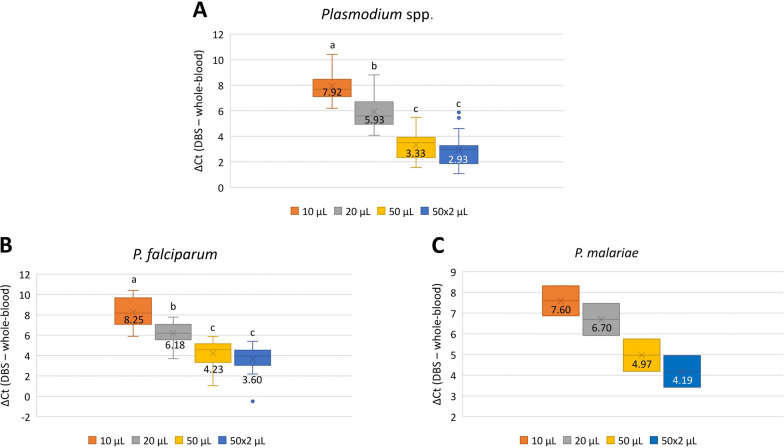
Results: (i) Real-time PCR from whole blood collection was positive for 100% of the 21 Plasmodium spp.-infected samples, whereas real-time PCR from DBSs detected Plasmodium spp. infection at lower proportions: 76.19% (16/21) for 10 µl, 85.71% (18/21) for 20 µl, 88.24% (15/17) for 50 µl and 85.71% (18/21) for 100 µl DBSs. (ii) Field diagnosis (microscopy and/or RDT) showed a 51.5% (103/200) positivity rate, while 50% (100/200) of the DBS samples tested positive by real-time PCR. Using field diagnosis as the reference method, the sensitivity of real-time PCR in DBS samples was 77.67% with a specificity of 79.38%. Plasmodium species were identified in 86 samples by real-time PCR: 81.40% (16/86) were caused by Plasmodium falciparum, 11.63% (10/86) were coinfections of P. falciparum + P. malariae, 4.65% (4/86) were P. falciparum + P. ovale, and 2.33% (2/86) were triple coinfections.
Conclusions: The DBS volume used for DNA extraction is a determining factor in the performance of real-time PCR for Plasmodium DNA detection. A DBS volume of 50-100 µl appears to be optimal for malaria diagnosis and Plasmodium species determination by real-time PCR. DBS is a suitable method for sample collection in Cubal followed by real-time PCR analysis in a reference laboratory.
期刊介绍:
Parasites & Vectors is an open access, peer-reviewed online journal dealing with the biology of parasites, parasitic diseases, intermediate hosts, vectors and vector-borne pathogens. Manuscripts published in this journal will be available to all worldwide, with no barriers to access, immediately following acceptance. However, authors retain the copyright of their material and may use it, or distribute it, as they wish.
Manuscripts on all aspects of the basic and applied biology of parasites, intermediate hosts, vectors and vector-borne pathogens will be considered. In addition to the traditional and well-established areas of science in these fields, we also aim to provide a vehicle for publication of the rapidly developing resources and technology in parasite, intermediate host and vector genomics and their impacts on biological research. We are able to publish large datasets and extensive results, frequently associated with genomic and post-genomic technologies, which are not readily accommodated in traditional journals. Manuscripts addressing broader issues, for example economics, social sciences and global climate change in relation to parasites, vectors and disease control, are also welcomed.






 京公网安备 11010802042870号
京ICP备2023020795号-1
京公网安备 11010802042870号
京ICP备2023020795号-1

 分享
分享
 求助内容:
求助内容: 应助结果提醒方式:
 扫码关注我们
