Mark J Lara, Roger Michaelides, Duncan Anderson, Wenqu Chen, Emma C Hall, Caroline Ludden, Aiden I G Schore, Umakant Mishra, Sarah N Scott
{"title":"阿拉斯加20米空间分辨率泥炭地范围图。","authors":"Mark J Lara, Roger Michaelides, Duncan Anderson, Wenqu Chen, Emma C Hall, Caroline Ludden, Aiden I G Schore, Umakant Mishra, Sarah N Scott","doi":"10.1038/s41597-025-04502-1","DOIUrl":null,"url":null,"abstract":"<p><p>Peatlands are prevalent across northern regions, including bogs, fens, marshes, meadows, and select tundra wetlands that all vary in size (e.g., 0.01 s to 10 s km<sup>2</sup>) and shape (e.g., circular to elongated). However, our best remotely sensed products describing the regional-scale distribution of peatland extents are constrained to 1 km<sup>2</sup> pixels, often representing notable sub-pixel heterogeneity and local-scale uncertainties. Here we develop a new 20 m spatial resolution wall-to-wall ~1.5 million km<sup>2</sup> peatland map of Alaska, using peat cores, ground observations, and sub-meter resolution image interpretation. Ground-data were used to train machine learning classifiers to detect peatlands using a fusion of Sentinel-1 (Dual-polarized Synthetic Aperture Radar), Sentinel-2 (Multi-Spectral Imager), and derivatives from the Arctic Digital Elevation Model (ArcticDEM), that were spatially constrained by a peatland suitability model. Statewide peatland mapping (overall agreement:85%) identified peatlands to cover 4.6, 10.4, and 5.3% of polar, boreal, and maritime ecoregions, respectively, and 7.3% of the total terrestrial land area. This new dataset will improve the representation of peatland carbon, nutrient, and fire dynamics across Alaska.</p>","PeriodicalId":21597,"journal":{"name":"Scientific Data","volume":"12 1","pages":"226"},"PeriodicalIF":6.9000,"publicationDate":"2025-02-06","publicationTypes":"Journal Article","fieldsOfStudy":null,"isOpenAccess":false,"openAccessPdf":"https://www.ncbi.nlm.nih.gov/pmc/articles/PMC11802868/pdf/","citationCount":"0","resultStr":"{\"title\":\"A 20 m spatial resolution peatland extent map of Alaska.\",\"authors\":\"Mark J Lara, Roger Michaelides, Duncan Anderson, Wenqu Chen, Emma C Hall, Caroline Ludden, Aiden I G Schore, Umakant Mishra, Sarah N Scott\",\"doi\":\"10.1038/s41597-025-04502-1\",\"DOIUrl\":null,\"url\":null,\"abstract\":\"<p><p>Peatlands are prevalent across northern regions, including bogs, fens, marshes, meadows, and select tundra wetlands that all vary in size (e.g., 0.01 s to 10 s km<sup>2</sup>) and shape (e.g., circular to elongated). However, our best remotely sensed products describing the regional-scale distribution of peatland extents are constrained to 1 km<sup>2</sup> pixels, often representing notable sub-pixel heterogeneity and local-scale uncertainties. Here we develop a new 20 m spatial resolution wall-to-wall ~1.5 million km<sup>2</sup> peatland map of Alaska, using peat cores, ground observations, and sub-meter resolution image interpretation. Ground-data were used to train machine learning classifiers to detect peatlands using a fusion of Sentinel-1 (Dual-polarized Synthetic Aperture Radar), Sentinel-2 (Multi-Spectral Imager), and derivatives from the Arctic Digital Elevation Model (ArcticDEM), that were spatially constrained by a peatland suitability model. Statewide peatland mapping (overall agreement:85%) identified peatlands to cover 4.6, 10.4, and 5.3% of polar, boreal, and maritime ecoregions, respectively, and 7.3% of the total terrestrial land area. This new dataset will improve the representation of peatland carbon, nutrient, and fire dynamics across Alaska.</p>\",\"PeriodicalId\":21597,\"journal\":{\"name\":\"Scientific Data\",\"volume\":\"12 1\",\"pages\":\"226\"},\"PeriodicalIF\":6.9000,\"publicationDate\":\"2025-02-06\",\"publicationTypes\":\"Journal Article\",\"fieldsOfStudy\":null,\"isOpenAccess\":false,\"openAccessPdf\":\"https://www.ncbi.nlm.nih.gov/pmc/articles/PMC11802868/pdf/\",\"citationCount\":\"0\",\"resultStr\":null,\"platform\":\"Semanticscholar\",\"paperid\":null,\"PeriodicalName\":\"Scientific Data\",\"FirstCategoryId\":\"103\",\"ListUrlMain\":\"https://doi.org/10.1038/s41597-025-04502-1\",\"RegionNum\":2,\"RegionCategory\":\"综合性期刊\",\"ArticlePicture\":[],\"TitleCN\":null,\"AbstractTextCN\":null,\"PMCID\":null,\"EPubDate\":\"\",\"PubModel\":\"\",\"JCR\":\"Q1\",\"JCRName\":\"MULTIDISCIPLINARY SCIENCES\",\"Score\":null,\"Total\":0}","platform":"Semanticscholar","paperid":null,"PeriodicalName":"Scientific Data","FirstCategoryId":"103","ListUrlMain":"https://doi.org/10.1038/s41597-025-04502-1","RegionNum":2,"RegionCategory":"综合性期刊","ArticlePicture":[],"TitleCN":null,"AbstractTextCN":null,"PMCID":null,"EPubDate":"","PubModel":"","JCR":"Q1","JCRName":"MULTIDISCIPLINARY SCIENCES","Score":null,"Total":0}
引用次数: 0
摘要
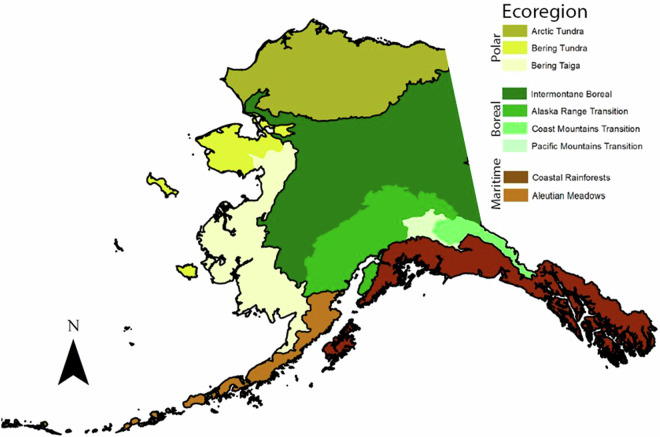
泥炭地在北部地区普遍存在,包括沼泽、沼泽、沼泽、草甸和部分冻土带湿地,它们的大小(例如,0.01 s至10 s km2)和形状(例如,圆形到细长形)各不相同。然而,我们最好的描述泥炭地区域尺度分布的遥感产品被限制在1平方公里像素,通常代表着显著的亚像素异质性和局地尺度的不确定性。本文利用泥炭岩心、地面观测和亚米分辨率的图像解译,绘制了一幅新的20米空间分辨率到150万平方公里的阿拉斯加泥炭地地图。地面数据用于训练机器学习分类器,通过融合Sentinel-1(双偏振合成孔径雷达)、Sentinel-2(多光谱成像仪)和北极数字高差模型(ArcticDEM)的衍生品来检测泥炭地,这些模型在空间上受到泥炭地适宜性模型的约束。全州泥炭地制图(总体一致性:85%)确定泥炭地分别覆盖了4.6、10.4和5.3%的极地、北方和海洋生态区域,占陆地总面积的7.3%。这个新的数据集将改善阿拉斯加泥炭地碳、营养和火灾动态的表现。
A 20 m spatial resolution peatland extent map of Alaska.
Peatlands are prevalent across northern regions, including bogs, fens, marshes, meadows, and select tundra wetlands that all vary in size (e.g., 0.01 s to 10 s km2) and shape (e.g., circular to elongated). However, our best remotely sensed products describing the regional-scale distribution of peatland extents are constrained to 1 km2 pixels, often representing notable sub-pixel heterogeneity and local-scale uncertainties. Here we develop a new 20 m spatial resolution wall-to-wall ~1.5 million km2 peatland map of Alaska, using peat cores, ground observations, and sub-meter resolution image interpretation. Ground-data were used to train machine learning classifiers to detect peatlands using a fusion of Sentinel-1 (Dual-polarized Synthetic Aperture Radar), Sentinel-2 (Multi-Spectral Imager), and derivatives from the Arctic Digital Elevation Model (ArcticDEM), that were spatially constrained by a peatland suitability model. Statewide peatland mapping (overall agreement:85%) identified peatlands to cover 4.6, 10.4, and 5.3% of polar, boreal, and maritime ecoregions, respectively, and 7.3% of the total terrestrial land area. This new dataset will improve the representation of peatland carbon, nutrient, and fire dynamics across Alaska.
期刊介绍:
Scientific Data is an open-access journal focused on data, publishing descriptions of research datasets and articles on data sharing across natural sciences, medicine, engineering, and social sciences. Its goal is to enhance the sharing and reuse of scientific data, encourage broader data sharing, and acknowledge those who share their data.
The journal primarily publishes Data Descriptors, which offer detailed descriptions of research datasets, including data collection methods and technical analyses validating data quality. These descriptors aim to facilitate data reuse rather than testing hypotheses or presenting new interpretations, methods, or in-depth analyses.





 京公网安备 11010802042870号
京ICP备2023020795号-1
京公网安备 11010802042870号
京ICP备2023020795号-1

 分享
分享
 求助内容:
求助内容: 应助结果提醒方式:
 扫码关注我们
