{"title":"利那洛肽在中国肠易激综合征合并便秘患者中的实际安全性:一项多中心、单臂、前瞻性观察研究","authors":"Yinglian Xiao, Xianmei Meng, Qingfeng Luo, Xiaohua Hou, Jie Jin, Xianfei Zhong, Wei Gong, Xiuling Li, Minhu Chen","doi":"10.1177/17562848251314819","DOIUrl":null,"url":null,"abstract":"<p><strong>Background: </strong>Linaclotide, a guanylate cyclase-C agonist, is indicated for irritable bowel syndrome with constipation (IBS-C). However, real-world data on the safety and patient-reported outcomes (PROs) of linaclotide are scarce in Chinese patients with IBS-C.</p><p><strong>Objectives: </strong>To assess the real-world safety and PROs of linaclotide in the Chinese IBS-C population.</p><p><strong>Design: </strong>Multicenter, prospective observational study.</p><p><strong>Methods: </strong>Adults with IBS-C who had taken or planned to take at least one dose of linaclotide 290 μg were enrolled and followed up for 3 months. Face-to-face visits were conducted at baseline (V1), Week 4 ± 7 days (V2), and Week 12 ± 7 days (V3). Primary endpoints included the incidences of adverse events (AEs), AEs by severity, adverse drug reactions (ADRs), serious AEs (SAEs), and AEs leading to treatment interruption, discontinuation, and death. Secondary endpoints included mean treatment satisfaction at V2 and V3, and mean overall Irritable Bowel Syndrome-Quality of Life (IBS-QoL) at V2.</p><p><strong>Results: </strong>Out of 3000 enrolled patients, 2963 took at least one dose of linaclotide and were analyzed. Overall, 712 patients (24.0%) reported 1095 AEs, which were mostly mild (89.9%). Diarrhea, reported in 297 out of the 2963 patients analyzed (10.0%), was the most common AE. No severe diarrhea was reported. Totally, 319 patients (10.8%) reported ADRs. Forty-six patients (1.6%) reported 50 SAEs and two cases were considered related to linaclotide treatment. Fifty-one (1.7%) and 70 patients (2.4%) interrupted and discontinued treatment due to AEs, respectively. One patient died of hepatic cancer, which was considered unrelated to linaclotide treatment. During the follow-up, the mean (±SD) treatment satisfaction increased numerically and continuously (V1, 2.8 ± 1.3 (<i>n</i> = 1721); V2, 3.5 ± 1.1 (<i>n</i> = 1705); V3, 3.9 ± 1.0 (<i>n</i> = 833)). The mean (±SD) overall IBS-QoL increased numerically from 73.2 ± 16.6 (<i>n</i> = 1924) at V1 to 80.2 ± 15.5 (<i>n</i> = 1738) at V2.</p><p><strong>Conclusion: </strong>In the Chinese real-world setting, linaclotide was safe and well tolerated in patients with IBS-C. Numerically, there are trends toward improvement in PROs with linaclotide treatment.</p>","PeriodicalId":48770,"journal":{"name":"Therapeutic Advances in Gastroenterology","volume":"18 ","pages":"17562848251314819"},"PeriodicalIF":3.8000,"publicationDate":"2025-02-05","publicationTypes":"Journal Article","fieldsOfStudy":null,"isOpenAccess":false,"openAccessPdf":"https://www.ncbi.nlm.nih.gov/pmc/articles/PMC11800259/pdf/","citationCount":"0","resultStr":"{\"title\":\"Real-world safety of linaclotide in Chinese patients with irritable bowel syndrome with constipation: a multicenter, single-arm, prospective observational study.\",\"authors\":\"Yinglian Xiao, Xianmei Meng, Qingfeng Luo, Xiaohua Hou, Jie Jin, Xianfei Zhong, Wei Gong, Xiuling Li, Minhu Chen\",\"doi\":\"10.1177/17562848251314819\",\"DOIUrl\":null,\"url\":null,\"abstract\":\"<p><strong>Background: </strong>Linaclotide, a guanylate cyclase-C agonist, is indicated for irritable bowel syndrome with constipation (IBS-C). However, real-world data on the safety and patient-reported outcomes (PROs) of linaclotide are scarce in Chinese patients with IBS-C.</p><p><strong>Objectives: </strong>To assess the real-world safety and PROs of linaclotide in the Chinese IBS-C population.</p><p><strong>Design: </strong>Multicenter, prospective observational study.</p><p><strong>Methods: </strong>Adults with IBS-C who had taken or planned to take at least one dose of linaclotide 290 μg were enrolled and followed up for 3 months. Face-to-face visits were conducted at baseline (V1), Week 4 ± 7 days (V2), and Week 12 ± 7 days (V3). Primary endpoints included the incidences of adverse events (AEs), AEs by severity, adverse drug reactions (ADRs), serious AEs (SAEs), and AEs leading to treatment interruption, discontinuation, and death. Secondary endpoints included mean treatment satisfaction at V2 and V3, and mean overall Irritable Bowel Syndrome-Quality of Life (IBS-QoL) at V2.</p><p><strong>Results: </strong>Out of 3000 enrolled patients, 2963 took at least one dose of linaclotide and were analyzed. Overall, 712 patients (24.0%) reported 1095 AEs, which were mostly mild (89.9%). Diarrhea, reported in 297 out of the 2963 patients analyzed (10.0%), was the most common AE. No severe diarrhea was reported. Totally, 319 patients (10.8%) reported ADRs. Forty-six patients (1.6%) reported 50 SAEs and two cases were considered related to linaclotide treatment. Fifty-one (1.7%) and 70 patients (2.4%) interrupted and discontinued treatment due to AEs, respectively. One patient died of hepatic cancer, which was considered unrelated to linaclotide treatment. During the follow-up, the mean (±SD) treatment satisfaction increased numerically and continuously (V1, 2.8 ± 1.3 (<i>n</i> = 1721); V2, 3.5 ± 1.1 (<i>n</i> = 1705); V3, 3.9 ± 1.0 (<i>n</i> = 833)). The mean (±SD) overall IBS-QoL increased numerically from 73.2 ± 16.6 (<i>n</i> = 1924) at V1 to 80.2 ± 15.5 (<i>n</i> = 1738) at V2.</p><p><strong>Conclusion: </strong>In the Chinese real-world setting, linaclotide was safe and well tolerated in patients with IBS-C. Numerically, there are trends toward improvement in PROs with linaclotide treatment.</p>\",\"PeriodicalId\":48770,\"journal\":{\"name\":\"Therapeutic Advances in Gastroenterology\",\"volume\":\"18 \",\"pages\":\"17562848251314819\"},\"PeriodicalIF\":3.8000,\"publicationDate\":\"2025-02-05\",\"publicationTypes\":\"Journal Article\",\"fieldsOfStudy\":null,\"isOpenAccess\":false,\"openAccessPdf\":\"https://www.ncbi.nlm.nih.gov/pmc/articles/PMC11800259/pdf/\",\"citationCount\":\"0\",\"resultStr\":null,\"platform\":\"Semanticscholar\",\"paperid\":null,\"PeriodicalName\":\"Therapeutic Advances in Gastroenterology\",\"FirstCategoryId\":\"3\",\"ListUrlMain\":\"https://doi.org/10.1177/17562848251314819\",\"RegionNum\":3,\"RegionCategory\":\"医学\",\"ArticlePicture\":[],\"TitleCN\":null,\"AbstractTextCN\":null,\"PMCID\":null,\"EPubDate\":\"2025/1/1 0:00:00\",\"PubModel\":\"eCollection\",\"JCR\":\"Q1\",\"JCRName\":\"GASTROENTEROLOGY & HEPATOLOGY\",\"Score\":null,\"Total\":0}","platform":"Semanticscholar","paperid":null,"PeriodicalName":"Therapeutic Advances in Gastroenterology","FirstCategoryId":"3","ListUrlMain":"https://doi.org/10.1177/17562848251314819","RegionNum":3,"RegionCategory":"医学","ArticlePicture":[],"TitleCN":null,"AbstractTextCN":null,"PMCID":null,"EPubDate":"2025/1/1 0:00:00","PubModel":"eCollection","JCR":"Q1","JCRName":"GASTROENTEROLOGY & HEPATOLOGY","Score":null,"Total":0}
Real-world safety of linaclotide in Chinese patients with irritable bowel syndrome with constipation: a multicenter, single-arm, prospective observational study.
Background: Linaclotide, a guanylate cyclase-C agonist, is indicated for irritable bowel syndrome with constipation (IBS-C). However, real-world data on the safety and patient-reported outcomes (PROs) of linaclotide are scarce in Chinese patients with IBS-C.
Objectives: To assess the real-world safety and PROs of linaclotide in the Chinese IBS-C population.
Methods: Adults with IBS-C who had taken or planned to take at least one dose of linaclotide 290 μg were enrolled and followed up for 3 months. Face-to-face visits were conducted at baseline (V1), Week 4 ± 7 days (V2), and Week 12 ± 7 days (V3). Primary endpoints included the incidences of adverse events (AEs), AEs by severity, adverse drug reactions (ADRs), serious AEs (SAEs), and AEs leading to treatment interruption, discontinuation, and death. Secondary endpoints included mean treatment satisfaction at V2 and V3, and mean overall Irritable Bowel Syndrome-Quality of Life (IBS-QoL) at V2.
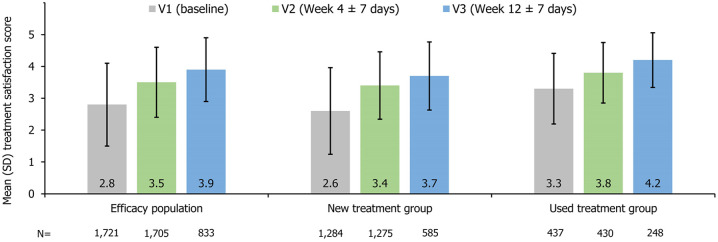
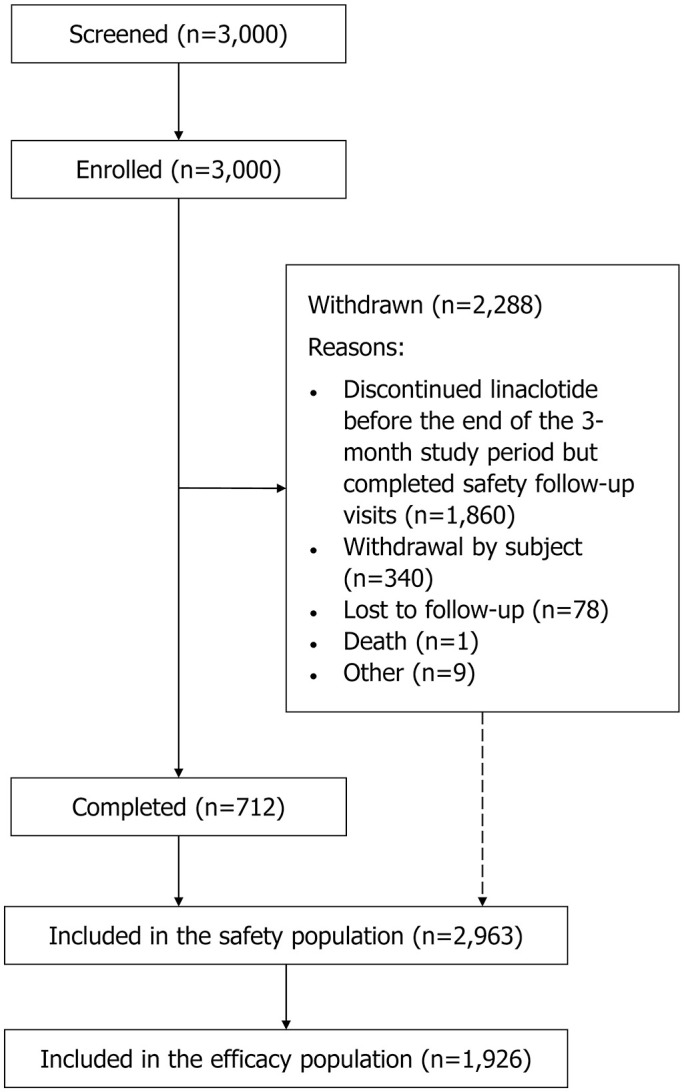
Results: Out of 3000 enrolled patients, 2963 took at least one dose of linaclotide and were analyzed. Overall, 712 patients (24.0%) reported 1095 AEs, which were mostly mild (89.9%). Diarrhea, reported in 297 out of the 2963 patients analyzed (10.0%), was the most common AE. No severe diarrhea was reported. Totally, 319 patients (10.8%) reported ADRs. Forty-six patients (1.6%) reported 50 SAEs and two cases were considered related to linaclotide treatment. Fifty-one (1.7%) and 70 patients (2.4%) interrupted and discontinued treatment due to AEs, respectively. One patient died of hepatic cancer, which was considered unrelated to linaclotide treatment. During the follow-up, the mean (±SD) treatment satisfaction increased numerically and continuously (V1, 2.8 ± 1.3 (n = 1721); V2, 3.5 ± 1.1 (n = 1705); V3, 3.9 ± 1.0 (n = 833)). The mean (±SD) overall IBS-QoL increased numerically from 73.2 ± 16.6 (n = 1924) at V1 to 80.2 ± 15.5 (n = 1738) at V2.
Conclusion: In the Chinese real-world setting, linaclotide was safe and well tolerated in patients with IBS-C. Numerically, there are trends toward improvement in PROs with linaclotide treatment.
期刊介绍:
Therapeutic Advances in Gastroenterology is an open access journal which delivers the highest quality peer-reviewed original research articles, reviews, and scholarly comment on pioneering efforts and innovative studies in the medical treatment of gastrointestinal and hepatic disorders. The journal has a strong clinical and pharmacological focus and is aimed at an international audience of clinicians and researchers in gastroenterology and related disciplines, providing an online forum for rapid dissemination of recent research and perspectives in this area.
The editors welcome original research articles across all areas of gastroenterology and hepatology.
The journal publishes original research articles and review articles primarily. Original research manuscripts may include laboratory, animal or human/clinical studies – all phases. Letters to the Editor and Case Reports will also be considered.





 京公网安备 11010802042870号
京ICP备2023020795号-1
京公网安备 11010802042870号
京ICP备2023020795号-1

 分享
分享
 求助内容:
求助内容: 应助结果提醒方式:
 扫码关注我们
