{"title":"具有有效抗菌活性的新型噻唑-胸膜残胺衍生物的发现","authors":"Xian-Long Qi, He-Chao Zhang, Xiao Xu, Xi-Wang Liu, Ya-Jun Yang, Zhun Li, Jian-Yong Li","doi":"10.1016/j.ejmech.2025.117374","DOIUrl":null,"url":null,"abstract":"<div><div>A series of novel thiazole-pleuromutilin derivatives were designed and synthesized, and their antibacterial activities were evaluated. Most of the synthesized derivatives showed good activity against Gram-positive bacteria, among which compound <strong>h19</strong> was more prominent and had the strongest antibacterial activity against MRSA. Compound <strong>h19</strong> was selected for further evaluation of bacterial time-kill kinetics, and the results demonstrated its highly promising efficacy in inhibiting MRSA growth. Moreover, <strong>h19</strong> exhibited a superior post-antibiotic effect (PAE) value and a lower possibility for bacterial resistance development compared to tiamulin. Docking studies demonstrated the strong affinity of <strong>h19</strong> for the 50S ribosomal subunit with a binding free energy of −10.6 kcal/mol. The cytotoxic assay indicated that <strong>h19</strong> had low cytotoxicity on both HEK293T and HepG2 cells (IC<sub>50</sub> > 200 μM). In MRSA systemic-infected mouse model, <strong>h19</strong> improved survival rates, reduced the bacterial load, and alleviated pathological changes in the lungs of the infected mice, which exhibited a more potent antibacterial efficacy compared to tiamulin. Compound <strong>h19</strong> also displayed low oral toxicity with an LD<sub>50</sub> value more than 2000 mg/kg.</div></div>","PeriodicalId":314,"journal":{"name":"European Journal of Medicinal Chemistry","volume":"287 ","pages":"Article 117374"},"PeriodicalIF":5.9000,"publicationDate":"2025-04-05","publicationTypes":"Journal Article","fieldsOfStudy":null,"isOpenAccess":false,"openAccessPdf":"","citationCount":"0","resultStr":"{\"title\":\"Discovery of novel thiazole-pleuromutilin derivatives with potent antibacterial activity\",\"authors\":\"Xian-Long Qi, He-Chao Zhang, Xiao Xu, Xi-Wang Liu, Ya-Jun Yang, Zhun Li, Jian-Yong Li\",\"doi\":\"10.1016/j.ejmech.2025.117374\",\"DOIUrl\":null,\"url\":null,\"abstract\":\"<div><div>A series of novel thiazole-pleuromutilin derivatives were designed and synthesized, and their antibacterial activities were evaluated. Most of the synthesized derivatives showed good activity against Gram-positive bacteria, among which compound <strong>h19</strong> was more prominent and had the strongest antibacterial activity against MRSA. Compound <strong>h19</strong> was selected for further evaluation of bacterial time-kill kinetics, and the results demonstrated its highly promising efficacy in inhibiting MRSA growth. Moreover, <strong>h19</strong> exhibited a superior post-antibiotic effect (PAE) value and a lower possibility for bacterial resistance development compared to tiamulin. Docking studies demonstrated the strong affinity of <strong>h19</strong> for the 50S ribosomal subunit with a binding free energy of −10.6 kcal/mol. The cytotoxic assay indicated that <strong>h19</strong> had low cytotoxicity on both HEK293T and HepG2 cells (IC<sub>50</sub> > 200 μM). In MRSA systemic-infected mouse model, <strong>h19</strong> improved survival rates, reduced the bacterial load, and alleviated pathological changes in the lungs of the infected mice, which exhibited a more potent antibacterial efficacy compared to tiamulin. Compound <strong>h19</strong> also displayed low oral toxicity with an LD<sub>50</sub> value more than 2000 mg/kg.</div></div>\",\"PeriodicalId\":314,\"journal\":{\"name\":\"European Journal of Medicinal Chemistry\",\"volume\":\"287 \",\"pages\":\"Article 117374\"},\"PeriodicalIF\":5.9000,\"publicationDate\":\"2025-04-05\",\"publicationTypes\":\"Journal Article\",\"fieldsOfStudy\":null,\"isOpenAccess\":false,\"openAccessPdf\":\"\",\"citationCount\":\"0\",\"resultStr\":null,\"platform\":\"Semanticscholar\",\"paperid\":null,\"PeriodicalName\":\"European Journal of Medicinal Chemistry\",\"FirstCategoryId\":\"3\",\"ListUrlMain\":\"https://www.sciencedirect.com/science/article/pii/S0223523425001394\",\"RegionNum\":2,\"RegionCategory\":\"医学\",\"ArticlePicture\":[],\"TitleCN\":null,\"AbstractTextCN\":null,\"PMCID\":null,\"EPubDate\":\"2025/2/8 0:00:00\",\"PubModel\":\"Epub\",\"JCR\":\"Q1\",\"JCRName\":\"CHEMISTRY, MEDICINAL\",\"Score\":null,\"Total\":0}","platform":"Semanticscholar","paperid":null,"PeriodicalName":"European Journal of Medicinal Chemistry","FirstCategoryId":"3","ListUrlMain":"https://www.sciencedirect.com/science/article/pii/S0223523425001394","RegionNum":2,"RegionCategory":"医学","ArticlePicture":[],"TitleCN":null,"AbstractTextCN":null,"PMCID":null,"EPubDate":"2025/2/8 0:00:00","PubModel":"Epub","JCR":"Q1","JCRName":"CHEMISTRY, MEDICINAL","Score":null,"Total":0}
Discovery of novel thiazole-pleuromutilin derivatives with potent antibacterial activity
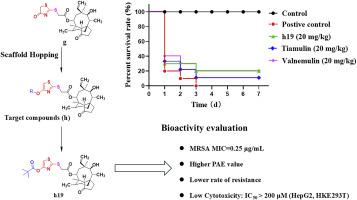
A series of novel thiazole-pleuromutilin derivatives were designed and synthesized, and their antibacterial activities were evaluated. Most of the synthesized derivatives showed good activity against Gram-positive bacteria, among which compound h19 was more prominent and had the strongest antibacterial activity against MRSA. Compound h19 was selected for further evaluation of bacterial time-kill kinetics, and the results demonstrated its highly promising efficacy in inhibiting MRSA growth. Moreover, h19 exhibited a superior post-antibiotic effect (PAE) value and a lower possibility for bacterial resistance development compared to tiamulin. Docking studies demonstrated the strong affinity of h19 for the 50S ribosomal subunit with a binding free energy of −10.6 kcal/mol. The cytotoxic assay indicated that h19 had low cytotoxicity on both HEK293T and HepG2 cells (IC50 > 200 μM). In MRSA systemic-infected mouse model, h19 improved survival rates, reduced the bacterial load, and alleviated pathological changes in the lungs of the infected mice, which exhibited a more potent antibacterial efficacy compared to tiamulin. Compound h19 also displayed low oral toxicity with an LD50 value more than 2000 mg/kg.
期刊介绍:
The European Journal of Medicinal Chemistry is a global journal that publishes studies on all aspects of medicinal chemistry. It provides a medium for publication of original papers and also welcomes critical review papers.
A typical paper would report on the organic synthesis, characterization and pharmacological evaluation of compounds. Other topics of interest are drug design, QSAR, molecular modeling, drug-receptor interactions, molecular aspects of drug metabolism, prodrug synthesis and drug targeting. The journal expects manuscripts to present the rational for a study, provide insight into the design of compounds or understanding of mechanism, or clarify the targets.





 京公网安备 11010802042870号
京ICP备2023020795号-1
京公网安备 11010802042870号
京ICP备2023020795号-1

 分享
分享
 求助内容:
求助内容: 应助结果提醒方式:
 扫码关注我们
