Zhichao Yang, Zonghai Yao, Mahbuba Tasmin, Parth Vashisht, Won Seok Jang, Feiyun Ouyang, Beining Wang, David McManus, Dan Berlowitz, Hong Yu
{"title":"揭示GPT-4V在USMLE问题高准确性背后隐藏的挑战:观察研究。","authors":"Zhichao Yang, Zonghai Yao, Mahbuba Tasmin, Parth Vashisht, Won Seok Jang, Feiyun Ouyang, Beining Wang, David McManus, Dan Berlowitz, Hong Yu","doi":"10.2196/65146","DOIUrl":null,"url":null,"abstract":"<p><strong>Background: </strong>Recent advancements in artificial intelligence, such as GPT-3.5 Turbo (OpenAI) and GPT-4, have demonstrated significant potential by achieving good scores on text-only United States Medical Licensing Examination (USMLE) exams and effectively answering questions from physicians. However, the ability of these models to interpret medical images remains underexplored.</p><p><strong>Objective: </strong>This study aimed to comprehensively evaluate the performance, interpretability, and limitations of GPT-3.5 Turbo, GPT-4, and its successor, GPT-4 Vision (GPT-4V), specifically focusing on GPT-4V's newly introduced image-understanding feature. By assessing the models on medical licensing examination questions that require image interpretation, we sought to highlight the strengths and weaknesses of GPT-4V in handling complex multimodal clinical information, thereby exposing hidden flaws and providing insights into its readiness for integration into clinical settings.</p><p><strong>Methods: </strong>This cross-sectional study tested GPT-4V, GPT-4, and ChatGPT-3.5 Turbo on a total of 227 multiple-choice questions with images from USMLE Step 1 (n=19), Step 2 clinical knowledge (n=14), Step 3 (n=18), the Diagnostic Radiology Qualifying Core Exam (DRQCE) (n=26), and AMBOSS question banks (n=150). AMBOSS provided expert-written hints and question difficulty levels. GPT-4V's accuracy was compared with 2 state-of-the-art large language models, GPT-3.5 Turbo and GPT-4. The quality of the explanations was evaluated by choosing human preference between an explanation by GPT-4V (without hint), an explanation by an expert, or a tie, using 3 qualitative metrics: comprehensive explanation, question information, and image interpretation. To better understand GPT-4V's explanation ability, we modified a patient case report to resemble a typical \"curbside consultation\" between physicians.</p><p><strong>Results: </strong>For questions with images, GPT-4V achieved an accuracy of 84.2%, 85.7%, 88.9%, and 73.1% in Step 1, Step 2 clinical knowledge, Step 3 of USMLE, and DRQCE, respectively. It outperformed GPT-3.5 Turbo (42.1%, 50%, 50%, 19.2%) and GPT-4 (63.2%, 64.3%, 66.7%, 26.9%). When GPT-4V answered correctly, its explanations were nearly as good as those provided by domain experts from AMBOSS. However, incorrect answers often had poor explanation quality: 18.2% (10/55) contained inaccurate text, 45.5% (25/55) had inference errors, and 76.3% (42/55) demonstrated image misunderstandings. With human expert assistance, GPT-4V reduced errors by an average of 40% (22/55). GPT-4V accuracy improved with hints, maintaining stable performance across difficulty levels, while medical student performance declined as difficulty increased. In a simulated curbside consultation scenario, GPT-4V required multiple specific prompts to interpret complex case data accurately.</p><p><strong>Conclusions: </strong>GPT-4V achieved high accuracy on multiple-choice questions with images, highlighting its potential in medical assessments. However, significant shortcomings were observed in the quality of explanations when questions were answered incorrectly, particularly in the interpretation of images, which could not be efficiently resolved through expert interaction. These findings reveal hidden flaws in the image interpretation capabilities of GPT-4V, underscoring the need for more comprehensive evaluations beyond multiple-choice questions before integrating GPT-4V into clinical settings.</p>","PeriodicalId":16337,"journal":{"name":"Journal of Medical Internet Research","volume":"27 ","pages":"e65146"},"PeriodicalIF":6.0000,"publicationDate":"2025-02-07","publicationTypes":"Journal Article","fieldsOfStudy":null,"isOpenAccess":false,"openAccessPdf":"https://www.ncbi.nlm.nih.gov/pmc/articles/PMC11845889/pdf/","citationCount":"0","resultStr":"{\"title\":\"Unveiling GPT-4V's hidden challenges behind high accuracy on USMLE questions: Observational Study.\",\"authors\":\"Zhichao Yang, Zonghai Yao, Mahbuba Tasmin, Parth Vashisht, Won Seok Jang, Feiyun Ouyang, Beining Wang, David McManus, Dan Berlowitz, Hong Yu\",\"doi\":\"10.2196/65146\",\"DOIUrl\":null,\"url\":null,\"abstract\":\"<p><strong>Background: </strong>Recent advancements in artificial intelligence, such as GPT-3.5 Turbo (OpenAI) and GPT-4, have demonstrated significant potential by achieving good scores on text-only United States Medical Licensing Examination (USMLE) exams and effectively answering questions from physicians. However, the ability of these models to interpret medical images remains underexplored.</p><p><strong>Objective: </strong>This study aimed to comprehensively evaluate the performance, interpretability, and limitations of GPT-3.5 Turbo, GPT-4, and its successor, GPT-4 Vision (GPT-4V), specifically focusing on GPT-4V's newly introduced image-understanding feature. By assessing the models on medical licensing examination questions that require image interpretation, we sought to highlight the strengths and weaknesses of GPT-4V in handling complex multimodal clinical information, thereby exposing hidden flaws and providing insights into its readiness for integration into clinical settings.</p><p><strong>Methods: </strong>This cross-sectional study tested GPT-4V, GPT-4, and ChatGPT-3.5 Turbo on a total of 227 multiple-choice questions with images from USMLE Step 1 (n=19), Step 2 clinical knowledge (n=14), Step 3 (n=18), the Diagnostic Radiology Qualifying Core Exam (DRQCE) (n=26), and AMBOSS question banks (n=150). AMBOSS provided expert-written hints and question difficulty levels. GPT-4V's accuracy was compared with 2 state-of-the-art large language models, GPT-3.5 Turbo and GPT-4. The quality of the explanations was evaluated by choosing human preference between an explanation by GPT-4V (without hint), an explanation by an expert, or a tie, using 3 qualitative metrics: comprehensive explanation, question information, and image interpretation. To better understand GPT-4V's explanation ability, we modified a patient case report to resemble a typical \\\"curbside consultation\\\" between physicians.</p><p><strong>Results: </strong>For questions with images, GPT-4V achieved an accuracy of 84.2%, 85.7%, 88.9%, and 73.1% in Step 1, Step 2 clinical knowledge, Step 3 of USMLE, and DRQCE, respectively. It outperformed GPT-3.5 Turbo (42.1%, 50%, 50%, 19.2%) and GPT-4 (63.2%, 64.3%, 66.7%, 26.9%). When GPT-4V answered correctly, its explanations were nearly as good as those provided by domain experts from AMBOSS. However, incorrect answers often had poor explanation quality: 18.2% (10/55) contained inaccurate text, 45.5% (25/55) had inference errors, and 76.3% (42/55) demonstrated image misunderstandings. With human expert assistance, GPT-4V reduced errors by an average of 40% (22/55). GPT-4V accuracy improved with hints, maintaining stable performance across difficulty levels, while medical student performance declined as difficulty increased. In a simulated curbside consultation scenario, GPT-4V required multiple specific prompts to interpret complex case data accurately.</p><p><strong>Conclusions: </strong>GPT-4V achieved high accuracy on multiple-choice questions with images, highlighting its potential in medical assessments. However, significant shortcomings were observed in the quality of explanations when questions were answered incorrectly, particularly in the interpretation of images, which could not be efficiently resolved through expert interaction. These findings reveal hidden flaws in the image interpretation capabilities of GPT-4V, underscoring the need for more comprehensive evaluations beyond multiple-choice questions before integrating GPT-4V into clinical settings.</p>\",\"PeriodicalId\":16337,\"journal\":{\"name\":\"Journal of Medical Internet Research\",\"volume\":\"27 \",\"pages\":\"e65146\"},\"PeriodicalIF\":6.0000,\"publicationDate\":\"2025-02-07\",\"publicationTypes\":\"Journal Article\",\"fieldsOfStudy\":null,\"isOpenAccess\":false,\"openAccessPdf\":\"https://www.ncbi.nlm.nih.gov/pmc/articles/PMC11845889/pdf/\",\"citationCount\":\"0\",\"resultStr\":null,\"platform\":\"Semanticscholar\",\"paperid\":null,\"PeriodicalName\":\"Journal of Medical Internet Research\",\"FirstCategoryId\":\"3\",\"ListUrlMain\":\"https://doi.org/10.2196/65146\",\"RegionNum\":2,\"RegionCategory\":\"医学\",\"ArticlePicture\":[],\"TitleCN\":null,\"AbstractTextCN\":null,\"PMCID\":null,\"EPubDate\":\"\",\"PubModel\":\"\",\"JCR\":\"Q1\",\"JCRName\":\"HEALTH CARE SCIENCES & SERVICES\",\"Score\":null,\"Total\":0}","platform":"Semanticscholar","paperid":null,"PeriodicalName":"Journal of Medical Internet Research","FirstCategoryId":"3","ListUrlMain":"https://doi.org/10.2196/65146","RegionNum":2,"RegionCategory":"医学","ArticlePicture":[],"TitleCN":null,"AbstractTextCN":null,"PMCID":null,"EPubDate":"","PubModel":"","JCR":"Q1","JCRName":"HEALTH CARE SCIENCES & SERVICES","Score":null,"Total":0}
Unveiling GPT-4V's hidden challenges behind high accuracy on USMLE questions: Observational Study.
Background: Recent advancements in artificial intelligence, such as GPT-3.5 Turbo (OpenAI) and GPT-4, have demonstrated significant potential by achieving good scores on text-only United States Medical Licensing Examination (USMLE) exams and effectively answering questions from physicians. However, the ability of these models to interpret medical images remains underexplored.
Objective: This study aimed to comprehensively evaluate the performance, interpretability, and limitations of GPT-3.5 Turbo, GPT-4, and its successor, GPT-4 Vision (GPT-4V), specifically focusing on GPT-4V's newly introduced image-understanding feature. By assessing the models on medical licensing examination questions that require image interpretation, we sought to highlight the strengths and weaknesses of GPT-4V in handling complex multimodal clinical information, thereby exposing hidden flaws and providing insights into its readiness for integration into clinical settings.
Methods: This cross-sectional study tested GPT-4V, GPT-4, and ChatGPT-3.5 Turbo on a total of 227 multiple-choice questions with images from USMLE Step 1 (n=19), Step 2 clinical knowledge (n=14), Step 3 (n=18), the Diagnostic Radiology Qualifying Core Exam (DRQCE) (n=26), and AMBOSS question banks (n=150). AMBOSS provided expert-written hints and question difficulty levels. GPT-4V's accuracy was compared with 2 state-of-the-art large language models, GPT-3.5 Turbo and GPT-4. The quality of the explanations was evaluated by choosing human preference between an explanation by GPT-4V (without hint), an explanation by an expert, or a tie, using 3 qualitative metrics: comprehensive explanation, question information, and image interpretation. To better understand GPT-4V's explanation ability, we modified a patient case report to resemble a typical "curbside consultation" between physicians.
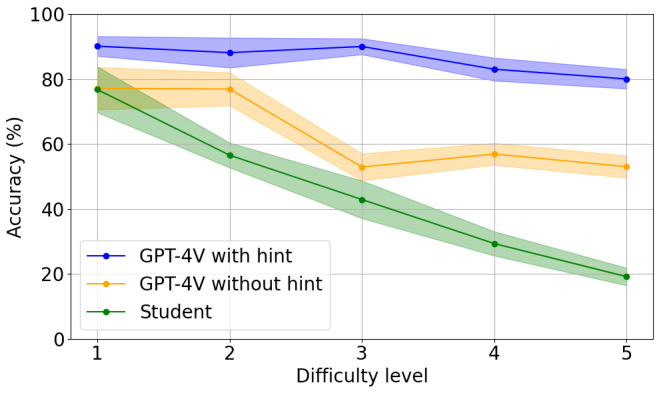
Results: For questions with images, GPT-4V achieved an accuracy of 84.2%, 85.7%, 88.9%, and 73.1% in Step 1, Step 2 clinical knowledge, Step 3 of USMLE, and DRQCE, respectively. It outperformed GPT-3.5 Turbo (42.1%, 50%, 50%, 19.2%) and GPT-4 (63.2%, 64.3%, 66.7%, 26.9%). When GPT-4V answered correctly, its explanations were nearly as good as those provided by domain experts from AMBOSS. However, incorrect answers often had poor explanation quality: 18.2% (10/55) contained inaccurate text, 45.5% (25/55) had inference errors, and 76.3% (42/55) demonstrated image misunderstandings. With human expert assistance, GPT-4V reduced errors by an average of 40% (22/55). GPT-4V accuracy improved with hints, maintaining stable performance across difficulty levels, while medical student performance declined as difficulty increased. In a simulated curbside consultation scenario, GPT-4V required multiple specific prompts to interpret complex case data accurately.
Conclusions: GPT-4V achieved high accuracy on multiple-choice questions with images, highlighting its potential in medical assessments. However, significant shortcomings were observed in the quality of explanations when questions were answered incorrectly, particularly in the interpretation of images, which could not be efficiently resolved through expert interaction. These findings reveal hidden flaws in the image interpretation capabilities of GPT-4V, underscoring the need for more comprehensive evaluations beyond multiple-choice questions before integrating GPT-4V into clinical settings.
期刊介绍:
The Journal of Medical Internet Research (JMIR) is a highly respected publication in the field of health informatics and health services. With a founding date in 1999, JMIR has been a pioneer in the field for over two decades.
As a leader in the industry, the journal focuses on digital health, data science, health informatics, and emerging technologies for health, medicine, and biomedical research. It is recognized as a top publication in these disciplines, ranking in the first quartile (Q1) by Impact Factor.
Notably, JMIR holds the prestigious position of being ranked #1 on Google Scholar within the "Medical Informatics" discipline.





 京公网安备 11010802042870号
京ICP备2023020795号-1
京公网安备 11010802042870号
京ICP备2023020795号-1

 分享
分享

 求助内容:
求助内容: 应助结果提醒方式:
 扫码关注我们
