Bryan Abadie, Yasmine Elghoul, Sakthi Surya Prakash, Besir Besir, Khaled Ziada, Miriam Jacob, Sanjeeb Bhattacharya, Pavan Bhat, Randall C Starling, W H Wilson Tang, Wael Jaber
{"title":"无同种异体心外膜血管病变心脏移植术后冠状动脉微血管功能障碍的正电子发射断层扫描及预后。","authors":"Bryan Abadie, Yasmine Elghoul, Sakthi Surya Prakash, Besir Besir, Khaled Ziada, Miriam Jacob, Sanjeeb Bhattacharya, Pavan Bhat, Randall C Starling, W H Wilson Tang, Wael Jaber","doi":"10.1093/ehjci/jeaf042","DOIUrl":null,"url":null,"abstract":"<p><strong>Aims: </strong>Cardiac allograft vasculopathy (CAV) affects both epicardial and microvascular coronary arteries, however, few studies have characterized microvascular dysfunction in this population. Several prior studies have shown that positron emission tomography/computed tomography (PET/CT) can be used to screen for epicardial CAV, however, the clinical implications of abnormal blood flow in the absence of epicardial CAV are unknown. Our study sought to assess the prognostic implications of microvascular dysfunction and its subtypes, endogen/functional and classical/structural, using PET/CT in cardiac transplant patients without epicardial CAV.</p><p><strong>Methods and results: </strong>Transplant patients with no prior history of CAV and normal myocardial perfusion imaging were included. Patients were then classified by the presence of coronary microvascular dysfunction (CMD) (myocardial flow reserve < 2.0); patients with CMD were further subcategorized into endogen/functional (stress myocardial blood flow ≥ 1.7 mL/min/g) and classical/structural (stress myocardial blood flow < 1.7 mL/min/g). The primary outcomes were all-cause mortality and a composite of all-cause mortality, heart failure hospitalization, acute coronary syndrome, revascularization, and re-transplantation. Three hundred fifty-six patients met the inclusion criteria. CMD was present in 141 (39.6%) patients, of which 112 (31.4%) had endogen/functional CMD and 29 (8.1%) had classical/structural CMD. After multivariable adjustment, endogen/functional CMD was associated with a higher rate of the composite outcome (HR 2.39, 95% CI 1.32-4.29, P = 0.004) and all-cause mortality (HR 2.98, 95% CI 1.34-6.64, P = 0.008). Classical/structural CMD was not associated with the primary composite outcome (HR 0.92, 95% CI 0.27-3.17, P = 0.893) or all-cause mortality (HR 1.22, 95% CI 0.263-5.69, P = 0.797).</p><p><strong>Conclusion: </strong>In cardiac transplant patients with no history of CAV and normal myocardial perfusion, an endogen/functional pattern of CMD is associated with higher rate of adverse events and death. This association was not present in patients with a classical/structural CMD pattern. Incorporating endogen/microvascular dysfunction assessment in PET/CT reporting may identify a higher-risk group hereto now considered low risk.</p>","PeriodicalId":12026,"journal":{"name":"European Heart Journal - Cardiovascular Imaging","volume":" ","pages":"957-965"},"PeriodicalIF":6.1000,"publicationDate":"2025-05-30","publicationTypes":"Journal Article","fieldsOfStudy":null,"isOpenAccess":false,"openAccessPdf":"","citationCount":"0","resultStr":"{\"title\":\"Coronary microvascular dysfunction by positron emission tomography and outcomes in patients after cardiac transplantation.\",\"authors\":\"Bryan Abadie, Yasmine Elghoul, Sakthi Surya Prakash, Besir Besir, Khaled Ziada, Miriam Jacob, Sanjeeb Bhattacharya, Pavan Bhat, Randall C Starling, W H Wilson Tang, Wael Jaber\",\"doi\":\"10.1093/ehjci/jeaf042\",\"DOIUrl\":null,\"url\":null,\"abstract\":\"<p><strong>Aims: </strong>Cardiac allograft vasculopathy (CAV) affects both epicardial and microvascular coronary arteries, however, few studies have characterized microvascular dysfunction in this population. Several prior studies have shown that positron emission tomography/computed tomography (PET/CT) can be used to screen for epicardial CAV, however, the clinical implications of abnormal blood flow in the absence of epicardial CAV are unknown. Our study sought to assess the prognostic implications of microvascular dysfunction and its subtypes, endogen/functional and classical/structural, using PET/CT in cardiac transplant patients without epicardial CAV.</p><p><strong>Methods and results: </strong>Transplant patients with no prior history of CAV and normal myocardial perfusion imaging were included. Patients were then classified by the presence of coronary microvascular dysfunction (CMD) (myocardial flow reserve < 2.0); patients with CMD were further subcategorized into endogen/functional (stress myocardial blood flow ≥ 1.7 mL/min/g) and classical/structural (stress myocardial blood flow < 1.7 mL/min/g). The primary outcomes were all-cause mortality and a composite of all-cause mortality, heart failure hospitalization, acute coronary syndrome, revascularization, and re-transplantation. Three hundred fifty-six patients met the inclusion criteria. CMD was present in 141 (39.6%) patients, of which 112 (31.4%) had endogen/functional CMD and 29 (8.1%) had classical/structural CMD. After multivariable adjustment, endogen/functional CMD was associated with a higher rate of the composite outcome (HR 2.39, 95% CI 1.32-4.29, P = 0.004) and all-cause mortality (HR 2.98, 95% CI 1.34-6.64, P = 0.008). Classical/structural CMD was not associated with the primary composite outcome (HR 0.92, 95% CI 0.27-3.17, P = 0.893) or all-cause mortality (HR 1.22, 95% CI 0.263-5.69, P = 0.797).</p><p><strong>Conclusion: </strong>In cardiac transplant patients with no history of CAV and normal myocardial perfusion, an endogen/functional pattern of CMD is associated with higher rate of adverse events and death. This association was not present in patients with a classical/structural CMD pattern. Incorporating endogen/microvascular dysfunction assessment in PET/CT reporting may identify a higher-risk group hereto now considered low risk.</p>\",\"PeriodicalId\":12026,\"journal\":{\"name\":\"European Heart Journal - Cardiovascular Imaging\",\"volume\":\" \",\"pages\":\"957-965\"},\"PeriodicalIF\":6.1000,\"publicationDate\":\"2025-05-30\",\"publicationTypes\":\"Journal Article\",\"fieldsOfStudy\":null,\"isOpenAccess\":false,\"openAccessPdf\":\"\",\"citationCount\":\"0\",\"resultStr\":null,\"platform\":\"Semanticscholar\",\"paperid\":null,\"PeriodicalName\":\"European Heart Journal - Cardiovascular Imaging\",\"FirstCategoryId\":\"3\",\"ListUrlMain\":\"https://doi.org/10.1093/ehjci/jeaf042\",\"RegionNum\":1,\"RegionCategory\":\"医学\",\"ArticlePicture\":[],\"TitleCN\":null,\"AbstractTextCN\":null,\"PMCID\":null,\"EPubDate\":\"\",\"PubModel\":\"\",\"JCR\":\"Q1\",\"JCRName\":\"CARDIAC & CARDIOVASCULAR SYSTEMS\",\"Score\":null,\"Total\":0}","platform":"Semanticscholar","paperid":null,"PeriodicalName":"European Heart Journal - Cardiovascular Imaging","FirstCategoryId":"3","ListUrlMain":"https://doi.org/10.1093/ehjci/jeaf042","RegionNum":1,"RegionCategory":"医学","ArticlePicture":[],"TitleCN":null,"AbstractTextCN":null,"PMCID":null,"EPubDate":"","PubModel":"","JCR":"Q1","JCRName":"CARDIAC & CARDIOVASCULAR SYSTEMS","Score":null,"Total":0}
引用次数: 0
摘要
背景:同种异体心脏移植血管病变(CAV)影响心外膜和微血管冠状动脉,但很少有研究表明这一人群的微血管功能障碍。先前的几项研究表明,正电子发射断层扫描/计算机断层扫描(PET/CT)可用于筛查心外膜CAV,但心外膜CAV缺失时血流量异常的临床意义尚不清楚。目的:本研究旨在通过PET/CT评估无心外膜CAV的心脏移植患者微血管功能障碍及其亚型(内源性/功能性和经典/结构性)的预后意义。方法:纳入无CAV病史、心肌灌注成像正常的移植患者。然后根据有无微血管功能障碍(CMD) (MFR)对患者进行分类。结果:356例患者符合纳入标准。141例(39.6%)患者存在CMD,其中112例(31.4%)为内源性/功能性CMD, 29例(8.1%)为经典/结构性CMD。多变量调整后,内源/功能性CMD与较高的复合结局率(HR 2.39, 95%CI 1.32-4.29, p = 0.004)和全因死亡率(HR 2.98, 95%CI 1.34-6.64, p = 0.008)相关。经典/结构性CMD与主要综合结局(HR 0.92, 95%CI 0.27-3.17, p = 0.893)或全因死亡率(HR 1.22, 95%CI 0.263-5.69, p = 0.797)无关。结论:在无CAV病史且心肌灌注正常的心脏移植患者中,CMD的内源性/功能性模式与较高的不良事件发生率和死亡率相关。这种关联在典型/结构性CMD模式的患者中不存在。在PET/CT报告中纳入内源性/微血管功能障碍评估可能会识别出目前被认为是低风险的高风险人群。
Coronary microvascular dysfunction by positron emission tomography and outcomes in patients after cardiac transplantation.
Aims: Cardiac allograft vasculopathy (CAV) affects both epicardial and microvascular coronary arteries, however, few studies have characterized microvascular dysfunction in this population. Several prior studies have shown that positron emission tomography/computed tomography (PET/CT) can be used to screen for epicardial CAV, however, the clinical implications of abnormal blood flow in the absence of epicardial CAV are unknown. Our study sought to assess the prognostic implications of microvascular dysfunction and its subtypes, endogen/functional and classical/structural, using PET/CT in cardiac transplant patients without epicardial CAV.
Methods and results: Transplant patients with no prior history of CAV and normal myocardial perfusion imaging were included. Patients were then classified by the presence of coronary microvascular dysfunction (CMD) (myocardial flow reserve < 2.0); patients with CMD were further subcategorized into endogen/functional (stress myocardial blood flow ≥ 1.7 mL/min/g) and classical/structural (stress myocardial blood flow < 1.7 mL/min/g). The primary outcomes were all-cause mortality and a composite of all-cause mortality, heart failure hospitalization, acute coronary syndrome, revascularization, and re-transplantation. Three hundred fifty-six patients met the inclusion criteria. CMD was present in 141 (39.6%) patients, of which 112 (31.4%) had endogen/functional CMD and 29 (8.1%) had classical/structural CMD. After multivariable adjustment, endogen/functional CMD was associated with a higher rate of the composite outcome (HR 2.39, 95% CI 1.32-4.29, P = 0.004) and all-cause mortality (HR 2.98, 95% CI 1.34-6.64, P = 0.008). Classical/structural CMD was not associated with the primary composite outcome (HR 0.92, 95% CI 0.27-3.17, P = 0.893) or all-cause mortality (HR 1.22, 95% CI 0.263-5.69, P = 0.797).
Conclusion: In cardiac transplant patients with no history of CAV and normal myocardial perfusion, an endogen/functional pattern of CMD is associated with higher rate of adverse events and death. This association was not present in patients with a classical/structural CMD pattern. Incorporating endogen/microvascular dysfunction assessment in PET/CT reporting may identify a higher-risk group hereto now considered low risk.
期刊介绍:
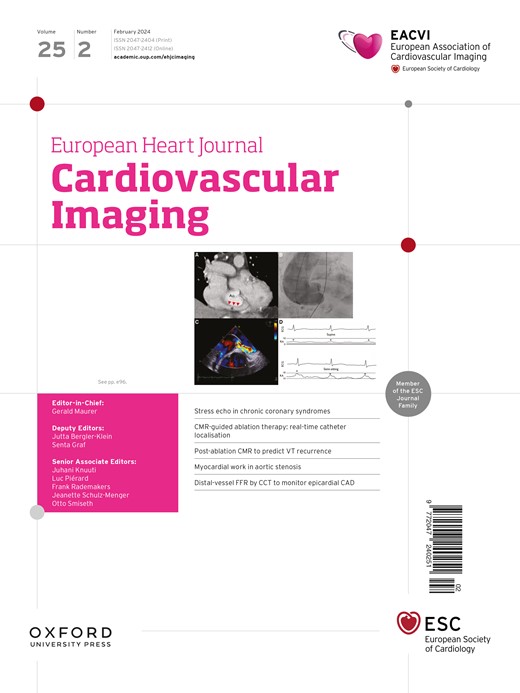
European Heart Journal – Cardiovascular Imaging is a monthly international peer reviewed journal dealing with Cardiovascular Imaging. It is an official publication of the European Association of Cardiovascular Imaging, a branch of the European Society of Cardiology.
The journal aims to publish the highest quality material, both scientific and clinical from all areas of cardiovascular imaging including echocardiography, magnetic resonance, computed tomography, nuclear and invasive imaging. A range of article types will be considered, including original research, reviews, editorials, image focus, letters and recommendation papers from relevant groups of the European Society of Cardiology. In addition it provides a forum for the exchange of information on all aspects of cardiovascular imaging.




 京公网安备 11010802042870号
京ICP备2023020795号-1
京公网安备 11010802042870号
京ICP备2023020795号-1

 分享
分享
 求助内容:
求助内容: 应助结果提醒方式:
 扫码关注我们
