Franziska Lieschke, Maximilian Rauch, Bastian Roller, Jan Hendrik Schaefer, Martin A Schaller-Paule
{"title":"基底动脉顶部综合征患者的症状、影像学特征、治疗决定和预后:来自综合卒中中心的经验","authors":"Franziska Lieschke, Maximilian Rauch, Bastian Roller, Jan Hendrik Schaefer, Martin A Schaller-Paule","doi":"10.1007/s12028-025-02219-y","DOIUrl":null,"url":null,"abstract":"<p><strong>Background: </strong>From visual, ocular, and pupillomotor abnormalities to qualitative and more importantly rapid quantitative disturbances of consciousness, top of the basilar artery syndrome (TOBS) represents a diagnostic challenge in neurocritical care. In this monocentric retrospective cross-sectional study, we will describe this particular patient group in detail and highlight its variability and the associated implications.</p><p><strong>Methods: </strong>Consecutive patients with radiologically confirmed TOBS presenting to our comprehensive stroke center were analyzed from 2010 to 2022. Baseline parameters at admission, including clinical symptoms, National Institutes of Health Stroke Scale (NIHSS) score, Glasgow Coma Scale (GCS) score, and imaging parameters (mode and success of recanalization measured by the Thrombolysis in Cerebral Infarction [TICI] score, extent of infarct, and infarct localization), were assessed. Functional dependence at discharge was analyzed with the modified Rankin scale (mRS) and Barthel Index.</p><p><strong>Results: </strong>We assessed 96 eligible patients with a mean age of 70 (SD ± 14) years, 41.67% of whom were female. The median NIHSS score at admission was 19 (interquartile range [IQR] 8-35), and the median GCS score was 7 (IQR 3-15). Dysphagia was identified in 51.72% of patients, with a significant number discharged with nasogastric tubes. Most patients received both intravenous thrombolysis (IVT) and mechanical thrombectomy (MT) (47%), whereas 32% received MT only, and 10% received no acute recanalizing therapy. Patients receiving both IVT and MT had higher frequencies of successful vessel revascularization (higher TICI scores) and better clinical outcomes compared to those receiving only MT (median mRS score 4 [IQR 2-5] vs. 5 [IQR 2-6], p = 0.046). Multivariable regression analysis confirmed that successful recanalization (TICI) and GCS score at admission were key predictors of functional outcomes.</p><p><strong>Conclusions: </strong>A large proportion of patients presenting with TOBS were severely affected by a significant reduction in vigilance, a condition that persists in the absence of recanalization and is then associated with a relevant dependency.</p>","PeriodicalId":19118,"journal":{"name":"Neurocritical Care","volume":" ","pages":"69-79"},"PeriodicalIF":4.2000,"publicationDate":"2025-08-01","publicationTypes":"Journal Article","fieldsOfStudy":null,"isOpenAccess":false,"openAccessPdf":"https://www.ncbi.nlm.nih.gov/pmc/articles/PMC12321678/pdf/","citationCount":"0","resultStr":"{\"title\":\"Symptoms, Imaging Features, Treatment Decisions, and Outcomes of Patients with Top of the Basilar Artery Syndrome: Experiences from a Comprehensive Stroke Center.\",\"authors\":\"Franziska Lieschke, Maximilian Rauch, Bastian Roller, Jan Hendrik Schaefer, Martin A Schaller-Paule\",\"doi\":\"10.1007/s12028-025-02219-y\",\"DOIUrl\":null,\"url\":null,\"abstract\":\"<p><strong>Background: </strong>From visual, ocular, and pupillomotor abnormalities to qualitative and more importantly rapid quantitative disturbances of consciousness, top of the basilar artery syndrome (TOBS) represents a diagnostic challenge in neurocritical care. In this monocentric retrospective cross-sectional study, we will describe this particular patient group in detail and highlight its variability and the associated implications.</p><p><strong>Methods: </strong>Consecutive patients with radiologically confirmed TOBS presenting to our comprehensive stroke center were analyzed from 2010 to 2022. Baseline parameters at admission, including clinical symptoms, National Institutes of Health Stroke Scale (NIHSS) score, Glasgow Coma Scale (GCS) score, and imaging parameters (mode and success of recanalization measured by the Thrombolysis in Cerebral Infarction [TICI] score, extent of infarct, and infarct localization), were assessed. Functional dependence at discharge was analyzed with the modified Rankin scale (mRS) and Barthel Index.</p><p><strong>Results: </strong>We assessed 96 eligible patients with a mean age of 70 (SD ± 14) years, 41.67% of whom were female. The median NIHSS score at admission was 19 (interquartile range [IQR] 8-35), and the median GCS score was 7 (IQR 3-15). Dysphagia was identified in 51.72% of patients, with a significant number discharged with nasogastric tubes. Most patients received both intravenous thrombolysis (IVT) and mechanical thrombectomy (MT) (47%), whereas 32% received MT only, and 10% received no acute recanalizing therapy. Patients receiving both IVT and MT had higher frequencies of successful vessel revascularization (higher TICI scores) and better clinical outcomes compared to those receiving only MT (median mRS score 4 [IQR 2-5] vs. 5 [IQR 2-6], p = 0.046). Multivariable regression analysis confirmed that successful recanalization (TICI) and GCS score at admission were key predictors of functional outcomes.</p><p><strong>Conclusions: </strong>A large proportion of patients presenting with TOBS were severely affected by a significant reduction in vigilance, a condition that persists in the absence of recanalization and is then associated with a relevant dependency.</p>\",\"PeriodicalId\":19118,\"journal\":{\"name\":\"Neurocritical Care\",\"volume\":\" \",\"pages\":\"69-79\"},\"PeriodicalIF\":4.2000,\"publicationDate\":\"2025-08-01\",\"publicationTypes\":\"Journal Article\",\"fieldsOfStudy\":null,\"isOpenAccess\":false,\"openAccessPdf\":\"https://www.ncbi.nlm.nih.gov/pmc/articles/PMC12321678/pdf/\",\"citationCount\":\"0\",\"resultStr\":null,\"platform\":\"Semanticscholar\",\"paperid\":null,\"PeriodicalName\":\"Neurocritical Care\",\"FirstCategoryId\":\"3\",\"ListUrlMain\":\"https://doi.org/10.1007/s12028-025-02219-y\",\"RegionNum\":3,\"RegionCategory\":\"医学\",\"ArticlePicture\":[],\"TitleCN\":null,\"AbstractTextCN\":null,\"PMCID\":null,\"EPubDate\":\"2025/2/7 0:00:00\",\"PubModel\":\"Epub\",\"JCR\":\"Q2\",\"JCRName\":\"CLINICAL NEUROLOGY\",\"Score\":null,\"Total\":0}","platform":"Semanticscholar","paperid":null,"PeriodicalName":"Neurocritical Care","FirstCategoryId":"3","ListUrlMain":"https://doi.org/10.1007/s12028-025-02219-y","RegionNum":3,"RegionCategory":"医学","ArticlePicture":[],"TitleCN":null,"AbstractTextCN":null,"PMCID":null,"EPubDate":"2025/2/7 0:00:00","PubModel":"Epub","JCR":"Q2","JCRName":"CLINICAL NEUROLOGY","Score":null,"Total":0}
Symptoms, Imaging Features, Treatment Decisions, and Outcomes of Patients with Top of the Basilar Artery Syndrome: Experiences from a Comprehensive Stroke Center.
Background: From visual, ocular, and pupillomotor abnormalities to qualitative and more importantly rapid quantitative disturbances of consciousness, top of the basilar artery syndrome (TOBS) represents a diagnostic challenge in neurocritical care. In this monocentric retrospective cross-sectional study, we will describe this particular patient group in detail and highlight its variability and the associated implications.
Methods: Consecutive patients with radiologically confirmed TOBS presenting to our comprehensive stroke center were analyzed from 2010 to 2022. Baseline parameters at admission, including clinical symptoms, National Institutes of Health Stroke Scale (NIHSS) score, Glasgow Coma Scale (GCS) score, and imaging parameters (mode and success of recanalization measured by the Thrombolysis in Cerebral Infarction [TICI] score, extent of infarct, and infarct localization), were assessed. Functional dependence at discharge was analyzed with the modified Rankin scale (mRS) and Barthel Index.
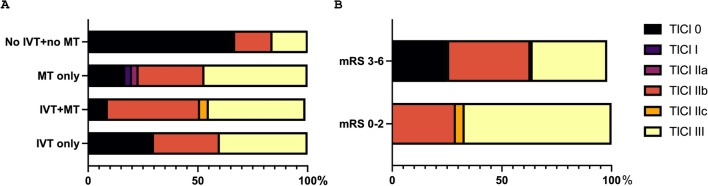
Results: We assessed 96 eligible patients with a mean age of 70 (SD ± 14) years, 41.67% of whom were female. The median NIHSS score at admission was 19 (interquartile range [IQR] 8-35), and the median GCS score was 7 (IQR 3-15). Dysphagia was identified in 51.72% of patients, with a significant number discharged with nasogastric tubes. Most patients received both intravenous thrombolysis (IVT) and mechanical thrombectomy (MT) (47%), whereas 32% received MT only, and 10% received no acute recanalizing therapy. Patients receiving both IVT and MT had higher frequencies of successful vessel revascularization (higher TICI scores) and better clinical outcomes compared to those receiving only MT (median mRS score 4 [IQR 2-5] vs. 5 [IQR 2-6], p = 0.046). Multivariable regression analysis confirmed that successful recanalization (TICI) and GCS score at admission were key predictors of functional outcomes.
Conclusions: A large proportion of patients presenting with TOBS were severely affected by a significant reduction in vigilance, a condition that persists in the absence of recanalization and is then associated with a relevant dependency.
期刊介绍:
Neurocritical Care is a peer reviewed scientific publication whose major goal is to disseminate new knowledge on all aspects of acute neurological care. It is directed towards neurosurgeons, neuro-intensivists, neurologists, anesthesiologists, emergency physicians, and critical care nurses treating patients with urgent neurologic disorders. These are conditions that may potentially evolve rapidly and could need immediate medical or surgical intervention. Neurocritical Care provides a comprehensive overview of current developments in intensive care neurology, neurosurgery and neuroanesthesia and includes information about new therapeutic avenues and technological innovations. Neurocritical Care is the official journal of the Neurocritical Care Society.






 京公网安备 11010802042870号
京ICP备2023020795号-1
京公网安备 11010802042870号
京ICP备2023020795号-1

 分享
分享
 求助内容:
求助内容: 应助结果提醒方式:
 扫码关注我们
