Deborah Pérez-Almada, Ángel Galán-Martín, María del Mar Contreras, Juan Miguel Romero-García, Eulogio Castro
{"title":"揭示从废弃橄榄渣中提取多产品生物炼制的技术、经济和环境影响","authors":"Deborah Pérez-Almada, Ángel Galán-Martín, María del Mar Contreras, Juan Miguel Romero-García, Eulogio Castro","doi":"10.1021/acssuschemeng.4c07901","DOIUrl":null,"url":null,"abstract":"Biorefineries are pivotal in advancing sustainability, yet most studies remain confined to laboratory scales, lacking comprehensive industrial-level analyses. In this work, the laboratory experiments are scaled up to design and assess the techno-economic and environmental implications of a multiproduct biorefinery system producing antioxidant extracts, lignin, and bioethanol from exhausted olive pomace, a residual biomass from olive oil extraction. Using process simulation and life cycle assessment, five scenarios were evaluated, varying in electricity sources (national mix, solar, wind, or olive biomass) and the heat and cooling sources (fossil natural gas or synthetic natural gas from capture CO<sub>2</sub> and electrolytic hydrogen), with one scenario incorporating a carbon capture and storage (CCS) system. The CCS scenario showed the highest overall costs, 2.5 times higher than the base scenario (27.74 vs 10.99 $/functional unit), primarily due to the additional infrastructure and energy-intensive processes associated with CO<sub>2</sub> utilization and storage. Despite higher costs, it achieved even a negative carbon footprint (−1.05 kg CO<sub>2</sub>eq per functional unit cradle-to-gate) and reduced impacts on ecosystem quality, resources, and human health. However, specific impacts like human noncarcinogenic and carcinogenic effects (40% and 60%) and ecotoxicity (up 70%) worsened. Notwithstanding economic barriers and environmental challenges, which can be alleviated by selling carbon credits and tailored policies and strategic decisions, these findings underscore the potential of integrating CCS into biorefinery schemes as a promising pathway to enhance environmental sustainability.","PeriodicalId":25,"journal":{"name":"ACS Sustainable Chemistry & Engineering","volume":"79 4 1","pages":""},"PeriodicalIF":7.3000,"publicationDate":"2025-02-09","publicationTypes":"Journal Article","fieldsOfStudy":null,"isOpenAccess":false,"openAccessPdf":"","citationCount":"0","resultStr":"{\"title\":\"Uncovering the Techno-Economic and Environmental Implications of a Multiproduct Biorefinery from Exhausted Olive Pomace\",\"authors\":\"Deborah Pérez-Almada, Ángel Galán-Martín, María del Mar Contreras, Juan Miguel Romero-García, Eulogio Castro\",\"doi\":\"10.1021/acssuschemeng.4c07901\",\"DOIUrl\":null,\"url\":null,\"abstract\":\"Biorefineries are pivotal in advancing sustainability, yet most studies remain confined to laboratory scales, lacking comprehensive industrial-level analyses. In this work, the laboratory experiments are scaled up to design and assess the techno-economic and environmental implications of a multiproduct biorefinery system producing antioxidant extracts, lignin, and bioethanol from exhausted olive pomace, a residual biomass from olive oil extraction. Using process simulation and life cycle assessment, five scenarios were evaluated, varying in electricity sources (national mix, solar, wind, or olive biomass) and the heat and cooling sources (fossil natural gas or synthetic natural gas from capture CO<sub>2</sub> and electrolytic hydrogen), with one scenario incorporating a carbon capture and storage (CCS) system. The CCS scenario showed the highest overall costs, 2.5 times higher than the base scenario (27.74 vs 10.99 $/functional unit), primarily due to the additional infrastructure and energy-intensive processes associated with CO<sub>2</sub> utilization and storage. Despite higher costs, it achieved even a negative carbon footprint (−1.05 kg CO<sub>2</sub>eq per functional unit cradle-to-gate) and reduced impacts on ecosystem quality, resources, and human health. However, specific impacts like human noncarcinogenic and carcinogenic effects (40% and 60%) and ecotoxicity (up 70%) worsened. Notwithstanding economic barriers and environmental challenges, which can be alleviated by selling carbon credits and tailored policies and strategic decisions, these findings underscore the potential of integrating CCS into biorefinery schemes as a promising pathway to enhance environmental sustainability.\",\"PeriodicalId\":25,\"journal\":{\"name\":\"ACS Sustainable Chemistry & Engineering\",\"volume\":\"79 4 1\",\"pages\":\"\"},\"PeriodicalIF\":7.3000,\"publicationDate\":\"2025-02-09\",\"publicationTypes\":\"Journal Article\",\"fieldsOfStudy\":null,\"isOpenAccess\":false,\"openAccessPdf\":\"\",\"citationCount\":\"0\",\"resultStr\":null,\"platform\":\"Semanticscholar\",\"paperid\":null,\"PeriodicalName\":\"ACS Sustainable Chemistry & Engineering\",\"FirstCategoryId\":\"92\",\"ListUrlMain\":\"https://doi.org/10.1021/acssuschemeng.4c07901\",\"RegionNum\":1,\"RegionCategory\":\"化学\",\"ArticlePicture\":[],\"TitleCN\":null,\"AbstractTextCN\":null,\"PMCID\":null,\"EPubDate\":\"\",\"PubModel\":\"\",\"JCR\":\"Q1\",\"JCRName\":\"CHEMISTRY, MULTIDISCIPLINARY\",\"Score\":null,\"Total\":0}","platform":"Semanticscholar","paperid":null,"PeriodicalName":"ACS Sustainable Chemistry & Engineering","FirstCategoryId":"92","ListUrlMain":"https://doi.org/10.1021/acssuschemeng.4c07901","RegionNum":1,"RegionCategory":"化学","ArticlePicture":[],"TitleCN":null,"AbstractTextCN":null,"PMCID":null,"EPubDate":"","PubModel":"","JCR":"Q1","JCRName":"CHEMISTRY, MULTIDISCIPLINARY","Score":null,"Total":0}
Uncovering the Techno-Economic and Environmental Implications of a Multiproduct Biorefinery from Exhausted Olive Pomace
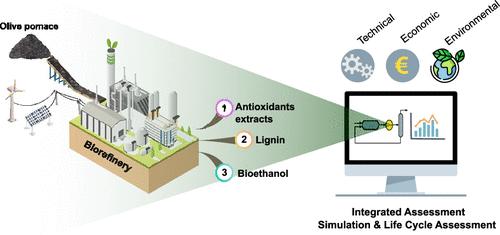
Biorefineries are pivotal in advancing sustainability, yet most studies remain confined to laboratory scales, lacking comprehensive industrial-level analyses. In this work, the laboratory experiments are scaled up to design and assess the techno-economic and environmental implications of a multiproduct biorefinery system producing antioxidant extracts, lignin, and bioethanol from exhausted olive pomace, a residual biomass from olive oil extraction. Using process simulation and life cycle assessment, five scenarios were evaluated, varying in electricity sources (national mix, solar, wind, or olive biomass) and the heat and cooling sources (fossil natural gas or synthetic natural gas from capture CO2 and electrolytic hydrogen), with one scenario incorporating a carbon capture and storage (CCS) system. The CCS scenario showed the highest overall costs, 2.5 times higher than the base scenario (27.74 vs 10.99 $/functional unit), primarily due to the additional infrastructure and energy-intensive processes associated with CO2 utilization and storage. Despite higher costs, it achieved even a negative carbon footprint (−1.05 kg CO2eq per functional unit cradle-to-gate) and reduced impacts on ecosystem quality, resources, and human health. However, specific impacts like human noncarcinogenic and carcinogenic effects (40% and 60%) and ecotoxicity (up 70%) worsened. Notwithstanding economic barriers and environmental challenges, which can be alleviated by selling carbon credits and tailored policies and strategic decisions, these findings underscore the potential of integrating CCS into biorefinery schemes as a promising pathway to enhance environmental sustainability.
期刊介绍:
ACS Sustainable Chemistry & Engineering is a prestigious weekly peer-reviewed scientific journal published by the American Chemical Society. Dedicated to advancing the principles of green chemistry and green engineering, it covers a wide array of research topics including green chemistry, green engineering, biomass, alternative energy, and life cycle assessment.
The journal welcomes submissions in various formats, including Letters, Articles, Features, and Perspectives (Reviews), that address the challenges of sustainability in the chemical enterprise and contribute to the advancement of sustainable practices. Join us in shaping the future of sustainable chemistry and engineering.




 京公网安备 11010802042870号
京ICP备2023020795号-1
京公网安备 11010802042870号
京ICP备2023020795号-1

 分享
分享
 求助内容:
求助内容: 应助结果提醒方式:
 扫码关注我们
