Yiwei Liu , Takahiro Mori , Yusei Ito , Kimiko Kuroki , Seiichiro Hayashi , Daisuke Kohda , Taro Shimizu , Tatsuhiro Ishida , Steve R. Roffler , Mika K. Kaneko , Yukinari Kato , Takao Arimori , Takamasa Teramoto , Kazuhiro Takemura , Kenta Ishibashi , Yoshiki Katayama , Katsumi Maenaka , Yoshimitsu Kakuta , Akio Kitao , Takeshi Mori
{"title":"naïve抗PEG抗体用于捕获柔性和无特征的PEG链的策略。","authors":"Yiwei Liu , Takahiro Mori , Yusei Ito , Kimiko Kuroki , Seiichiro Hayashi , Daisuke Kohda , Taro Shimizu , Tatsuhiro Ishida , Steve R. Roffler , Mika K. Kaneko , Yukinari Kato , Takao Arimori , Takamasa Teramoto , Kazuhiro Takemura , Kenta Ishibashi , Yoshiki Katayama , Katsumi Maenaka , Yoshimitsu Kakuta , Akio Kitao , Takeshi Mori","doi":"10.1016/j.jconrel.2025.02.001","DOIUrl":null,"url":null,"abstract":"<div><div>Polyethylene glycol (PEG) is widely used as a standard stealth polymer, although the induction of anti-PEG antibodies and consequent effects have drawn attention in recent years. To date, several anti-PEG antibodies induced by PEG-modified proteins via the T cell-dependent (TD) pathway, in which affinity maturation occurs, have been reported. In contrast, structures of the naïve anti-PEG antibodies before affinity maturation have not been described in the literature. Here, to understand the details of the naïve anti-PEG antibodies capturing PEG, we studied a naïve anti-PEG antibody induced by a PEG-modified liposome in the absence of affinity maturation via the T cell-independent (TI) pathway. The mutation levels, structures as well as in vitro and in silico binding properties of TI and TD anti-PEG antibodies were compared. The TI anti-PEG antibody showed no mutation and a low binding affinity toward PEG, meanwhile, it allowed PEG chain sliding and weak interaction with the terminal group. Furthermore, the naïve anti-PEG antibodies may obtain high affinities by forming tunnel structures via minimal mutations. This research provides new insights into polymer–antibody interactions, which can facilitate the development of novel stealth polymers that can avoid antibody induction.</div></div>","PeriodicalId":15450,"journal":{"name":"Journal of Controlled Release","volume":"380 ","pages":"Pages 396-403"},"PeriodicalIF":11.5000,"publicationDate":"2025-04-10","publicationTypes":"Journal Article","fieldsOfStudy":null,"isOpenAccess":false,"openAccessPdf":"","citationCount":"0","resultStr":"{\"title\":\"The strategy used by naïve anti-PEG antibodies to capture flexible and featureless PEG chains\",\"authors\":\"Yiwei Liu , Takahiro Mori , Yusei Ito , Kimiko Kuroki , Seiichiro Hayashi , Daisuke Kohda , Taro Shimizu , Tatsuhiro Ishida , Steve R. Roffler , Mika K. Kaneko , Yukinari Kato , Takao Arimori , Takamasa Teramoto , Kazuhiro Takemura , Kenta Ishibashi , Yoshiki Katayama , Katsumi Maenaka , Yoshimitsu Kakuta , Akio Kitao , Takeshi Mori\",\"doi\":\"10.1016/j.jconrel.2025.02.001\",\"DOIUrl\":null,\"url\":null,\"abstract\":\"<div><div>Polyethylene glycol (PEG) is widely used as a standard stealth polymer, although the induction of anti-PEG antibodies and consequent effects have drawn attention in recent years. To date, several anti-PEG antibodies induced by PEG-modified proteins via the T cell-dependent (TD) pathway, in which affinity maturation occurs, have been reported. In contrast, structures of the naïve anti-PEG antibodies before affinity maturation have not been described in the literature. Here, to understand the details of the naïve anti-PEG antibodies capturing PEG, we studied a naïve anti-PEG antibody induced by a PEG-modified liposome in the absence of affinity maturation via the T cell-independent (TI) pathway. The mutation levels, structures as well as in vitro and in silico binding properties of TI and TD anti-PEG antibodies were compared. The TI anti-PEG antibody showed no mutation and a low binding affinity toward PEG, meanwhile, it allowed PEG chain sliding and weak interaction with the terminal group. Furthermore, the naïve anti-PEG antibodies may obtain high affinities by forming tunnel structures via minimal mutations. This research provides new insights into polymer–antibody interactions, which can facilitate the development of novel stealth polymers that can avoid antibody induction.</div></div>\",\"PeriodicalId\":15450,\"journal\":{\"name\":\"Journal of Controlled Release\",\"volume\":\"380 \",\"pages\":\"Pages 396-403\"},\"PeriodicalIF\":11.5000,\"publicationDate\":\"2025-04-10\",\"publicationTypes\":\"Journal Article\",\"fieldsOfStudy\":null,\"isOpenAccess\":false,\"openAccessPdf\":\"\",\"citationCount\":\"0\",\"resultStr\":null,\"platform\":\"Semanticscholar\",\"paperid\":null,\"PeriodicalName\":\"Journal of Controlled Release\",\"FirstCategoryId\":\"3\",\"ListUrlMain\":\"https://www.sciencedirect.com/science/article/pii/S0168365925001063\",\"RegionNum\":1,\"RegionCategory\":\"医学\",\"ArticlePicture\":[],\"TitleCN\":null,\"AbstractTextCN\":null,\"PMCID\":null,\"EPubDate\":\"2025/2/10 0:00:00\",\"PubModel\":\"Epub\",\"JCR\":\"Q1\",\"JCRName\":\"CHEMISTRY, MULTIDISCIPLINARY\",\"Score\":null,\"Total\":0}","platform":"Semanticscholar","paperid":null,"PeriodicalName":"Journal of Controlled Release","FirstCategoryId":"3","ListUrlMain":"https://www.sciencedirect.com/science/article/pii/S0168365925001063","RegionNum":1,"RegionCategory":"医学","ArticlePicture":[],"TitleCN":null,"AbstractTextCN":null,"PMCID":null,"EPubDate":"2025/2/10 0:00:00","PubModel":"Epub","JCR":"Q1","JCRName":"CHEMISTRY, MULTIDISCIPLINARY","Score":null,"Total":0}
The strategy used by naïve anti-PEG antibodies to capture flexible and featureless PEG chains
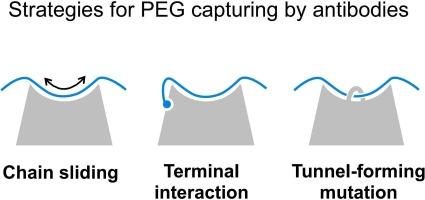
Polyethylene glycol (PEG) is widely used as a standard stealth polymer, although the induction of anti-PEG antibodies and consequent effects have drawn attention in recent years. To date, several anti-PEG antibodies induced by PEG-modified proteins via the T cell-dependent (TD) pathway, in which affinity maturation occurs, have been reported. In contrast, structures of the naïve anti-PEG antibodies before affinity maturation have not been described in the literature. Here, to understand the details of the naïve anti-PEG antibodies capturing PEG, we studied a naïve anti-PEG antibody induced by a PEG-modified liposome in the absence of affinity maturation via the T cell-independent (TI) pathway. The mutation levels, structures as well as in vitro and in silico binding properties of TI and TD anti-PEG antibodies were compared. The TI anti-PEG antibody showed no mutation and a low binding affinity toward PEG, meanwhile, it allowed PEG chain sliding and weak interaction with the terminal group. Furthermore, the naïve anti-PEG antibodies may obtain high affinities by forming tunnel structures via minimal mutations. This research provides new insights into polymer–antibody interactions, which can facilitate the development of novel stealth polymers that can avoid antibody induction.
期刊介绍:
The Journal of Controlled Release (JCR) proudly serves as the Official Journal of the Controlled Release Society and the Japan Society of Drug Delivery System.
Dedicated to the broad field of delivery science and technology, JCR publishes high-quality research articles covering drug delivery systems and all facets of formulations. This includes the physicochemical and biological properties of drugs, design and characterization of dosage forms, release mechanisms, in vivo testing, and formulation research and development across pharmaceutical, diagnostic, agricultural, environmental, cosmetic, and food industries.
Priority is given to manuscripts that contribute to the fundamental understanding of principles or demonstrate the advantages of novel technologies in terms of safety and efficacy over current clinical standards. JCR strives to be a leading platform for advancements in delivery science and technology.





 京公网安备 11010802042870号
京ICP备2023020795号-1
京公网安备 11010802042870号
京ICP备2023020795号-1

 分享
分享
 求助内容:
求助内容: 应助结果提醒方式:
 扫码关注我们
