{"title":"利用蛇床子提取物绿色合成氧化锌纳米颗粒:处方优化、表征及抗真菌活性。","authors":"Xinyue Zhang , Minxin Zhang , Huiling Han , Zhenzhen Chen , Aiwen Huang","doi":"10.1016/j.micpath.2024.107256","DOIUrl":null,"url":null,"abstract":"<div><div>Currently, the drugs employed to treat superficial fungal infections are encountering challenges, particularly the rise of drug resistance. Numerous studies have suggested that zinc oxide nanoparticles (ZnO NPs) show promise in the realm of antifungal treatment. Green synthesis makes the preparation of ZnO NPs more environmentally friendly and economical. In order to prepare antifungal active nanoparticles with low economic cost and stable performance, zinc oxide nanoparticles (CM-ZnONPs) were synthesized for the first time in this study using zinc sulfate heptahydrate (ZnSO<sub>4</sub>·7H<sub>2</sub>O) with a <em>Cnidium monnieri</em> (L.) Cuss. (<em>C</em>. <em>monnieri</em>) fruit extract as a reducing agent. In this study, the Box-Behnken design method was used to optimize the manufacturing process of CM-ZnONP. Various techniques, including UV–vis, Fourier Transform Infrared Spectroscopy (FTIR) and X-ray Powder Diffraction (XRD) were employed to demonstrate the successful preparation of CM-ZnONPs. The Transmission Electron Microscopy (TEM) analysis indicated that the size of CM-ZnONPs was 53.30 ± 12.89 nm. The dynamic light scattering (DLS) analysis showed the size of 157.7 ± 15.57 nm for CM-ZnONPs, along with an average polydispersity index (PDI) of 0.1791 ± 0.1394. The zone of inhibition of CM-ZnONPs against <em>Candida albicans</em> (<em>C. albicans</em>) was demonstrated to be 17.0 ± 0.8 mm by paper diffusion experiments. The minimum inhibitory concentration (MIC) of CM-ZnONPs against <em>C. albicans</em> was established at 58.59 μg/mL through the microdilution method. In summary, CM-ZnONPs exhibit excellent performance and antifungal activity in various properties. It is expected to be widely produced and used as an effective treatment for superficial fungal infections.</div></div>","PeriodicalId":18599,"journal":{"name":"Microbial pathogenesis","volume":"200 ","pages":"Article 107256"},"PeriodicalIF":3.5000,"publicationDate":"2025-03-01","publicationTypes":"Journal Article","fieldsOfStudy":null,"isOpenAccess":false,"openAccessPdf":"","citationCount":"0","resultStr":"{\"title\":\"Green synthesis of zinc oxide nanoparticles using Cnidium monnieri fruit extract: Prescription optimization, Characterization and antifungal activity\",\"authors\":\"Xinyue Zhang , Minxin Zhang , Huiling Han , Zhenzhen Chen , Aiwen Huang\",\"doi\":\"10.1016/j.micpath.2024.107256\",\"DOIUrl\":null,\"url\":null,\"abstract\":\"<div><div>Currently, the drugs employed to treat superficial fungal infections are encountering challenges, particularly the rise of drug resistance. Numerous studies have suggested that zinc oxide nanoparticles (ZnO NPs) show promise in the realm of antifungal treatment. Green synthesis makes the preparation of ZnO NPs more environmentally friendly and economical. In order to prepare antifungal active nanoparticles with low economic cost and stable performance, zinc oxide nanoparticles (CM-ZnONPs) were synthesized for the first time in this study using zinc sulfate heptahydrate (ZnSO<sub>4</sub>·7H<sub>2</sub>O) with a <em>Cnidium monnieri</em> (L.) Cuss. (<em>C</em>. <em>monnieri</em>) fruit extract as a reducing agent. In this study, the Box-Behnken design method was used to optimize the manufacturing process of CM-ZnONP. Various techniques, including UV–vis, Fourier Transform Infrared Spectroscopy (FTIR) and X-ray Powder Diffraction (XRD) were employed to demonstrate the successful preparation of CM-ZnONPs. The Transmission Electron Microscopy (TEM) analysis indicated that the size of CM-ZnONPs was 53.30 ± 12.89 nm. The dynamic light scattering (DLS) analysis showed the size of 157.7 ± 15.57 nm for CM-ZnONPs, along with an average polydispersity index (PDI) of 0.1791 ± 0.1394. The zone of inhibition of CM-ZnONPs against <em>Candida albicans</em> (<em>C. albicans</em>) was demonstrated to be 17.0 ± 0.8 mm by paper diffusion experiments. The minimum inhibitory concentration (MIC) of CM-ZnONPs against <em>C. albicans</em> was established at 58.59 μg/mL through the microdilution method. In summary, CM-ZnONPs exhibit excellent performance and antifungal activity in various properties. It is expected to be widely produced and used as an effective treatment for superficial fungal infections.</div></div>\",\"PeriodicalId\":18599,\"journal\":{\"name\":\"Microbial pathogenesis\",\"volume\":\"200 \",\"pages\":\"Article 107256\"},\"PeriodicalIF\":3.5000,\"publicationDate\":\"2025-03-01\",\"publicationTypes\":\"Journal Article\",\"fieldsOfStudy\":null,\"isOpenAccess\":false,\"openAccessPdf\":\"\",\"citationCount\":\"0\",\"resultStr\":null,\"platform\":\"Semanticscholar\",\"paperid\":null,\"PeriodicalName\":\"Microbial pathogenesis\",\"FirstCategoryId\":\"3\",\"ListUrlMain\":\"https://www.sciencedirect.com/science/article/pii/S088240102400723X\",\"RegionNum\":3,\"RegionCategory\":\"医学\",\"ArticlePicture\":[],\"TitleCN\":null,\"AbstractTextCN\":null,\"PMCID\":null,\"EPubDate\":\"2025/2/5 0:00:00\",\"PubModel\":\"Epub\",\"JCR\":\"Q3\",\"JCRName\":\"IMMUNOLOGY\",\"Score\":null,\"Total\":0}","platform":"Semanticscholar","paperid":null,"PeriodicalName":"Microbial pathogenesis","FirstCategoryId":"3","ListUrlMain":"https://www.sciencedirect.com/science/article/pii/S088240102400723X","RegionNum":3,"RegionCategory":"医学","ArticlePicture":[],"TitleCN":null,"AbstractTextCN":null,"PMCID":null,"EPubDate":"2025/2/5 0:00:00","PubModel":"Epub","JCR":"Q3","JCRName":"IMMUNOLOGY","Score":null,"Total":0}
Green synthesis of zinc oxide nanoparticles using Cnidium monnieri fruit extract: Prescription optimization, Characterization and antifungal activity
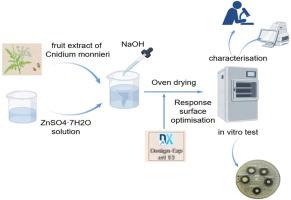
Currently, the drugs employed to treat superficial fungal infections are encountering challenges, particularly the rise of drug resistance. Numerous studies have suggested that zinc oxide nanoparticles (ZnO NPs) show promise in the realm of antifungal treatment. Green synthesis makes the preparation of ZnO NPs more environmentally friendly and economical. In order to prepare antifungal active nanoparticles with low economic cost and stable performance, zinc oxide nanoparticles (CM-ZnONPs) were synthesized for the first time in this study using zinc sulfate heptahydrate (ZnSO4·7H2O) with a Cnidium monnieri (L.) Cuss. (C. monnieri) fruit extract as a reducing agent. In this study, the Box-Behnken design method was used to optimize the manufacturing process of CM-ZnONP. Various techniques, including UV–vis, Fourier Transform Infrared Spectroscopy (FTIR) and X-ray Powder Diffraction (XRD) were employed to demonstrate the successful preparation of CM-ZnONPs. The Transmission Electron Microscopy (TEM) analysis indicated that the size of CM-ZnONPs was 53.30 ± 12.89 nm. The dynamic light scattering (DLS) analysis showed the size of 157.7 ± 15.57 nm for CM-ZnONPs, along with an average polydispersity index (PDI) of 0.1791 ± 0.1394. The zone of inhibition of CM-ZnONPs against Candida albicans (C. albicans) was demonstrated to be 17.0 ± 0.8 mm by paper diffusion experiments. The minimum inhibitory concentration (MIC) of CM-ZnONPs against C. albicans was established at 58.59 μg/mL through the microdilution method. In summary, CM-ZnONPs exhibit excellent performance and antifungal activity in various properties. It is expected to be widely produced and used as an effective treatment for superficial fungal infections.
期刊介绍:
Microbial Pathogenesis publishes original contributions and reviews about the molecular and cellular mechanisms of infectious diseases. It covers microbiology, host-pathogen interaction and immunology related to infectious agents, including bacteria, fungi, viruses and protozoa. It also accepts papers in the field of clinical microbiology, with the exception of case reports.
Research Areas Include:
-Pathogenesis
-Virulence factors
-Host susceptibility or resistance
-Immune mechanisms
-Identification, cloning and sequencing of relevant genes
-Genetic studies
-Viruses, prokaryotic organisms and protozoa
-Microbiota
-Systems biology related to infectious diseases
-Targets for vaccine design (pre-clinical studies)



 京公网安备 11010802042870号
京ICP备2023020795号-1
京公网安备 11010802042870号
京ICP备2023020795号-1

 分享
分享
 求助内容:
求助内容: 应助结果提醒方式:
 扫码关注我们
