Meng Xia , Ziteng Li , Hanrui Jiang , Yuanqing Li , Linghao Hu , Yongchang He , Siqi Huang , Lei Tang , Cheng Luo , Shuangxi Gu , Hong Ding , Mingliang Wang
{"title":"新型咪唑[1,2-b]吡嗪衍生物作为CDK12/13共价抑制剂的发现","authors":"Meng Xia , Ziteng Li , Hanrui Jiang , Yuanqing Li , Linghao Hu , Yongchang He , Siqi Huang , Lei Tang , Cheng Luo , Shuangxi Gu , Hong Ding , Mingliang Wang","doi":"10.1016/j.ejmech.2025.117378","DOIUrl":null,"url":null,"abstract":"<div><div>Triple-negative breast cancer (TNBC) is widely recognized as the most aggressive subtype of breast cancer, and treatment options for patients with TNBC remain highly limited. Recently, cyclin-dependent kinases 12/13 (CDK12/13) have been identified as promising therapeutic targets for TNBC. In our study, we report the design and synthesis of novel imidazo[1,2-<em>b</em>]pyrazine-based covalent inhibitors of CDK12/13, which exhibit potent inhibitory activity against TNBC cells. Among these compounds, compound <strong>24</strong> emerged as the most potent inhibitor, with CDK12 IC<sub>50</sub> of 15.5 nM and CDK13 IC<sub>50</sub> of 12.2 nM. Compound <strong>24</strong> forms a covalent bond with Cys1039 of CDK12 and effectively suppresses the proliferation of TNBC cell lines MDA-MB-231 and MDA-MB-468, with EC<sub>50</sub> values of 5.0 nM and 6.0 nM, respectively. Compound <strong>24</strong> demonstrated superior efficacy to the currently known CDK12/13 covalent inhibitor, THZ531. These findings suggest compound <strong>24</strong> may be a promising lead for developing CDK12/13-targeted therapies for treating TNBC.</div></div>","PeriodicalId":314,"journal":{"name":"European Journal of Medicinal Chemistry","volume":"288 ","pages":"Article 117378"},"PeriodicalIF":6.7000,"publicationDate":"2025-04-15","publicationTypes":"Journal Article","fieldsOfStudy":null,"isOpenAccess":false,"openAccessPdf":"","citationCount":"0","resultStr":"{\"title\":\"Discovery of novel imidazo[1,2-b]pyridazine derivatives as potent covalent inhibitors of CDK12/13\",\"authors\":\"Meng Xia , Ziteng Li , Hanrui Jiang , Yuanqing Li , Linghao Hu , Yongchang He , Siqi Huang , Lei Tang , Cheng Luo , Shuangxi Gu , Hong Ding , Mingliang Wang\",\"doi\":\"10.1016/j.ejmech.2025.117378\",\"DOIUrl\":null,\"url\":null,\"abstract\":\"<div><div>Triple-negative breast cancer (TNBC) is widely recognized as the most aggressive subtype of breast cancer, and treatment options for patients with TNBC remain highly limited. Recently, cyclin-dependent kinases 12/13 (CDK12/13) have been identified as promising therapeutic targets for TNBC. In our study, we report the design and synthesis of novel imidazo[1,2-<em>b</em>]pyrazine-based covalent inhibitors of CDK12/13, which exhibit potent inhibitory activity against TNBC cells. Among these compounds, compound <strong>24</strong> emerged as the most potent inhibitor, with CDK12 IC<sub>50</sub> of 15.5 nM and CDK13 IC<sub>50</sub> of 12.2 nM. Compound <strong>24</strong> forms a covalent bond with Cys1039 of CDK12 and effectively suppresses the proliferation of TNBC cell lines MDA-MB-231 and MDA-MB-468, with EC<sub>50</sub> values of 5.0 nM and 6.0 nM, respectively. Compound <strong>24</strong> demonstrated superior efficacy to the currently known CDK12/13 covalent inhibitor, THZ531. These findings suggest compound <strong>24</strong> may be a promising lead for developing CDK12/13-targeted therapies for treating TNBC.</div></div>\",\"PeriodicalId\":314,\"journal\":{\"name\":\"European Journal of Medicinal Chemistry\",\"volume\":\"288 \",\"pages\":\"Article 117378\"},\"PeriodicalIF\":6.7000,\"publicationDate\":\"2025-04-15\",\"publicationTypes\":\"Journal Article\",\"fieldsOfStudy\":null,\"isOpenAccess\":false,\"openAccessPdf\":\"\",\"citationCount\":\"0\",\"resultStr\":null,\"platform\":\"Semanticscholar\",\"paperid\":null,\"PeriodicalName\":\"European Journal of Medicinal Chemistry\",\"FirstCategoryId\":\"3\",\"ListUrlMain\":\"https://www.sciencedirect.com/science/article/pii/S0223523425001436\",\"RegionNum\":2,\"RegionCategory\":\"医学\",\"ArticlePicture\":[],\"TitleCN\":null,\"AbstractTextCN\":null,\"PMCID\":null,\"EPubDate\":\"2025/2/10 0:00:00\",\"PubModel\":\"Epub\",\"JCR\":\"Q1\",\"JCRName\":\"CHEMISTRY, MEDICINAL\",\"Score\":null,\"Total\":0}","platform":"Semanticscholar","paperid":null,"PeriodicalName":"European Journal of Medicinal Chemistry","FirstCategoryId":"3","ListUrlMain":"https://www.sciencedirect.com/science/article/pii/S0223523425001436","RegionNum":2,"RegionCategory":"医学","ArticlePicture":[],"TitleCN":null,"AbstractTextCN":null,"PMCID":null,"EPubDate":"2025/2/10 0:00:00","PubModel":"Epub","JCR":"Q1","JCRName":"CHEMISTRY, MEDICINAL","Score":null,"Total":0}
Discovery of novel imidazo[1,2-b]pyridazine derivatives as potent covalent inhibitors of CDK12/13
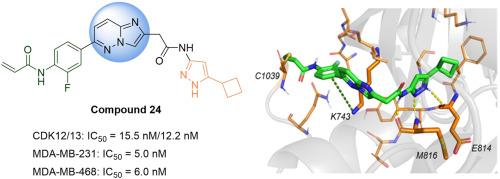
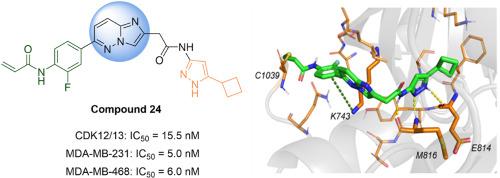
Triple-negative breast cancer (TNBC) is widely recognized as the most aggressive subtype of breast cancer, and treatment options for patients with TNBC remain highly limited. Recently, cyclin-dependent kinases 12/13 (CDK12/13) have been identified as promising therapeutic targets for TNBC. In our study, we report the design and synthesis of novel imidazo[1,2-b]pyrazine-based covalent inhibitors of CDK12/13, which exhibit potent inhibitory activity against TNBC cells. Among these compounds, compound 24 emerged as the most potent inhibitor, with CDK12 IC50 of 15.5 nM and CDK13 IC50 of 12.2 nM. Compound 24 forms a covalent bond with Cys1039 of CDK12 and effectively suppresses the proliferation of TNBC cell lines MDA-MB-231 and MDA-MB-468, with EC50 values of 5.0 nM and 6.0 nM, respectively. Compound 24 demonstrated superior efficacy to the currently known CDK12/13 covalent inhibitor, THZ531. These findings suggest compound 24 may be a promising lead for developing CDK12/13-targeted therapies for treating TNBC.
期刊介绍:
The European Journal of Medicinal Chemistry is a global journal that publishes studies on all aspects of medicinal chemistry. It provides a medium for publication of original papers and also welcomes critical review papers.
A typical paper would report on the organic synthesis, characterization and pharmacological evaluation of compounds. Other topics of interest are drug design, QSAR, molecular modeling, drug-receptor interactions, molecular aspects of drug metabolism, prodrug synthesis and drug targeting. The journal expects manuscripts to present the rational for a study, provide insight into the design of compounds or understanding of mechanism, or clarify the targets.




 京公网安备 11010802042870号
京ICP备2023020795号-1
京公网安备 11010802042870号
京ICP备2023020795号-1

 分享
分享
 求助内容:
求助内容: 应助结果提醒方式:
 扫码关注我们
