氟吡喃种子处理对小麦白粉病的防治

IF 3.8 1区 农林科学 Q1 AGRONOMY Pest Management Science Pub Date : 2025-02-10 DOI:10.1002/ps.8706
Chao Xu, Xiaomeng Guo, Xiaoya Tian, Xuebiao Zhang, Hong Zhang, Qinyan Wu, Hongzhou Chen, Hongfu Yang
{"title":"氟吡喃种子处理对小麦白粉病的防治","authors":"Chao Xu,&nbsp;Xiaomeng Guo,&nbsp;Xiaoya Tian,&nbsp;Xuebiao Zhang,&nbsp;Hong Zhang,&nbsp;Qinyan Wu,&nbsp;Hongzhou Chen,&nbsp;Hongfu Yang","doi":"10.1002/ps.8706","DOIUrl":null,"url":null,"abstract":"<div>\n \n \n <section>\n \n <h3> BACKGROUND</h3>\n \n <p>Wheat powdery mildew is an airborne multi-cycle disease caused by <i>Blumeria graminis</i> f. sp. <i>tritici</i>. This disease can cause severe yield reduction or total crop loss. Fluopyram is a succinate dehydrogenase inhibitor (SDHI) used for the prevention and control of gray mold, powdery mildew, and downy mildew in fruits and vegetables.</p>\n </section>\n \n <section>\n \n <h3> RESULTS</h3>\n \n <p>We used fluopyram to treat wheat seeds and demonstrated excellent control of powdery mildew. Fluopyram treatment did not affect wheat seed germination. After seed treatment, the residual amounts of fluopyram in harvested wheat grains and in soil were lower than the maximum residue limit (MRL, 0.07 mg kg<sup>−1</sup>). We explored the mechanism of action of fluopyram on wheat powdery mildew using eukaryotic reference transcriptome analysis. The differentially expressed genes (DEGs) in wheat plants treated with fluopyram were mostly enriched in the photosynthesis pathway. SPAD (soil–plant analysis development) value measurements showed a significant increase in chlorophyll content after treatment. The enzyme activity of chitinase and the relative expression levels of related genes (<i>Cht3</i> and <i>Cht4</i>) were significantly up-regulated, indicating that the defense response of wheat was activated.</p>\n </section>\n \n <section>\n \n <h3> CONCLUSION</h3>\n \n <p>Fluopyram seed treatment is expected to be developed for the control of wheat powdery mildew. The research in this study will provide important theoretical basis for controlling wheat powdery mildew caused by <i>Blumeria graminis</i> f. sp. <i>tritici</i> in the field. © 2025 Society of Chemical Industry.</p>\n </section>\n </div>","PeriodicalId":218,"journal":{"name":"Pest Management Science","volume":"81 6","pages":"3328-3338"},"PeriodicalIF":3.8000,"publicationDate":"2025-02-10","publicationTypes":"Journal Article","fieldsOfStudy":null,"isOpenAccess":false,"openAccessPdf":"","citationCount":"0","resultStr":"{\"title\":\"Control of wheat powdery mildew using fluopyram seed treatment\",\"authors\":\"Chao Xu,&nbsp;Xiaomeng Guo,&nbsp;Xiaoya Tian,&nbsp;Xuebiao Zhang,&nbsp;Hong Zhang,&nbsp;Qinyan Wu,&nbsp;Hongzhou Chen,&nbsp;Hongfu Yang\",\"doi\":\"10.1002/ps.8706\",\"DOIUrl\":null,\"url\":null,\"abstract\":\"<div>\\n \\n \\n <section>\\n \\n <h3> BACKGROUND</h3>\\n \\n <p>Wheat powdery mildew is an airborne multi-cycle disease caused by <i>Blumeria graminis</i> f. sp. <i>tritici</i>. This disease can cause severe yield reduction or total crop loss. Fluopyram is a succinate dehydrogenase inhibitor (SDHI) used for the prevention and control of gray mold, powdery mildew, and downy mildew in fruits and vegetables.</p>\\n </section>\\n \\n <section>\\n \\n <h3> RESULTS</h3>\\n \\n <p>We used fluopyram to treat wheat seeds and demonstrated excellent control of powdery mildew. Fluopyram treatment did not affect wheat seed germination. After seed treatment, the residual amounts of fluopyram in harvested wheat grains and in soil were lower than the maximum residue limit (MRL, 0.07 mg kg<sup>−1</sup>). We explored the mechanism of action of fluopyram on wheat powdery mildew using eukaryotic reference transcriptome analysis. The differentially expressed genes (DEGs) in wheat plants treated with fluopyram were mostly enriched in the photosynthesis pathway. SPAD (soil–plant analysis development) value measurements showed a significant increase in chlorophyll content after treatment. The enzyme activity of chitinase and the relative expression levels of related genes (<i>Cht3</i> and <i>Cht4</i>) were significantly up-regulated, indicating that the defense response of wheat was activated.</p>\\n </section>\\n \\n <section>\\n \\n <h3> CONCLUSION</h3>\\n \\n <p>Fluopyram seed treatment is expected to be developed for the control of wheat powdery mildew. The research in this study will provide important theoretical basis for controlling wheat powdery mildew caused by <i>Blumeria graminis</i> f. sp. <i>tritici</i> in the field. © 2025 Society of Chemical Industry.</p>\\n </section>\\n </div>\",\"PeriodicalId\":218,\"journal\":{\"name\":\"Pest Management Science\",\"volume\":\"81 6\",\"pages\":\"3328-3338\"},\"PeriodicalIF\":3.8000,\"publicationDate\":\"2025-02-10\",\"publicationTypes\":\"Journal Article\",\"fieldsOfStudy\":null,\"isOpenAccess\":false,\"openAccessPdf\":\"\",\"citationCount\":\"0\",\"resultStr\":null,\"platform\":\"Semanticscholar\",\"paperid\":null,\"PeriodicalName\":\"Pest Management Science\",\"FirstCategoryId\":\"97\",\"ListUrlMain\":\"https://scijournals.onlinelibrary.wiley.com/doi/10.1002/ps.8706\",\"RegionNum\":1,\"RegionCategory\":\"农林科学\",\"ArticlePicture\":[],\"TitleCN\":null,\"AbstractTextCN\":null,\"PMCID\":null,\"EPubDate\":\"\",\"PubModel\":\"\",\"JCR\":\"Q1\",\"JCRName\":\"AGRONOMY\",\"Score\":null,\"Total\":0}","platform":"Semanticscholar","paperid":null,"PeriodicalName":"Pest Management Science","FirstCategoryId":"97","ListUrlMain":"https://scijournals.onlinelibrary.wiley.com/doi/10.1002/ps.8706","RegionNum":1,"RegionCategory":"农林科学","ArticlePicture":[],"TitleCN":null,"AbstractTextCN":null,"PMCID":null,"EPubDate":"","PubModel":"","JCR":"Q1","JCRName":"AGRONOMY","Score":null,"Total":0}
引用次数: 0

摘要

小麦白粉病是由小麦蓝孢杆菌引起的一种空气传播的多周期疾病。此病可造成严重减产或作物全损。氟吡喃是琥珀酸脱氢酶抑制剂(SDHI),用于防治水果和蔬菜中的灰霉病、白粉病和霜霉病。
本文章由计算机程序翻译,如有差异,请以英文原文为准。

摘要图片

摘要图片

摘要图片

摘要图片

摘要图片

查看原文
分享 分享
微信好友 朋友圈 QQ好友 复制链接
本刊更多论文
Control of wheat powdery mildew using fluopyram seed treatment

BACKGROUND

Wheat powdery mildew is an airborne multi-cycle disease caused by Blumeria graminis f. sp. tritici. This disease can cause severe yield reduction or total crop loss. Fluopyram is a succinate dehydrogenase inhibitor (SDHI) used for the prevention and control of gray mold, powdery mildew, and downy mildew in fruits and vegetables.

RESULTS

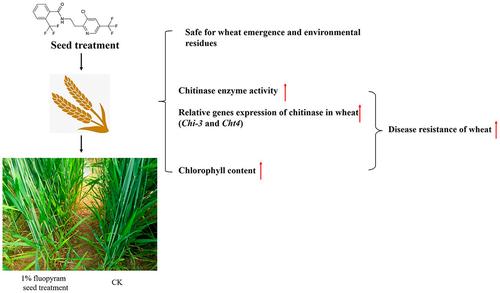
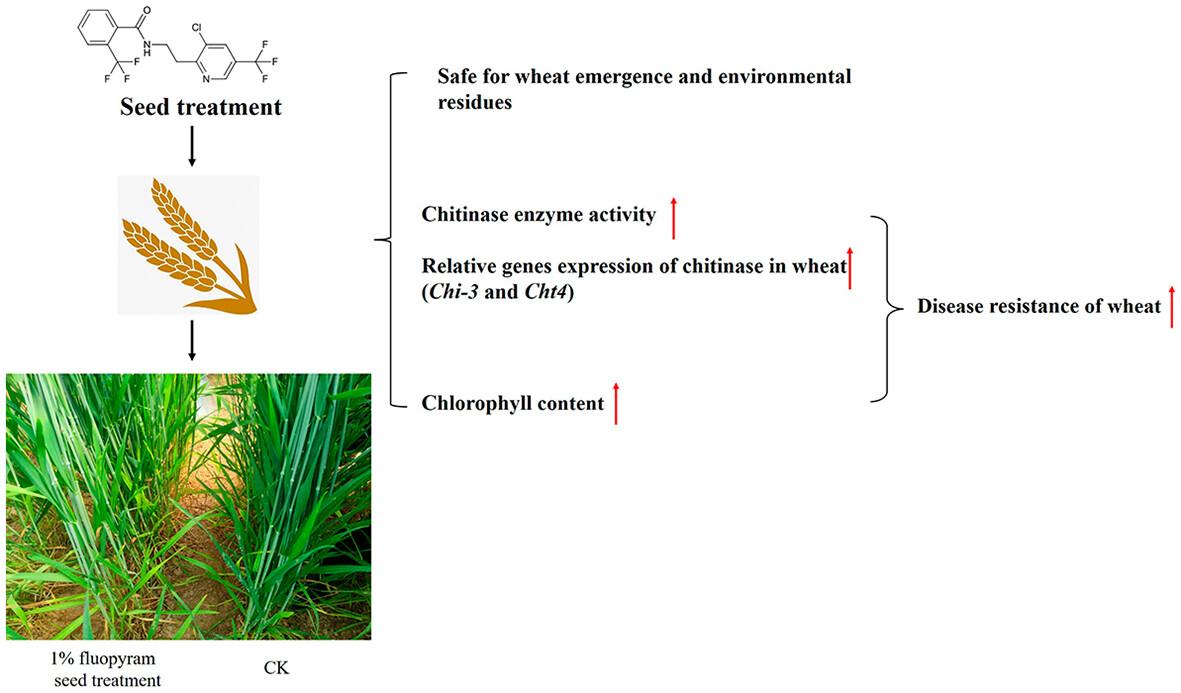
We used fluopyram to treat wheat seeds and demonstrated excellent control of powdery mildew. Fluopyram treatment did not affect wheat seed germination. After seed treatment, the residual amounts of fluopyram in harvested wheat grains and in soil were lower than the maximum residue limit (MRL, 0.07 mg kg−1). We explored the mechanism of action of fluopyram on wheat powdery mildew using eukaryotic reference transcriptome analysis. The differentially expressed genes (DEGs) in wheat plants treated with fluopyram were mostly enriched in the photosynthesis pathway. SPAD (soil–plant analysis development) value measurements showed a significant increase in chlorophyll content after treatment. The enzyme activity of chitinase and the relative expression levels of related genes (Cht3 and Cht4) were significantly up-regulated, indicating that the defense response of wheat was activated.

CONCLUSION

Fluopyram seed treatment is expected to be developed for the control of wheat powdery mildew. The research in this study will provide important theoretical basis for controlling wheat powdery mildew caused by Blumeria graminis f. sp. tritici in the field. © 2025 Society of Chemical Industry.

求助全文
通过发布文献求助,成功后即可免费获取论文全文。 去求助
来源期刊
Pest Management Science
Pest Management Science 农林科学-昆虫学
CiteScore
7.90
自引率
9.80%
发文量
553
审稿时长
4.8 months
期刊介绍: Pest Management Science is the international journal of research and development in crop protection and pest control. Since its launch in 1970, the journal has become the premier forum for papers on the discovery, application, and impact on the environment of products and strategies designed for pest management. Published for SCI by John Wiley & Sons Ltd.
期刊最新文献
Design, synthesis and insecticidal activity evaluation of novel oxime ether sulfonamide derivatives containing cyclopropane fragments against Plutella xylostella. Conned by the enemy: the entomopathogenic fungus Metarhizium anisopliae lures and kills Drosophila suzukii. Electrophysiological responses and field attractants of Hoplia spectabilis Medvedev (Coleoptera: Scarabaeidae) adults to host plant volatiles. Effect of the gut microbiota on insect reproduction: mechanisms and biotechnological prospects. Effect of drift-reducing spray configurations on spray deposition and coverage in winter wheat.
×
引用
GB/T 7714-2015
复制
MLA
复制
APA
复制
导出至
BibTeX EndNote RefMan NoteFirst NoteExpress
×
×
提示
您的信息不完整,为了账户安全,请先补充。
现在去补充
×
提示
您因"违规操作"
具体请查看互助需知
我知道了
×
提示
现在去查看 取消
×
提示
确定
0
微信
客服QQ
Book学术公众号 扫码关注我们
反馈
×
意见反馈
请填写您的意见或建议
请填写您的手机或邮箱
已复制链接
已复制链接
快去分享给好友吧!
我知道了
×
扫码分享
扫码分享
Book学术官方微信
Book学术官方微信
Book学术文献互助
Book学术文献互助群
群 号:604180095
Book学术
文献互助 智能选刊 最新文献 互助须知 联系我们:info@booksci.cn
Book学术提供免费学术资源搜索服务,方便国内外学者检索中英文文献。致力于提供最便捷和优质的服务体验。
Copyright © 2023 Book学术 All rights reserved.
ghs 京公网安备 11010802042870号 京ICP备2023020795号-1