Rosario Touriño-Peralba, Julio Rodríguez-Lago, David Lamas-Francis, Laura Martínez-Pérez, Teresa Rodríguez-Ares
{"title":"人口统计学和地形学结果提示进行性圆锥角膜患者对交联离子导入反应不佳。","authors":"Rosario Touriño-Peralba, Julio Rodríguez-Lago, David Lamas-Francis, Laura Martínez-Pérez, Teresa Rodríguez-Ares","doi":"10.1007/s10792-025-03421-9","DOIUrl":null,"url":null,"abstract":"<p><strong>Purpose: </strong>To evaluate demographic and tomographical parameters in predicting treatment response following transepithelial iontophoresis-assisted corneal cross-linking (I-CXL) for progressive keratoconus.</p><p><strong>Methods: </strong>Forty eyes (20 aged < 19 years and 20 aged ≥ 19 years) underwent I-CXL treatment between 2016 and 2022. Progression criteria based on the ABCD system, changes in asphericity (Q), demographic factors and keratoconus phenotypes were evaluated. Subjects were followed for 24 months after procedure.</p><p><strong>Results: </strong>Sixty percent of participants were male. The mean age at the time of treatment was 21.0 ± 6.0 years. All tomographical values showed progression after 2 years of follow-up (p < 0.05), particularly during the first 6 months, except for anterior curvature. Within the ABCD grading system, we observed: A) an increase in anterior curvature, more evident with lower initial values; B) an increase in posterior curvature, more pronounced with higher initial values. Two years after I-CXL, 20% of subjects met progression criteria in two or more parameters, with 62.5% being under 19 years of age. Patients with a family history of corneal ectasia exhibited a mean KMax progression of 1.94D ± 1.88, (p = 0.046). Only phenotypes 3 and 4 showed progression. Although patients under 19 years showed greater progression in all tomographical variables at the end of the study, this difference was not statistically significant.</p><p><strong>Conclusion: </strong>Treatment with I-CXL did not stop progression in the variables studied two years after the procedure in an effective manner, especially in patients younger than 19 years. A family history of corneal ectasia and subtype 4 keratoconus predicted a less favourable response to I-CXL.</p>","PeriodicalId":14473,"journal":{"name":"International Ophthalmology","volume":"45 1","pages":"69"},"PeriodicalIF":1.7000,"publicationDate":"2025-02-10","publicationTypes":"Journal Article","fieldsOfStudy":null,"isOpenAccess":false,"openAccessPdf":"https://www.ncbi.nlm.nih.gov/pmc/articles/PMC11811480/pdf/","citationCount":"0","resultStr":"{\"title\":\"Demographic and topographic findings suggesting poor response to crosslinking-iontophoresis in patients with progressive keratoconus.\",\"authors\":\"Rosario Touriño-Peralba, Julio Rodríguez-Lago, David Lamas-Francis, Laura Martínez-Pérez, Teresa Rodríguez-Ares\",\"doi\":\"10.1007/s10792-025-03421-9\",\"DOIUrl\":null,\"url\":null,\"abstract\":\"<p><strong>Purpose: </strong>To evaluate demographic and tomographical parameters in predicting treatment response following transepithelial iontophoresis-assisted corneal cross-linking (I-CXL) for progressive keratoconus.</p><p><strong>Methods: </strong>Forty eyes (20 aged < 19 years and 20 aged ≥ 19 years) underwent I-CXL treatment between 2016 and 2022. Progression criteria based on the ABCD system, changes in asphericity (Q), demographic factors and keratoconus phenotypes were evaluated. Subjects were followed for 24 months after procedure.</p><p><strong>Results: </strong>Sixty percent of participants were male. The mean age at the time of treatment was 21.0 ± 6.0 years. All tomographical values showed progression after 2 years of follow-up (p < 0.05), particularly during the first 6 months, except for anterior curvature. Within the ABCD grading system, we observed: A) an increase in anterior curvature, more evident with lower initial values; B) an increase in posterior curvature, more pronounced with higher initial values. Two years after I-CXL, 20% of subjects met progression criteria in two or more parameters, with 62.5% being under 19 years of age. Patients with a family history of corneal ectasia exhibited a mean KMax progression of 1.94D ± 1.88, (p = 0.046). Only phenotypes 3 and 4 showed progression. Although patients under 19 years showed greater progression in all tomographical variables at the end of the study, this difference was not statistically significant.</p><p><strong>Conclusion: </strong>Treatment with I-CXL did not stop progression in the variables studied two years after the procedure in an effective manner, especially in patients younger than 19 years. A family history of corneal ectasia and subtype 4 keratoconus predicted a less favourable response to I-CXL.</p>\",\"PeriodicalId\":14473,\"journal\":{\"name\":\"International Ophthalmology\",\"volume\":\"45 1\",\"pages\":\"69\"},\"PeriodicalIF\":1.7000,\"publicationDate\":\"2025-02-10\",\"publicationTypes\":\"Journal Article\",\"fieldsOfStudy\":null,\"isOpenAccess\":false,\"openAccessPdf\":\"https://www.ncbi.nlm.nih.gov/pmc/articles/PMC11811480/pdf/\",\"citationCount\":\"0\",\"resultStr\":null,\"platform\":\"Semanticscholar\",\"paperid\":null,\"PeriodicalName\":\"International Ophthalmology\",\"FirstCategoryId\":\"3\",\"ListUrlMain\":\"https://doi.org/10.1007/s10792-025-03421-9\",\"RegionNum\":4,\"RegionCategory\":\"医学\",\"ArticlePicture\":[],\"TitleCN\":null,\"AbstractTextCN\":null,\"PMCID\":null,\"EPubDate\":\"\",\"PubModel\":\"\",\"JCR\":\"Q3\",\"JCRName\":\"OPHTHALMOLOGY\",\"Score\":null,\"Total\":0}","platform":"Semanticscholar","paperid":null,"PeriodicalName":"International Ophthalmology","FirstCategoryId":"3","ListUrlMain":"https://doi.org/10.1007/s10792-025-03421-9","RegionNum":4,"RegionCategory":"医学","ArticlePicture":[],"TitleCN":null,"AbstractTextCN":null,"PMCID":null,"EPubDate":"","PubModel":"","JCR":"Q3","JCRName":"OPHTHALMOLOGY","Score":null,"Total":0}
Demographic and topographic findings suggesting poor response to crosslinking-iontophoresis in patients with progressive keratoconus.
Purpose: To evaluate demographic and tomographical parameters in predicting treatment response following transepithelial iontophoresis-assisted corneal cross-linking (I-CXL) for progressive keratoconus.
Methods: Forty eyes (20 aged < 19 years and 20 aged ≥ 19 years) underwent I-CXL treatment between 2016 and 2022. Progression criteria based on the ABCD system, changes in asphericity (Q), demographic factors and keratoconus phenotypes were evaluated. Subjects were followed for 24 months after procedure.
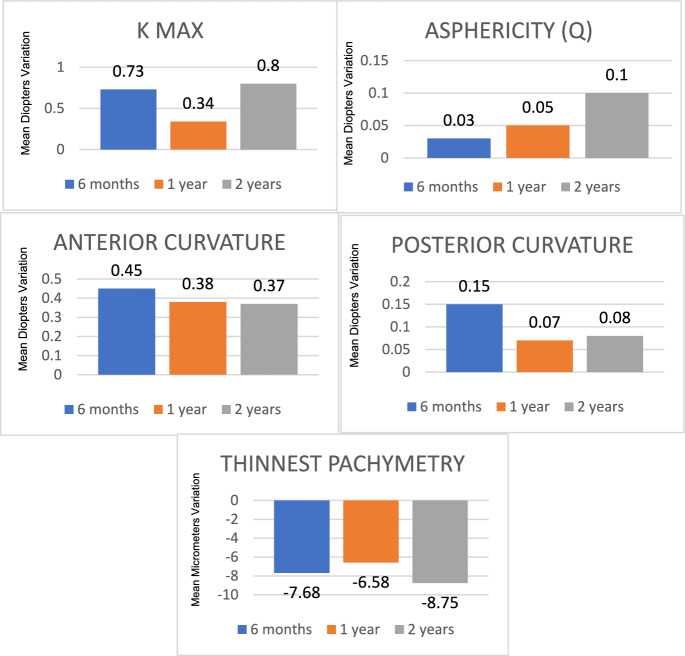
Results: Sixty percent of participants were male. The mean age at the time of treatment was 21.0 ± 6.0 years. All tomographical values showed progression after 2 years of follow-up (p < 0.05), particularly during the first 6 months, except for anterior curvature. Within the ABCD grading system, we observed: A) an increase in anterior curvature, more evident with lower initial values; B) an increase in posterior curvature, more pronounced with higher initial values. Two years after I-CXL, 20% of subjects met progression criteria in two or more parameters, with 62.5% being under 19 years of age. Patients with a family history of corneal ectasia exhibited a mean KMax progression of 1.94D ± 1.88, (p = 0.046). Only phenotypes 3 and 4 showed progression. Although patients under 19 years showed greater progression in all tomographical variables at the end of the study, this difference was not statistically significant.
Conclusion: Treatment with I-CXL did not stop progression in the variables studied two years after the procedure in an effective manner, especially in patients younger than 19 years. A family history of corneal ectasia and subtype 4 keratoconus predicted a less favourable response to I-CXL.
期刊介绍:
International Ophthalmology provides the clinician with articles on all the relevant subspecialties of ophthalmology, with a broad international scope. The emphasis is on presentation of the latest clinical research in the field. In addition, the journal includes regular sections devoted to new developments in technologies, products, and techniques.





 京公网安备 11010802042870号
京ICP备2023020795号-1
京公网安备 11010802042870号
京ICP备2023020795号-1

 分享
分享
 求助内容:
求助内容: 应助结果提醒方式:
 扫码关注我们
