Matthew J. Takle, Linden Schrecker, Benjamin J. Deadman, Joachim Dickhaut, Andy Wieja, Klaus Hellgardt, King Kuok Mimi Hii
{"title":"手性胺在连续流动中的闪速热外消旋化:利用DoE和多元瞬态流动对反应空间的探索","authors":"Matthew J. Takle, Linden Schrecker, Benjamin J. Deadman, Joachim Dickhaut, Andy Wieja, Klaus Hellgardt, King Kuok Mimi Hii","doi":"10.1021/acs.oprd.4c00508","DOIUrl":null,"url":null,"abstract":"The robustness of the flash thermal racemization of optically active 1-phenylethylamine over Pd/γ-Al<sub>2</sub>O<sub>3</sub> was studied by applying split-plot design-of-experiments (DoE), where the effects of temperature, flow rate, and concentration (3-factors) on the e.e. and selectivity (2-responses) were examined and quantified. The same effects were also interrogated using multivariate ramps in transient flow to produce response surfaces for the reaction space. The same set of optimal conditions for the process was identified by both approaches, and the same relationships between the variables were observed: while the extent of racemization (e.e.) can be directly correlated to temperature, a more complex relationship between temperature and flow rate on the selectivity was uncovered.","PeriodicalId":55,"journal":{"name":"Organic Process Research & Development","volume":"121 1","pages":""},"PeriodicalIF":3.5000,"publicationDate":"2025-02-11","publicationTypes":"Journal Article","fieldsOfStudy":null,"isOpenAccess":false,"openAccessPdf":"","citationCount":"0","resultStr":"{\"title\":\"Flash Thermal Racemization of Chiral Amine in Continuous Flow: An Exploration of Reaction Space Using DoE and Multivariate Transient Flow\",\"authors\":\"Matthew J. Takle, Linden Schrecker, Benjamin J. Deadman, Joachim Dickhaut, Andy Wieja, Klaus Hellgardt, King Kuok Mimi Hii\",\"doi\":\"10.1021/acs.oprd.4c00508\",\"DOIUrl\":null,\"url\":null,\"abstract\":\"The robustness of the flash thermal racemization of optically active 1-phenylethylamine over Pd/γ-Al<sub>2</sub>O<sub>3</sub> was studied by applying split-plot design-of-experiments (DoE), where the effects of temperature, flow rate, and concentration (3-factors) on the e.e. and selectivity (2-responses) were examined and quantified. The same effects were also interrogated using multivariate ramps in transient flow to produce response surfaces for the reaction space. The same set of optimal conditions for the process was identified by both approaches, and the same relationships between the variables were observed: while the extent of racemization (e.e.) can be directly correlated to temperature, a more complex relationship between temperature and flow rate on the selectivity was uncovered.\",\"PeriodicalId\":55,\"journal\":{\"name\":\"Organic Process Research & Development\",\"volume\":\"121 1\",\"pages\":\"\"},\"PeriodicalIF\":3.5000,\"publicationDate\":\"2025-02-11\",\"publicationTypes\":\"Journal Article\",\"fieldsOfStudy\":null,\"isOpenAccess\":false,\"openAccessPdf\":\"\",\"citationCount\":\"0\",\"resultStr\":null,\"platform\":\"Semanticscholar\",\"paperid\":null,\"PeriodicalName\":\"Organic Process Research & Development\",\"FirstCategoryId\":\"92\",\"ListUrlMain\":\"https://doi.org/10.1021/acs.oprd.4c00508\",\"RegionNum\":3,\"RegionCategory\":\"化学\",\"ArticlePicture\":[],\"TitleCN\":null,\"AbstractTextCN\":null,\"PMCID\":null,\"EPubDate\":\"\",\"PubModel\":\"\",\"JCR\":\"Q2\",\"JCRName\":\"CHEMISTRY, APPLIED\",\"Score\":null,\"Total\":0}","platform":"Semanticscholar","paperid":null,"PeriodicalName":"Organic Process Research & Development","FirstCategoryId":"92","ListUrlMain":"https://doi.org/10.1021/acs.oprd.4c00508","RegionNum":3,"RegionCategory":"化学","ArticlePicture":[],"TitleCN":null,"AbstractTextCN":null,"PMCID":null,"EPubDate":"","PubModel":"","JCR":"Q2","JCRName":"CHEMISTRY, APPLIED","Score":null,"Total":0}
Flash Thermal Racemization of Chiral Amine in Continuous Flow: An Exploration of Reaction Space Using DoE and Multivariate Transient Flow
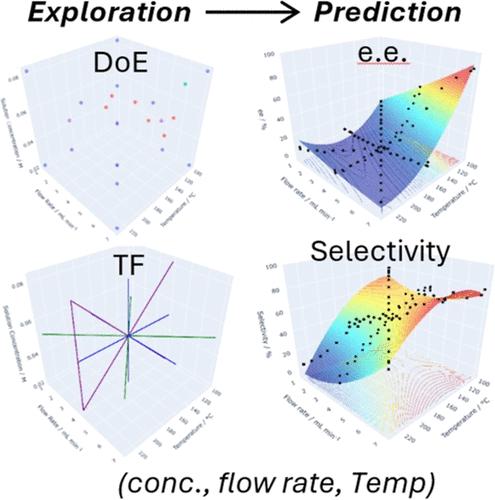
The robustness of the flash thermal racemization of optically active 1-phenylethylamine over Pd/γ-Al2O3 was studied by applying split-plot design-of-experiments (DoE), where the effects of temperature, flow rate, and concentration (3-factors) on the e.e. and selectivity (2-responses) were examined and quantified. The same effects were also interrogated using multivariate ramps in transient flow to produce response surfaces for the reaction space. The same set of optimal conditions for the process was identified by both approaches, and the same relationships between the variables were observed: while the extent of racemization (e.e.) can be directly correlated to temperature, a more complex relationship between temperature and flow rate on the selectivity was uncovered.
期刊介绍:
The journal Organic Process Research & Development serves as a communication tool between industrial chemists and chemists working in universities and research institutes. As such, it reports original work from the broad field of industrial process chemistry but also presents academic results that are relevant, or potentially relevant, to industrial applications. Process chemistry is the science that enables the safe, environmentally benign and ultimately economical manufacturing of organic compounds that are required in larger amounts to help address the needs of society. Consequently, the Journal encompasses every aspect of organic chemistry, including all aspects of catalysis, synthetic methodology development and synthetic strategy exploration, but also includes aspects from analytical and solid-state chemistry and chemical engineering, such as work-up tools,process safety, or flow-chemistry. The goal of development and optimization of chemical reactions and processes is their transfer to a larger scale; original work describing such studies and the actual implementation on scale is highly relevant to the journal. However, studies on new developments from either industry, research institutes or academia that have not yet been demonstrated on scale, but where an industrial utility can be expected and where the study has addressed important prerequisites for a scale-up and has given confidence into the reliability and practicality of the chemistry, also serve the mission of OPR&D as a communication tool between the different contributors to the field.




 京公网安备 11010802042870号
京ICP备2023020795号-1
京公网安备 11010802042870号
京ICP备2023020795号-1

 分享
分享
 求助内容:
求助内容: 应助结果提醒方式:
 扫码关注我们
