Gui-Rong Zhang , Zhiyuan Sun , Xinyu Liu , Jiansong Wang , He Li , Xiaoliang Qu , Hui Yu , Liu-Liu Shen , Donghai Mei
{"title":"HMF选择性电氧化为FDCA:通过低温电解抑制非法拉第转化","authors":"Gui-Rong Zhang , Zhiyuan Sun , Xinyu Liu , Jiansong Wang , He Li , Xiaoliang Qu , Hui Yu , Liu-Liu Shen , Donghai Mei","doi":"10.1016/j.jcat.2025.116002","DOIUrl":null,"url":null,"abstract":"<div><div>Electrooxidation of 5-hydroxymethylfurfural (HMF) to 2,5-furandicarboxylic acid (FDCA) is a promising strategy for biomass valorization. However, a significant challenge arises from the substantial carbon loss due to spontaneous HMF degradation in alkaline electrolytes, particularly at high concentrations. In this study, we present a straightforward approach to mitigating carbon loss during the electrochemical conversion of HMF to FDCA by suppressing non-Faradaic degradation through low-temperature electrolysis. Notably, under conventional room temperature conditions, carbon losses of up to 25 % can occur, whereas our low-temperature electrolysis method reduces carbon loss to negligible levels (< 1 %) even at high HMF concentrations (up to 500 mM) in highly alkaline electrolyte (2.0 M KOH). This strategy effectively addresses the long-standing challenge of balancing the enhanced kinetics of HMF electrooxidation with the accelerated degradation of HMF as its concentration increases in alkaline media. Our findings highlight the critical role of suppressing non-Faradaic degradation in the efficient conversion of HMF and demonstrate that low-temperature electrolysis offers a viable solution to the challenges of industrial-scale electrochemical biomass valorization.</div></div>","PeriodicalId":346,"journal":{"name":"Journal of Catalysis","volume":"444 ","pages":"Article 116002"},"PeriodicalIF":6.0000,"publicationDate":"2025-04-01","publicationTypes":"Journal Article","fieldsOfStudy":null,"isOpenAccess":false,"openAccessPdf":"","citationCount":"0","resultStr":"{\"title\":\"Toward selective electrooxidation of HMF to FDCA: Suppressing non-Faradaic transformations via low temperature electrolysis\",\"authors\":\"Gui-Rong Zhang , Zhiyuan Sun , Xinyu Liu , Jiansong Wang , He Li , Xiaoliang Qu , Hui Yu , Liu-Liu Shen , Donghai Mei\",\"doi\":\"10.1016/j.jcat.2025.116002\",\"DOIUrl\":null,\"url\":null,\"abstract\":\"<div><div>Electrooxidation of 5-hydroxymethylfurfural (HMF) to 2,5-furandicarboxylic acid (FDCA) is a promising strategy for biomass valorization. However, a significant challenge arises from the substantial carbon loss due to spontaneous HMF degradation in alkaline electrolytes, particularly at high concentrations. In this study, we present a straightforward approach to mitigating carbon loss during the electrochemical conversion of HMF to FDCA by suppressing non-Faradaic degradation through low-temperature electrolysis. Notably, under conventional room temperature conditions, carbon losses of up to 25 % can occur, whereas our low-temperature electrolysis method reduces carbon loss to negligible levels (< 1 %) even at high HMF concentrations (up to 500 mM) in highly alkaline electrolyte (2.0 M KOH). This strategy effectively addresses the long-standing challenge of balancing the enhanced kinetics of HMF electrooxidation with the accelerated degradation of HMF as its concentration increases in alkaline media. Our findings highlight the critical role of suppressing non-Faradaic degradation in the efficient conversion of HMF and demonstrate that low-temperature electrolysis offers a viable solution to the challenges of industrial-scale electrochemical biomass valorization.</div></div>\",\"PeriodicalId\":346,\"journal\":{\"name\":\"Journal of Catalysis\",\"volume\":\"444 \",\"pages\":\"Article 116002\"},\"PeriodicalIF\":6.0000,\"publicationDate\":\"2025-04-01\",\"publicationTypes\":\"Journal Article\",\"fieldsOfStudy\":null,\"isOpenAccess\":false,\"openAccessPdf\":\"\",\"citationCount\":\"0\",\"resultStr\":null,\"platform\":\"Semanticscholar\",\"paperid\":null,\"PeriodicalName\":\"Journal of Catalysis\",\"FirstCategoryId\":\"92\",\"ListUrlMain\":\"https://www.sciencedirect.com/science/article/pii/S0021951725000673\",\"RegionNum\":1,\"RegionCategory\":\"化学\",\"ArticlePicture\":[],\"TitleCN\":null,\"AbstractTextCN\":null,\"PMCID\":null,\"EPubDate\":\"2025/2/10 0:00:00\",\"PubModel\":\"Epub\",\"JCR\":\"Q2\",\"JCRName\":\"CHEMISTRY, PHYSICAL\",\"Score\":null,\"Total\":0}","platform":"Semanticscholar","paperid":null,"PeriodicalName":"Journal of Catalysis","FirstCategoryId":"92","ListUrlMain":"https://www.sciencedirect.com/science/article/pii/S0021951725000673","RegionNum":1,"RegionCategory":"化学","ArticlePicture":[],"TitleCN":null,"AbstractTextCN":null,"PMCID":null,"EPubDate":"2025/2/10 0:00:00","PubModel":"Epub","JCR":"Q2","JCRName":"CHEMISTRY, PHYSICAL","Score":null,"Total":0}
引用次数: 0
摘要
5-羟甲基糠醛(HMF)电氧化制2,5-呋喃二羧酸(FDCA)是一种很有前途的生物质增值策略。然而,由于碱性电解质中自发的HMF降解,特别是在高浓度下,造成了大量的碳损失,这是一个重大的挑战。在这项研究中,我们提出了一种直接的方法,通过低温电解抑制非法拉第降解来减轻HMF到FDCA的电化学转化过程中的碳损失。值得注意的是,在传统的室温条件下,可以发生高达25% %的碳损失,而我们的低温电解方法可以将碳损失降低到可以忽略不计的水平(<;1 %),即使在高HMF浓度(高达500 mM)在高碱性电解质(2.0 M KOH)。该策略有效地解决了长期存在的挑战,即随着碱性介质中HMF浓度的增加,HMF电氧化动力学的增强与加速降解之间的平衡。我们的研究结果强调了抑制非法拉第降解在HMF有效转化中的关键作用,并证明低温电解为工业规模电化学生物质增值的挑战提供了可行的解决方案。
Toward selective electrooxidation of HMF to FDCA: Suppressing non-Faradaic transformations via low temperature electrolysis
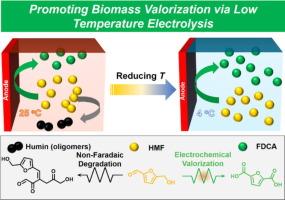
Electrooxidation of 5-hydroxymethylfurfural (HMF) to 2,5-furandicarboxylic acid (FDCA) is a promising strategy for biomass valorization. However, a significant challenge arises from the substantial carbon loss due to spontaneous HMF degradation in alkaline electrolytes, particularly at high concentrations. In this study, we present a straightforward approach to mitigating carbon loss during the electrochemical conversion of HMF to FDCA by suppressing non-Faradaic degradation through low-temperature electrolysis. Notably, under conventional room temperature conditions, carbon losses of up to 25 % can occur, whereas our low-temperature electrolysis method reduces carbon loss to negligible levels (< 1 %) even at high HMF concentrations (up to 500 mM) in highly alkaline electrolyte (2.0 M KOH). This strategy effectively addresses the long-standing challenge of balancing the enhanced kinetics of HMF electrooxidation with the accelerated degradation of HMF as its concentration increases in alkaline media. Our findings highlight the critical role of suppressing non-Faradaic degradation in the efficient conversion of HMF and demonstrate that low-temperature electrolysis offers a viable solution to the challenges of industrial-scale electrochemical biomass valorization.
期刊介绍:
The Journal of Catalysis publishes scholarly articles on both heterogeneous and homogeneous catalysis, covering a wide range of chemical transformations. These include various types of catalysis, such as those mediated by photons, plasmons, and electrons. The focus of the studies is to understand the relationship between catalytic function and the underlying chemical properties of surfaces and metal complexes.
The articles in the journal offer innovative concepts and explore the synthesis and kinetics of inorganic solids and homogeneous complexes. Furthermore, they discuss spectroscopic techniques for characterizing catalysts, investigate the interaction of probes and reacting species with catalysts, and employ theoretical methods.
The research presented in the journal should have direct relevance to the field of catalytic processes, addressing either fundamental aspects or applications of catalysis.





 京公网安备 11010802042870号
京ICP备2023020795号-1
京公网安备 11010802042870号
京ICP备2023020795号-1

 分享
分享
 求助内容:
求助内容: 应助结果提醒方式:
 扫码关注我们
