Guofang Guo , Yan Zhang , Ziting Huang , Wen Liu , Xueyi Lu , Zihan Liu , Xu-Qiong Xiao , Ying Bai , Xinxin Shao
{"title":"直接三氘甲基硒化与货架稳定试剂硒甲基-d3硒磺酸盐","authors":"Guofang Guo , Yan Zhang , Ziting Huang , Wen Liu , Xueyi Lu , Zihan Liu , Xu-Qiong Xiao , Ying Bai , Xinxin Shao","doi":"10.1039/d4qo02396j","DOIUrl":null,"url":null,"abstract":"<div><div>The direct incorporation of deuterated functional groups into organic molecules has emerged as a strategically important approach in synthetic chemistry. Among various deuterated moieties, the selenomethyl-<em>d</em><sub>3</sub> group has attracted significant attention but remains underexplored, primarily due to the limited availability of versatile synthetic precursors. In this work, we have developed an electrophilic trideuteromethylselenating reagent, <em>Se</em>-methyl-<em>d</em><sub>3</sub> benzenesulfonoselenoate with >99% D-incorporation. This reagent can be conveniently synthesized through a one-step procedure and enables efficient trideuteromethylselenation for diverse nucleophiles or electrophiles, including boronic acids, boronic esters, terminal alkynes, β-ketoesters, oxindoles and diazodium salts under mild reaction conditions. Furthermore, the difunctionalization of unactivated alkenes by simultaneous construction of C–S and C–SeCD<sub>3</sub> bonds is well-documented. The utility of the odourless electrophilic SeCD<sub>3</sub> reagent has been demonstrated through late-stage modification of various bioactive molecules.</div></div>","PeriodicalId":94379,"journal":{"name":"Organic chemistry frontiers : an international journal of organic chemistry","volume":"12 8","pages":"Pages 2592-2599"},"PeriodicalIF":0.0000,"publicationDate":"2025-02-12","publicationTypes":"Journal Article","fieldsOfStudy":null,"isOpenAccess":false,"openAccessPdf":"","citationCount":"0","resultStr":"{\"title\":\"Direct trideuteromethylselenation with a shelf-stable reagent Se-methyl-d3 selenosulfonate†\",\"authors\":\"Guofang Guo , Yan Zhang , Ziting Huang , Wen Liu , Xueyi Lu , Zihan Liu , Xu-Qiong Xiao , Ying Bai , Xinxin Shao\",\"doi\":\"10.1039/d4qo02396j\",\"DOIUrl\":null,\"url\":null,\"abstract\":\"<div><div>The direct incorporation of deuterated functional groups into organic molecules has emerged as a strategically important approach in synthetic chemistry. Among various deuterated moieties, the selenomethyl-<em>d</em><sub>3</sub> group has attracted significant attention but remains underexplored, primarily due to the limited availability of versatile synthetic precursors. In this work, we have developed an electrophilic trideuteromethylselenating reagent, <em>Se</em>-methyl-<em>d</em><sub>3</sub> benzenesulfonoselenoate with >99% D-incorporation. This reagent can be conveniently synthesized through a one-step procedure and enables efficient trideuteromethylselenation for diverse nucleophiles or electrophiles, including boronic acids, boronic esters, terminal alkynes, β-ketoesters, oxindoles and diazodium salts under mild reaction conditions. Furthermore, the difunctionalization of unactivated alkenes by simultaneous construction of C–S and C–SeCD<sub>3</sub> bonds is well-documented. The utility of the odourless electrophilic SeCD<sub>3</sub> reagent has been demonstrated through late-stage modification of various bioactive molecules.</div></div>\",\"PeriodicalId\":94379,\"journal\":{\"name\":\"Organic chemistry frontiers : an international journal of organic chemistry\",\"volume\":\"12 8\",\"pages\":\"Pages 2592-2599\"},\"PeriodicalIF\":0.0000,\"publicationDate\":\"2025-02-12\",\"publicationTypes\":\"Journal Article\",\"fieldsOfStudy\":null,\"isOpenAccess\":false,\"openAccessPdf\":\"\",\"citationCount\":\"0\",\"resultStr\":null,\"platform\":\"Semanticscholar\",\"paperid\":null,\"PeriodicalName\":\"Organic chemistry frontiers : an international journal of organic chemistry\",\"FirstCategoryId\":\"1085\",\"ListUrlMain\":\"https://www.sciencedirect.com/org/science/article/pii/S2052412925001160\",\"RegionNum\":0,\"RegionCategory\":null,\"ArticlePicture\":[],\"TitleCN\":null,\"AbstractTextCN\":null,\"PMCID\":null,\"EPubDate\":\"\",\"PubModel\":\"\",\"JCR\":\"\",\"JCRName\":\"\",\"Score\":null,\"Total\":0}","platform":"Semanticscholar","paperid":null,"PeriodicalName":"Organic chemistry frontiers : an international journal of organic chemistry","FirstCategoryId":"1085","ListUrlMain":"https://www.sciencedirect.com/org/science/article/pii/S2052412925001160","RegionNum":0,"RegionCategory":null,"ArticlePicture":[],"TitleCN":null,"AbstractTextCN":null,"PMCID":null,"EPubDate":"","PubModel":"","JCR":"","JCRName":"","Score":null,"Total":0}
Direct trideuteromethylselenation with a shelf-stable reagent Se-methyl-d3 selenosulfonate†
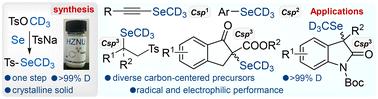
The direct incorporation of deuterated functional groups into organic molecules has emerged as a strategically important approach in synthetic chemistry. Among various deuterated moieties, the selenomethyl-d3 group has attracted significant attention but remains underexplored, primarily due to the limited availability of versatile synthetic precursors. In this work, we have developed an electrophilic trideuteromethylselenating reagent, Se-methyl-d3 benzenesulfonoselenoate with >99% D-incorporation. This reagent can be conveniently synthesized through a one-step procedure and enables efficient trideuteromethylselenation for diverse nucleophiles or electrophiles, including boronic acids, boronic esters, terminal alkynes, β-ketoesters, oxindoles and diazodium salts under mild reaction conditions. Furthermore, the difunctionalization of unactivated alkenes by simultaneous construction of C–S and C–SeCD3 bonds is well-documented. The utility of the odourless electrophilic SeCD3 reagent has been demonstrated through late-stage modification of various bioactive molecules.



 京公网安备 11010802042870号
京ICP备2023020795号-1
京公网安备 11010802042870号
京ICP备2023020795号-1

 分享
分享

 求助内容:
求助内容: 应助结果提醒方式:
 扫码关注我们
