Wanzhen Lin , Xin Ding , Jun-Wei Han , Li-Shuang Yu , Fa-Jie Chen
{"title":"多肽钉接用多氟试剂","authors":"Wanzhen Lin , Xin Ding , Jun-Wei Han , Li-Shuang Yu , Fa-Jie Chen","doi":"10.1039/d5qo00112a","DOIUrl":null,"url":null,"abstract":"<div><div>Peptide stapling has emerged as a valuable approach for modulating peptide structures and enhancing their functional properties, with broad applications for drug discovery and biomolecular engineering. Among the diverse stapling strategies, polyfluorinated reagent-mediated approaches stand out due to their unique ability to provide desirable physicochemical properties such as improved stability, lipophilicity, and binding affinity. This review highlights recent advancements in polyfluorinated reagents for native peptide stapling, focusing on three major classes: arylation, vinylation, and amidation reagents. These reagents enable precise peptide modifications by leveraging the reactivity and selectivity modulated by fluorine substituents, facilitating the engineering of native peptides and biologics.</div></div>","PeriodicalId":94379,"journal":{"name":"Organic chemistry frontiers : an international journal of organic chemistry","volume":"12 8","pages":"Pages 2777-2789"},"PeriodicalIF":0.0000,"publicationDate":"2025-02-12","publicationTypes":"Journal Article","fieldsOfStudy":null,"isOpenAccess":false,"openAccessPdf":"","citationCount":"0","resultStr":"{\"title\":\"Polyfluorinated reagents for peptide stapling\",\"authors\":\"Wanzhen Lin , Xin Ding , Jun-Wei Han , Li-Shuang Yu , Fa-Jie Chen\",\"doi\":\"10.1039/d5qo00112a\",\"DOIUrl\":null,\"url\":null,\"abstract\":\"<div><div>Peptide stapling has emerged as a valuable approach for modulating peptide structures and enhancing their functional properties, with broad applications for drug discovery and biomolecular engineering. Among the diverse stapling strategies, polyfluorinated reagent-mediated approaches stand out due to their unique ability to provide desirable physicochemical properties such as improved stability, lipophilicity, and binding affinity. This review highlights recent advancements in polyfluorinated reagents for native peptide stapling, focusing on three major classes: arylation, vinylation, and amidation reagents. These reagents enable precise peptide modifications by leveraging the reactivity and selectivity modulated by fluorine substituents, facilitating the engineering of native peptides and biologics.</div></div>\",\"PeriodicalId\":94379,\"journal\":{\"name\":\"Organic chemistry frontiers : an international journal of organic chemistry\",\"volume\":\"12 8\",\"pages\":\"Pages 2777-2789\"},\"PeriodicalIF\":0.0000,\"publicationDate\":\"2025-02-12\",\"publicationTypes\":\"Journal Article\",\"fieldsOfStudy\":null,\"isOpenAccess\":false,\"openAccessPdf\":\"\",\"citationCount\":\"0\",\"resultStr\":null,\"platform\":\"Semanticscholar\",\"paperid\":null,\"PeriodicalName\":\"Organic chemistry frontiers : an international journal of organic chemistry\",\"FirstCategoryId\":\"1085\",\"ListUrlMain\":\"https://www.sciencedirect.com/org/science/article/pii/S2052412925001202\",\"RegionNum\":0,\"RegionCategory\":null,\"ArticlePicture\":[],\"TitleCN\":null,\"AbstractTextCN\":null,\"PMCID\":null,\"EPubDate\":\"2025/2/11 0:00:00\",\"PubModel\":\"Epub\",\"JCR\":\"\",\"JCRName\":\"\",\"Score\":null,\"Total\":0}","platform":"Semanticscholar","paperid":null,"PeriodicalName":"Organic chemistry frontiers : an international journal of organic chemistry","FirstCategoryId":"1085","ListUrlMain":"https://www.sciencedirect.com/org/science/article/pii/S2052412925001202","RegionNum":0,"RegionCategory":null,"ArticlePicture":[],"TitleCN":null,"AbstractTextCN":null,"PMCID":null,"EPubDate":"2025/2/11 0:00:00","PubModel":"Epub","JCR":"","JCRName":"","Score":null,"Total":0}
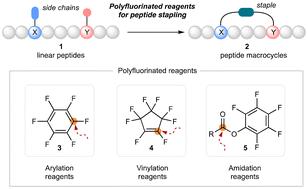
Peptide stapling has emerged as a valuable approach for modulating peptide structures and enhancing their functional properties, with broad applications for drug discovery and biomolecular engineering. Among the diverse stapling strategies, polyfluorinated reagent-mediated approaches stand out due to their unique ability to provide desirable physicochemical properties such as improved stability, lipophilicity, and binding affinity. This review highlights recent advancements in polyfluorinated reagents for native peptide stapling, focusing on three major classes: arylation, vinylation, and amidation reagents. These reagents enable precise peptide modifications by leveraging the reactivity and selectivity modulated by fluorine substituents, facilitating the engineering of native peptides and biologics.




 京公网安备 11010802042870号
京ICP备2023020795号-1
京公网安备 11010802042870号
京ICP备2023020795号-1

 分享
分享

 求助内容:
求助内容: 应助结果提醒方式:
 扫码关注我们
