Daifan Yue , Dongming Zheng , Linlan Yang , Yuxin Bai , Zhen Song , Dongmei Li , Xiaoqin Yu , Yan Li
{"title":"小檗碱破坏高亲和力铁转运系统以逆转白色念珠菌的氟康唑耐药性","authors":"Daifan Yue , Dongming Zheng , Linlan Yang , Yuxin Bai , Zhen Song , Dongmei Li , Xiaoqin Yu , Yan Li","doi":"10.1016/j.micpath.2025.107370","DOIUrl":null,"url":null,"abstract":"<div><div>Invasive fungal infection is usually caused by <em>Candida albicans</em> infection, which has a high incidence rate and mortality in critically ill patients. New drugs are needed to combat this pathogen since the limited treatment options currently available and increasing resistance to existing drugs. Berberine (BBR) is an active compound in <em>Coptis chinensis</em>, <em>Phellodendron chinense</em> and <em>Radix berberidis</em>, which is clinically used to treat inflammatory bowel disease, but its inhibitory effect on drug-resistant fungi has not been clarified. In this study, based on the evidence of BBR inhibiting the expression of azole-resistance genes, reducing cell adhesion and disrupting biofilm formation, transcriptome analysis revealed that the disruption of iron acquisition pathway may be the core link in BBR inhibiting drug-resistant fungi. Combined with the subsequent experimental results, including the reduction of intracellular ferrous ion content, the weakening of iron reductase activity and the overall downregulation of the coding gene of the high-affinity iron reduction system, it is speculated that the fungal growth defect under BBR treatment is the result of the interruption of the high-affinity iron acquisition pathway. Ftr1 plays a central role in the drug targeting of this transport system. Meanwhile, due to the iron deficiency within the cell, the biological function of mitochondria is impaired, ultimately leading to fungal death. This study not only reflects the application value of BBR in the clinical treatment of fungal infections, but also provides a potential strategy to address the current drug-resistance dilemma.</div></div>","PeriodicalId":18599,"journal":{"name":"Microbial pathogenesis","volume":"200 ","pages":"Article 107370"},"PeriodicalIF":3.5000,"publicationDate":"2025-03-01","publicationTypes":"Journal Article","fieldsOfStudy":null,"isOpenAccess":false,"openAccessPdf":"","citationCount":"0","resultStr":"{\"title\":\"Berberine disrupts the high-affinity iron transport system to reverse the fluconazole-resistance in Candida albicans\",\"authors\":\"Daifan Yue , Dongming Zheng , Linlan Yang , Yuxin Bai , Zhen Song , Dongmei Li , Xiaoqin Yu , Yan Li\",\"doi\":\"10.1016/j.micpath.2025.107370\",\"DOIUrl\":null,\"url\":null,\"abstract\":\"<div><div>Invasive fungal infection is usually caused by <em>Candida albicans</em> infection, which has a high incidence rate and mortality in critically ill patients. New drugs are needed to combat this pathogen since the limited treatment options currently available and increasing resistance to existing drugs. Berberine (BBR) is an active compound in <em>Coptis chinensis</em>, <em>Phellodendron chinense</em> and <em>Radix berberidis</em>, which is clinically used to treat inflammatory bowel disease, but its inhibitory effect on drug-resistant fungi has not been clarified. In this study, based on the evidence of BBR inhibiting the expression of azole-resistance genes, reducing cell adhesion and disrupting biofilm formation, transcriptome analysis revealed that the disruption of iron acquisition pathway may be the core link in BBR inhibiting drug-resistant fungi. Combined with the subsequent experimental results, including the reduction of intracellular ferrous ion content, the weakening of iron reductase activity and the overall downregulation of the coding gene of the high-affinity iron reduction system, it is speculated that the fungal growth defect under BBR treatment is the result of the interruption of the high-affinity iron acquisition pathway. Ftr1 plays a central role in the drug targeting of this transport system. Meanwhile, due to the iron deficiency within the cell, the biological function of mitochondria is impaired, ultimately leading to fungal death. This study not only reflects the application value of BBR in the clinical treatment of fungal infections, but also provides a potential strategy to address the current drug-resistance dilemma.</div></div>\",\"PeriodicalId\":18599,\"journal\":{\"name\":\"Microbial pathogenesis\",\"volume\":\"200 \",\"pages\":\"Article 107370\"},\"PeriodicalIF\":3.5000,\"publicationDate\":\"2025-03-01\",\"publicationTypes\":\"Journal Article\",\"fieldsOfStudy\":null,\"isOpenAccess\":false,\"openAccessPdf\":\"\",\"citationCount\":\"0\",\"resultStr\":null,\"platform\":\"Semanticscholar\",\"paperid\":null,\"PeriodicalName\":\"Microbial pathogenesis\",\"FirstCategoryId\":\"3\",\"ListUrlMain\":\"https://www.sciencedirect.com/science/article/pii/S0882401025000956\",\"RegionNum\":3,\"RegionCategory\":\"医学\",\"ArticlePicture\":[],\"TitleCN\":null,\"AbstractTextCN\":null,\"PMCID\":null,\"EPubDate\":\"2025/2/8 0:00:00\",\"PubModel\":\"Epub\",\"JCR\":\"Q3\",\"JCRName\":\"IMMUNOLOGY\",\"Score\":null,\"Total\":0}","platform":"Semanticscholar","paperid":null,"PeriodicalName":"Microbial pathogenesis","FirstCategoryId":"3","ListUrlMain":"https://www.sciencedirect.com/science/article/pii/S0882401025000956","RegionNum":3,"RegionCategory":"医学","ArticlePicture":[],"TitleCN":null,"AbstractTextCN":null,"PMCID":null,"EPubDate":"2025/2/8 0:00:00","PubModel":"Epub","JCR":"Q3","JCRName":"IMMUNOLOGY","Score":null,"Total":0}
Berberine disrupts the high-affinity iron transport system to reverse the fluconazole-resistance in Candida albicans
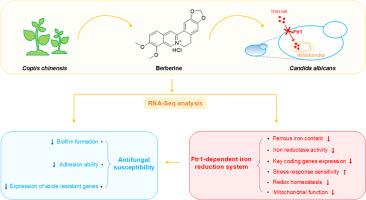
Invasive fungal infection is usually caused by Candida albicans infection, which has a high incidence rate and mortality in critically ill patients. New drugs are needed to combat this pathogen since the limited treatment options currently available and increasing resistance to existing drugs. Berberine (BBR) is an active compound in Coptis chinensis, Phellodendron chinense and Radix berberidis, which is clinically used to treat inflammatory bowel disease, but its inhibitory effect on drug-resistant fungi has not been clarified. In this study, based on the evidence of BBR inhibiting the expression of azole-resistance genes, reducing cell adhesion and disrupting biofilm formation, transcriptome analysis revealed that the disruption of iron acquisition pathway may be the core link in BBR inhibiting drug-resistant fungi. Combined with the subsequent experimental results, including the reduction of intracellular ferrous ion content, the weakening of iron reductase activity and the overall downregulation of the coding gene of the high-affinity iron reduction system, it is speculated that the fungal growth defect under BBR treatment is the result of the interruption of the high-affinity iron acquisition pathway. Ftr1 plays a central role in the drug targeting of this transport system. Meanwhile, due to the iron deficiency within the cell, the biological function of mitochondria is impaired, ultimately leading to fungal death. This study not only reflects the application value of BBR in the clinical treatment of fungal infections, but also provides a potential strategy to address the current drug-resistance dilemma.
期刊介绍:
Microbial Pathogenesis publishes original contributions and reviews about the molecular and cellular mechanisms of infectious diseases. It covers microbiology, host-pathogen interaction and immunology related to infectious agents, including bacteria, fungi, viruses and protozoa. It also accepts papers in the field of clinical microbiology, with the exception of case reports.
Research Areas Include:
-Pathogenesis
-Virulence factors
-Host susceptibility or resistance
-Immune mechanisms
-Identification, cloning and sequencing of relevant genes
-Genetic studies
-Viruses, prokaryotic organisms and protozoa
-Microbiota
-Systems biology related to infectious diseases
-Targets for vaccine design (pre-clinical studies)




 京公网安备 11010802042870号
京ICP备2023020795号-1
京公网安备 11010802042870号
京ICP备2023020795号-1

 分享
分享
 求助内容:
求助内容: 应助结果提醒方式:
 扫码关注我们
