Jiang Tu , Tao Mao , Suhui Xie , Hang Xiao , Peng Wang
{"title":"双化学交联策略制备轻质、阻燃、高模量和疏水纤维素低温凝胶","authors":"Jiang Tu , Tao Mao , Suhui Xie , Hang Xiao , Peng Wang","doi":"10.1016/j.carbpol.2025.123364","DOIUrl":null,"url":null,"abstract":"<div><div>Cellulose cryogel shows great application potential as a thermal insulation material because of its eco-friendliness, lightweight, high porosity and highly-efficient thermal insulation property. However, the high flammability and hydrophilicity have become bottlenecks to restrict its application in the thermal insulation field. Herein, we synthesized an amylose derivative with ammonium phosphate groups (AM), and reported a dual chemical crosslinking strategy to fabricate lightweight, flame-retardant, high-modulus and hydrophobic cellulose cryogel with AM and methyltrimethoxysilane (MTMS) via baking-crosslinking and chemical vapor deposition techniques. The dual crosslinking structure endowed the composite cryogel (AM30Si) with a high specific modulus of 47.0 MPa/(g/cm<sup>3</sup>), which enabled it to sustain 12,500 times its own weight. The thermal conductivity of AM30Si was only 28.7 mW/(m·K), which benefited from its anfractuous three-dimensional porous network structure. The P/N/Si synergy enhanced the flame retardancy of AM30Si, and its UL-94 rating and LOI value reached V-0 and 39.2%, respectively. Moreover, AM30Si possessed satisfactory hydrophobicity, oil absorption and continuous oil-water separation ability. This study provides not only an insight into the syntheses of reactive polysaccharide derivatives with high flame-retardant activity, but also an innovative solution to simultaneously address the inflammability, hydrophilicity and inadequate strength of cellulose cryogel while largely maintaining its lightweight feature.</div></div>","PeriodicalId":261,"journal":{"name":"Carbohydrate Polymers","volume":"355 ","pages":"Article 123364"},"PeriodicalIF":12.5000,"publicationDate":"2025-05-01","publicationTypes":"Journal Article","fieldsOfStudy":null,"isOpenAccess":false,"openAccessPdf":"","citationCount":"0","resultStr":"{\"title\":\"Dual chemical crosslinking strategy to fabricate lightweight, flame-retardant, high-modulus and hydrophobic cellulose cryogel\",\"authors\":\"Jiang Tu , Tao Mao , Suhui Xie , Hang Xiao , Peng Wang\",\"doi\":\"10.1016/j.carbpol.2025.123364\",\"DOIUrl\":null,\"url\":null,\"abstract\":\"<div><div>Cellulose cryogel shows great application potential as a thermal insulation material because of its eco-friendliness, lightweight, high porosity and highly-efficient thermal insulation property. However, the high flammability and hydrophilicity have become bottlenecks to restrict its application in the thermal insulation field. Herein, we synthesized an amylose derivative with ammonium phosphate groups (AM), and reported a dual chemical crosslinking strategy to fabricate lightweight, flame-retardant, high-modulus and hydrophobic cellulose cryogel with AM and methyltrimethoxysilane (MTMS) via baking-crosslinking and chemical vapor deposition techniques. The dual crosslinking structure endowed the composite cryogel (AM30Si) with a high specific modulus of 47.0 MPa/(g/cm<sup>3</sup>), which enabled it to sustain 12,500 times its own weight. The thermal conductivity of AM30Si was only 28.7 mW/(m·K), which benefited from its anfractuous three-dimensional porous network structure. The P/N/Si synergy enhanced the flame retardancy of AM30Si, and its UL-94 rating and LOI value reached V-0 and 39.2%, respectively. Moreover, AM30Si possessed satisfactory hydrophobicity, oil absorption and continuous oil-water separation ability. This study provides not only an insight into the syntheses of reactive polysaccharide derivatives with high flame-retardant activity, but also an innovative solution to simultaneously address the inflammability, hydrophilicity and inadequate strength of cellulose cryogel while largely maintaining its lightweight feature.</div></div>\",\"PeriodicalId\":261,\"journal\":{\"name\":\"Carbohydrate Polymers\",\"volume\":\"355 \",\"pages\":\"Article 123364\"},\"PeriodicalIF\":12.5000,\"publicationDate\":\"2025-05-01\",\"publicationTypes\":\"Journal Article\",\"fieldsOfStudy\":null,\"isOpenAccess\":false,\"openAccessPdf\":\"\",\"citationCount\":\"0\",\"resultStr\":null,\"platform\":\"Semanticscholar\",\"paperid\":null,\"PeriodicalName\":\"Carbohydrate Polymers\",\"FirstCategoryId\":\"92\",\"ListUrlMain\":\"https://www.sciencedirect.com/science/article/pii/S0144861725001456\",\"RegionNum\":1,\"RegionCategory\":\"化学\",\"ArticlePicture\":[],\"TitleCN\":null,\"AbstractTextCN\":null,\"PMCID\":null,\"EPubDate\":\"2025/2/8 0:00:00\",\"PubModel\":\"Epub\",\"JCR\":\"Q1\",\"JCRName\":\"CHEMISTRY, APPLIED\",\"Score\":null,\"Total\":0}","platform":"Semanticscholar","paperid":null,"PeriodicalName":"Carbohydrate Polymers","FirstCategoryId":"92","ListUrlMain":"https://www.sciencedirect.com/science/article/pii/S0144861725001456","RegionNum":1,"RegionCategory":"化学","ArticlePicture":[],"TitleCN":null,"AbstractTextCN":null,"PMCID":null,"EPubDate":"2025/2/8 0:00:00","PubModel":"Epub","JCR":"Q1","JCRName":"CHEMISTRY, APPLIED","Score":null,"Total":0}
Dual chemical crosslinking strategy to fabricate lightweight, flame-retardant, high-modulus and hydrophobic cellulose cryogel
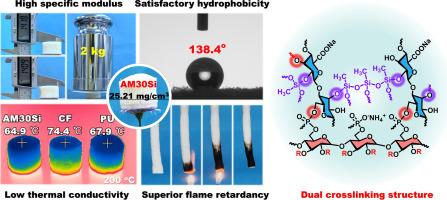
Cellulose cryogel shows great application potential as a thermal insulation material because of its eco-friendliness, lightweight, high porosity and highly-efficient thermal insulation property. However, the high flammability and hydrophilicity have become bottlenecks to restrict its application in the thermal insulation field. Herein, we synthesized an amylose derivative with ammonium phosphate groups (AM), and reported a dual chemical crosslinking strategy to fabricate lightweight, flame-retardant, high-modulus and hydrophobic cellulose cryogel with AM and methyltrimethoxysilane (MTMS) via baking-crosslinking and chemical vapor deposition techniques. The dual crosslinking structure endowed the composite cryogel (AM30Si) with a high specific modulus of 47.0 MPa/(g/cm3), which enabled it to sustain 12,500 times its own weight. The thermal conductivity of AM30Si was only 28.7 mW/(m·K), which benefited from its anfractuous three-dimensional porous network structure. The P/N/Si synergy enhanced the flame retardancy of AM30Si, and its UL-94 rating and LOI value reached V-0 and 39.2%, respectively. Moreover, AM30Si possessed satisfactory hydrophobicity, oil absorption and continuous oil-water separation ability. This study provides not only an insight into the syntheses of reactive polysaccharide derivatives with high flame-retardant activity, but also an innovative solution to simultaneously address the inflammability, hydrophilicity and inadequate strength of cellulose cryogel while largely maintaining its lightweight feature.
期刊介绍:
Carbohydrate Polymers stands as a prominent journal in the glycoscience field, dedicated to exploring and harnessing the potential of polysaccharides with applications spanning bioenergy, bioplastics, biomaterials, biorefining, chemistry, drug delivery, food, health, nanotechnology, packaging, paper, pharmaceuticals, medicine, oil recovery, textiles, tissue engineering, wood, and various aspects of glycoscience.
The journal emphasizes the central role of well-characterized carbohydrate polymers, highlighting their significance as the primary focus rather than a peripheral topic. Each paper must prominently feature at least one named carbohydrate polymer, evident in both citation and title, with a commitment to innovative research that advances scientific knowledge.




 京公网安备 11010802042870号
京ICP备2023020795号-1
京公网安备 11010802042870号
京ICP备2023020795号-1

 分享
分享
 求助内容:
求助内容: 应助结果提醒方式:
 扫码关注我们
