Chengli Yang , Xukun Liao , Kai Zhou , Yongchao Yao , Xinlong He , Wen Zhong , Dan Zheng , Yan Yang , Ming Li , Meng Zhou , Yadi Zhou , Lin Li , Yang Bai , Kun Shi , Zhiyong Qian
{"title":"多功能纳米颗粒和胶原酶双负载热敏水凝胶系统增强肿瘤渗透,逆转免疫抑制和光动力免疫治疗","authors":"Chengli Yang , Xukun Liao , Kai Zhou , Yongchao Yao , Xinlong He , Wen Zhong , Dan Zheng , Yan Yang , Ming Li , Meng Zhou , Yadi Zhou , Lin Li , Yang Bai , Kun Shi , Zhiyong Qian","doi":"10.1016/j.bioactmat.2025.02.014","DOIUrl":null,"url":null,"abstract":"<div><div>Breast cancer is the most prevalent and lethal malignancy among females, with a critical need for safer and less invasive treatments. Photodynamic therapy (PDT) can effectively eliminate tumor cells with minimal side effects. Furthermore, the combination of PDT and immunotherapy using nanoparticles has shown promise in treating both primary and distant metastatic tumor cells. Therefore, this study proposes applying the PDT-immunotherapy combination to breast cancer treatment. However, the low immunogenicity characteristic of “cold” tumors in part of breast cancer significantly diminishes therapeutic efficacy. To address this challenge, here, a nano-gel system (designated as HCSC-gel) is constructed, which co-delivers a mitochondria-targeted photosensitizer and a STING agonist, capable of robustly activating “cold” tumor immunity. This system is further enhanced by collagenase (CN) to improve therapeutic outcomes. Upon injection into the primary tumor site, HCSC-gel rapidly forms a gel matrix, releasing CN to degrade the tumor extracellular matrix and facilitate the penetration of photosensitizers, STING agonists, and oxygen into the tumor tissue. Under laser irradiation, PDT and STING-mediated immune responses are activated, reversing the low immunogenicity of breast cancer and effectively treating both primary and metastatic lesions. This HCSC-gel nano hydrogel delivery platform is anticipated to provide novel insights for the clinical management of breast cancer and other low immunogenic “cold” tumors, offering significant benefits to patients.</div></div>","PeriodicalId":8762,"journal":{"name":"Bioactive Materials","volume":"48 ","pages":"Pages 1-17"},"PeriodicalIF":18.0000,"publicationDate":"2025-06-01","publicationTypes":"Journal Article","fieldsOfStudy":null,"isOpenAccess":false,"openAccessPdf":"","citationCount":"0","resultStr":"{\"title\":\"Multifunctional nanoparticles and collagenase dual loaded thermosensitive hydrogel system for enhanced tumor-penetration, reversed immune suppression and photodynamic-immunotherapy\",\"authors\":\"Chengli Yang , Xukun Liao , Kai Zhou , Yongchao Yao , Xinlong He , Wen Zhong , Dan Zheng , Yan Yang , Ming Li , Meng Zhou , Yadi Zhou , Lin Li , Yang Bai , Kun Shi , Zhiyong Qian\",\"doi\":\"10.1016/j.bioactmat.2025.02.014\",\"DOIUrl\":null,\"url\":null,\"abstract\":\"<div><div>Breast cancer is the most prevalent and lethal malignancy among females, with a critical need for safer and less invasive treatments. Photodynamic therapy (PDT) can effectively eliminate tumor cells with minimal side effects. Furthermore, the combination of PDT and immunotherapy using nanoparticles has shown promise in treating both primary and distant metastatic tumor cells. Therefore, this study proposes applying the PDT-immunotherapy combination to breast cancer treatment. However, the low immunogenicity characteristic of “cold” tumors in part of breast cancer significantly diminishes therapeutic efficacy. To address this challenge, here, a nano-gel system (designated as HCSC-gel) is constructed, which co-delivers a mitochondria-targeted photosensitizer and a STING agonist, capable of robustly activating “cold” tumor immunity. This system is further enhanced by collagenase (CN) to improve therapeutic outcomes. Upon injection into the primary tumor site, HCSC-gel rapidly forms a gel matrix, releasing CN to degrade the tumor extracellular matrix and facilitate the penetration of photosensitizers, STING agonists, and oxygen into the tumor tissue. Under laser irradiation, PDT and STING-mediated immune responses are activated, reversing the low immunogenicity of breast cancer and effectively treating both primary and metastatic lesions. This HCSC-gel nano hydrogel delivery platform is anticipated to provide novel insights for the clinical management of breast cancer and other low immunogenic “cold” tumors, offering significant benefits to patients.</div></div>\",\"PeriodicalId\":8762,\"journal\":{\"name\":\"Bioactive Materials\",\"volume\":\"48 \",\"pages\":\"Pages 1-17\"},\"PeriodicalIF\":18.0000,\"publicationDate\":\"2025-06-01\",\"publicationTypes\":\"Journal Article\",\"fieldsOfStudy\":null,\"isOpenAccess\":false,\"openAccessPdf\":\"\",\"citationCount\":\"0\",\"resultStr\":null,\"platform\":\"Semanticscholar\",\"paperid\":null,\"PeriodicalName\":\"Bioactive Materials\",\"FirstCategoryId\":\"5\",\"ListUrlMain\":\"https://www.sciencedirect.com/science/article/pii/S2452199X25000623\",\"RegionNum\":1,\"RegionCategory\":\"医学\",\"ArticlePicture\":[],\"TitleCN\":null,\"AbstractTextCN\":null,\"PMCID\":null,\"EPubDate\":\"2025/2/12 0:00:00\",\"PubModel\":\"Epub\",\"JCR\":\"Q1\",\"JCRName\":\"ENGINEERING, BIOMEDICAL\",\"Score\":null,\"Total\":0}","platform":"Semanticscholar","paperid":null,"PeriodicalName":"Bioactive Materials","FirstCategoryId":"5","ListUrlMain":"https://www.sciencedirect.com/science/article/pii/S2452199X25000623","RegionNum":1,"RegionCategory":"医学","ArticlePicture":[],"TitleCN":null,"AbstractTextCN":null,"PMCID":null,"EPubDate":"2025/2/12 0:00:00","PubModel":"Epub","JCR":"Q1","JCRName":"ENGINEERING, BIOMEDICAL","Score":null,"Total":0}
Multifunctional nanoparticles and collagenase dual loaded thermosensitive hydrogel system for enhanced tumor-penetration, reversed immune suppression and photodynamic-immunotherapy
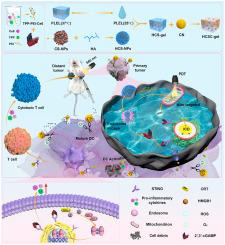
Breast cancer is the most prevalent and lethal malignancy among females, with a critical need for safer and less invasive treatments. Photodynamic therapy (PDT) can effectively eliminate tumor cells with minimal side effects. Furthermore, the combination of PDT and immunotherapy using nanoparticles has shown promise in treating both primary and distant metastatic tumor cells. Therefore, this study proposes applying the PDT-immunotherapy combination to breast cancer treatment. However, the low immunogenicity characteristic of “cold” tumors in part of breast cancer significantly diminishes therapeutic efficacy. To address this challenge, here, a nano-gel system (designated as HCSC-gel) is constructed, which co-delivers a mitochondria-targeted photosensitizer and a STING agonist, capable of robustly activating “cold” tumor immunity. This system is further enhanced by collagenase (CN) to improve therapeutic outcomes. Upon injection into the primary tumor site, HCSC-gel rapidly forms a gel matrix, releasing CN to degrade the tumor extracellular matrix and facilitate the penetration of photosensitizers, STING agonists, and oxygen into the tumor tissue. Under laser irradiation, PDT and STING-mediated immune responses are activated, reversing the low immunogenicity of breast cancer and effectively treating both primary and metastatic lesions. This HCSC-gel nano hydrogel delivery platform is anticipated to provide novel insights for the clinical management of breast cancer and other low immunogenic “cold” tumors, offering significant benefits to patients.
Bioactive MaterialsBiochemistry, Genetics and Molecular Biology-Biotechnology
CiteScore
28.00
自引率
6.30%
发文量
436
审稿时长
20 days
期刊介绍:
Bioactive Materials is a peer-reviewed research publication that focuses on advancements in bioactive materials. The journal accepts research papers, reviews, and rapid communications in the field of next-generation biomaterials that interact with cells, tissues, and organs in various living organisms.
The primary goal of Bioactive Materials is to promote the science and engineering of biomaterials that exhibit adaptiveness to the biological environment. These materials are specifically designed to stimulate or direct appropriate cell and tissue responses or regulate interactions with microorganisms.
The journal covers a wide range of bioactive materials, including those that are engineered or designed in terms of their physical form (e.g. particulate, fiber), topology (e.g. porosity, surface roughness), or dimensions (ranging from macro to nano-scales). Contributions are sought from the following categories of bioactive materials:
Bioactive metals and alloys
Bioactive inorganics: ceramics, glasses, and carbon-based materials
Bioactive polymers and gels
Bioactive materials derived from natural sources
Bioactive composites
These materials find applications in human and veterinary medicine, such as implants, tissue engineering scaffolds, cell/drug/gene carriers, as well as imaging and sensing devices.





 京公网安备 11010802042870号
京ICP备2023020795号-1
京公网安备 11010802042870号
京ICP备2023020795号-1

 分享
分享
 求助内容:
求助内容: 应助结果提醒方式:
 扫码关注我们
