A Rannebro, C Mesas-Burgos, U Fläring, S Eksborg, J Berner
{"title":"新生儿先天性膈疝成功拔管的预后因素。","authors":"A Rannebro, C Mesas-Burgos, U Fläring, S Eksborg, J Berner","doi":"10.3389/fped.2025.1530467","DOIUrl":null,"url":null,"abstract":"<p><strong>Introduction: </strong>Neonates with congenital diaphragmatic hernia (CDH) have an associated high mortality and morbidity. The European CDH EURO consortium has developed guidelines for initial and perioperative ventilatory management. There are, however, no recommendations on how to wean these patients from the ventilator. Extubation failure is more frequent in this group of patients than in other neonates. The aim of this study was to describe patient characteristics and risk factors for failed extubation and to evaluate predictive factors for successful weaning.</p><p><strong>Methods: </strong>We performed a retrospective study in a single centre tertiary pediatric intensive care unit in Stockholm, Sweden. CDH-patients (<i>n</i> = 38), aged 0-28 days, with extubation events were identified from 2017 to 2019. Eight patients (21.1%) needed reintubation within 24 h after the first extubation attempt. Patient demographics, surgical repair with patch, oxygenation saturation index (OSI), rapid shallow breathing index (RSBI), ventilatory settings, fluid balance and sedation on the day of extubation were recorded.</p><p><strong>Results: </strong>Patients in the failed extubation group (FE) had lower birth weight (<i>p</i> < 0.05), surgical patch repair (<i>p</i> < 0.05), longer length of stay in intensive care (<i>p</i> < 0.05), longer time on the ventilator (<i>p</i> < 0.05) and other comorbidities (<i>p</i> < 0.001). Using logistic regression we identified OSI, RSBI and inspiratory pressure (Pinsp) as factors predicting a successful extubation, AUCROC 0.95 (95% CI: 0.87 to 1.00). Patients in the FE-group had significantly more often pulmonary hypertension requiring treatment (<i>p</i> < 0.05), a higher fraction of inspired oxygen (FiO<sub>2</sub>) (<i>p</i> < 0.05) and hypercapnia (<i>p</i> < 0.001) prior to extubation and an oxygen demand exceeding 40% two hours after extubation (<i>p</i> < 0.05).</p><p><strong>Conclusion: </strong>Useful predictors of successful extubation in CDH patients are OSI, RSBI and Pinsp. Low birth weight, patch repair and comorbidity also appear to be important factors. Prospective studies are required to confirm findings in the present study.</p>","PeriodicalId":12637,"journal":{"name":"Frontiers in Pediatrics","volume":"13 ","pages":"1530467"},"PeriodicalIF":2.0000,"publicationDate":"2025-01-27","publicationTypes":"Journal Article","fieldsOfStudy":null,"isOpenAccess":false,"openAccessPdf":"https://www.ncbi.nlm.nih.gov/pmc/articles/PMC11807963/pdf/","citationCount":"0","resultStr":"{\"title\":\"Prognostic factors for successful extubation in newborns with congenital diaphragmatic hernia.\",\"authors\":\"A Rannebro, C Mesas-Burgos, U Fläring, S Eksborg, J Berner\",\"doi\":\"10.3389/fped.2025.1530467\",\"DOIUrl\":null,\"url\":null,\"abstract\":\"<p><strong>Introduction: </strong>Neonates with congenital diaphragmatic hernia (CDH) have an associated high mortality and morbidity. The European CDH EURO consortium has developed guidelines for initial and perioperative ventilatory management. There are, however, no recommendations on how to wean these patients from the ventilator. Extubation failure is more frequent in this group of patients than in other neonates. The aim of this study was to describe patient characteristics and risk factors for failed extubation and to evaluate predictive factors for successful weaning.</p><p><strong>Methods: </strong>We performed a retrospective study in a single centre tertiary pediatric intensive care unit in Stockholm, Sweden. CDH-patients (<i>n</i> = 38), aged 0-28 days, with extubation events were identified from 2017 to 2019. Eight patients (21.1%) needed reintubation within 24 h after the first extubation attempt. Patient demographics, surgical repair with patch, oxygenation saturation index (OSI), rapid shallow breathing index (RSBI), ventilatory settings, fluid balance and sedation on the day of extubation were recorded.</p><p><strong>Results: </strong>Patients in the failed extubation group (FE) had lower birth weight (<i>p</i> < 0.05), surgical patch repair (<i>p</i> < 0.05), longer length of stay in intensive care (<i>p</i> < 0.05), longer time on the ventilator (<i>p</i> < 0.05) and other comorbidities (<i>p</i> < 0.001). Using logistic regression we identified OSI, RSBI and inspiratory pressure (Pinsp) as factors predicting a successful extubation, AUCROC 0.95 (95% CI: 0.87 to 1.00). Patients in the FE-group had significantly more often pulmonary hypertension requiring treatment (<i>p</i> < 0.05), a higher fraction of inspired oxygen (FiO<sub>2</sub>) (<i>p</i> < 0.05) and hypercapnia (<i>p</i> < 0.001) prior to extubation and an oxygen demand exceeding 40% two hours after extubation (<i>p</i> < 0.05).</p><p><strong>Conclusion: </strong>Useful predictors of successful extubation in CDH patients are OSI, RSBI and Pinsp. Low birth weight, patch repair and comorbidity also appear to be important factors. Prospective studies are required to confirm findings in the present study.</p>\",\"PeriodicalId\":12637,\"journal\":{\"name\":\"Frontiers in Pediatrics\",\"volume\":\"13 \",\"pages\":\"1530467\"},\"PeriodicalIF\":2.0000,\"publicationDate\":\"2025-01-27\",\"publicationTypes\":\"Journal Article\",\"fieldsOfStudy\":null,\"isOpenAccess\":false,\"openAccessPdf\":\"https://www.ncbi.nlm.nih.gov/pmc/articles/PMC11807963/pdf/\",\"citationCount\":\"0\",\"resultStr\":null,\"platform\":\"Semanticscholar\",\"paperid\":null,\"PeriodicalName\":\"Frontiers in Pediatrics\",\"FirstCategoryId\":\"3\",\"ListUrlMain\":\"https://doi.org/10.3389/fped.2025.1530467\",\"RegionNum\":3,\"RegionCategory\":\"医学\",\"ArticlePicture\":[],\"TitleCN\":null,\"AbstractTextCN\":null,\"PMCID\":null,\"EPubDate\":\"2025/1/1 0:00:00\",\"PubModel\":\"eCollection\",\"JCR\":\"Q2\",\"JCRName\":\"PEDIATRICS\",\"Score\":null,\"Total\":0}","platform":"Semanticscholar","paperid":null,"PeriodicalName":"Frontiers in Pediatrics","FirstCategoryId":"3","ListUrlMain":"https://doi.org/10.3389/fped.2025.1530467","RegionNum":3,"RegionCategory":"医学","ArticlePicture":[],"TitleCN":null,"AbstractTextCN":null,"PMCID":null,"EPubDate":"2025/1/1 0:00:00","PubModel":"eCollection","JCR":"Q2","JCRName":"PEDIATRICS","Score":null,"Total":0}
引用次数: 0
摘要
新生儿先天性膈疝(CDH)具有相关的高死亡率和发病率。欧洲CDH欧洲联盟制定了初始和围手术期通气管理指南。然而,没有关于如何让这些患者脱离呼吸机的建议。拔管失败在这组患者中比在其他新生儿中更常见。本研究的目的是描述拔管失败的患者特征和危险因素,并评估成功脱机的预测因素。方法:我们在瑞典斯德哥尔摩的一个单中心三级儿科重症监护室进行了一项回顾性研究。在2017年至2019年期间,发现年龄0-28天的cdh患者(n = 38)发生拔管事件。8例患者(21.1%)在首次拔管后24 h内需要再次插管。记录拔管当日患者人口统计学、手术补片修复、氧合饱和度指数(OSI)、快速浅呼吸指数(RSBI)、通气设置、体液平衡及镇静情况。结果:拔管失败组(FE)患儿出生体重较低(p p p p p 2) (p p p 2)结论:预测CDH患儿拔管成功的有效指标为OSI、RSBI和Pinsp。低出生体重、补片修复和合并症也是重要因素。需要前瞻性研究来证实本研究的发现。
Prognostic factors for successful extubation in newborns with congenital diaphragmatic hernia.
Introduction: Neonates with congenital diaphragmatic hernia (CDH) have an associated high mortality and morbidity. The European CDH EURO consortium has developed guidelines for initial and perioperative ventilatory management. There are, however, no recommendations on how to wean these patients from the ventilator. Extubation failure is more frequent in this group of patients than in other neonates. The aim of this study was to describe patient characteristics and risk factors for failed extubation and to evaluate predictive factors for successful weaning.
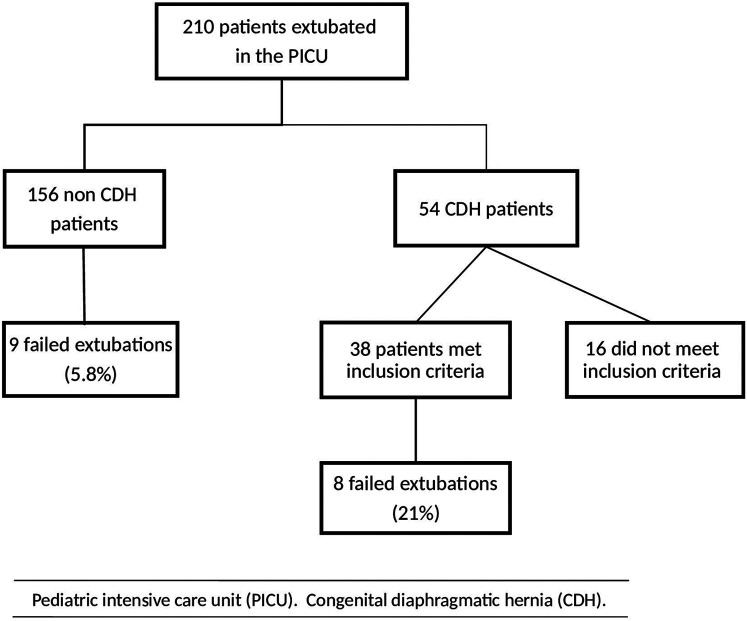
Methods: We performed a retrospective study in a single centre tertiary pediatric intensive care unit in Stockholm, Sweden. CDH-patients (n = 38), aged 0-28 days, with extubation events were identified from 2017 to 2019. Eight patients (21.1%) needed reintubation within 24 h after the first extubation attempt. Patient demographics, surgical repair with patch, oxygenation saturation index (OSI), rapid shallow breathing index (RSBI), ventilatory settings, fluid balance and sedation on the day of extubation were recorded.
Results: Patients in the failed extubation group (FE) had lower birth weight (p < 0.05), surgical patch repair (p < 0.05), longer length of stay in intensive care (p < 0.05), longer time on the ventilator (p < 0.05) and other comorbidities (p < 0.001). Using logistic regression we identified OSI, RSBI and inspiratory pressure (Pinsp) as factors predicting a successful extubation, AUCROC 0.95 (95% CI: 0.87 to 1.00). Patients in the FE-group had significantly more often pulmonary hypertension requiring treatment (p < 0.05), a higher fraction of inspired oxygen (FiO2) (p < 0.05) and hypercapnia (p < 0.001) prior to extubation and an oxygen demand exceeding 40% two hours after extubation (p < 0.05).
Conclusion: Useful predictors of successful extubation in CDH patients are OSI, RSBI and Pinsp. Low birth weight, patch repair and comorbidity also appear to be important factors. Prospective studies are required to confirm findings in the present study.
期刊介绍:
Frontiers in Pediatrics (Impact Factor 2.33) publishes rigorously peer-reviewed research broadly across the field, from basic to clinical research that meets ongoing challenges in pediatric patient care and child health. Field Chief Editors Arjan Te Pas at Leiden University and Michael L. Moritz at the Children''s Hospital of Pittsburgh are supported by an outstanding Editorial Board of international experts. This multidisciplinary open-access journal is at the forefront of disseminating and communicating scientific knowledge and impactful discoveries to researchers, academics, clinicians and the public worldwide.
Frontiers in Pediatrics also features Research Topics, Frontiers special theme-focused issues managed by Guest Associate Editors, addressing important areas in pediatrics. In this fashion, Frontiers serves as an outlet to publish the broadest aspects of pediatrics in both basic and clinical research, including high-quality reviews, case reports, editorials and commentaries related to all aspects of pediatrics.






 京公网安备 11010802042870号
京ICP备2023020795号-1
京公网安备 11010802042870号
京ICP备2023020795号-1

 分享
分享
 求助内容:
求助内容: 应助结果提醒方式:
 扫码关注我们
