Luyang Zhang, Yuichiro Hayashi, Masahiro Oda, Kensaku Mori
{"title":"双重混合伪标签框架:增强分类不平衡CT体积的半监督分割。","authors":"Luyang Zhang, Yuichiro Hayashi, Masahiro Oda, Kensaku Mori","doi":"10.1007/s11548-024-03281-1","DOIUrl":null,"url":null,"abstract":"<p><strong>Purpose: </strong>Deep-learning-based supervised CT segmentation relies on fully and densely labeled data, the labeling process of which is time-consuming. In this study, our proposed method aims to improve segmentation performance on CT volumes with limited annotated data by considering category-wise difficulties and distribution.</p><p><strong>Methods: </strong>We propose a novel confidence-difficulty weight (CDifW) allocation method that considers confidence levels, balancing the training across different categories, influencing the loss function and volume-mixing process for pseudo-label generation. Additionally, we introduce a novel Double-Mix Pseudo-label Framework (DMPF), which strategically selects categories for image blending based on the distribution of voxel-counts per category and the weight of segmentation difficulty. DMPF is designed to enhance the segmentation performance of categories that are challenging to segment.</p><p><strong>Result: </strong>Our approach was tested on two commonly used datasets: a Congenital Heart Disease (CHD) dataset and a Beyond-the-Cranial-Vault (BTCV) Abdomen dataset. Compared to the SOTA methods, our approach achieved an improvement of 5.1% and 7.0% in Dice score for the segmentation of difficult-to-segment categories on 5% of the labeled data in CHD and 40% of the labeled data in BTCV, respectively.</p><p><strong>Conclusion: </strong>Our method improves segmentation performance in difficult categories within CT volumes by category-wise weights and weight-based mixture augmentation. Our method was validated across multiple datasets and is significant for advancing semi-supervised segmentation tasks in health care. The code is available at https://github.com/MoriLabNU/Double-Mix .</p>","PeriodicalId":51251,"journal":{"name":"International Journal of Computer Assisted Radiology and Surgery","volume":" ","pages":"991-1002"},"PeriodicalIF":2.3000,"publicationDate":"2025-05-01","publicationTypes":"Journal Article","fieldsOfStudy":null,"isOpenAccess":false,"openAccessPdf":"https://www.ncbi.nlm.nih.gov/pmc/articles/PMC12055930/pdf/","citationCount":"0","resultStr":"{\"title\":\"Double-mix pseudo-label framework: enhancing semi-supervised segmentation on category-imbalanced CT volumes.\",\"authors\":\"Luyang Zhang, Yuichiro Hayashi, Masahiro Oda, Kensaku Mori\",\"doi\":\"10.1007/s11548-024-03281-1\",\"DOIUrl\":null,\"url\":null,\"abstract\":\"<p><strong>Purpose: </strong>Deep-learning-based supervised CT segmentation relies on fully and densely labeled data, the labeling process of which is time-consuming. In this study, our proposed method aims to improve segmentation performance on CT volumes with limited annotated data by considering category-wise difficulties and distribution.</p><p><strong>Methods: </strong>We propose a novel confidence-difficulty weight (CDifW) allocation method that considers confidence levels, balancing the training across different categories, influencing the loss function and volume-mixing process for pseudo-label generation. Additionally, we introduce a novel Double-Mix Pseudo-label Framework (DMPF), which strategically selects categories for image blending based on the distribution of voxel-counts per category and the weight of segmentation difficulty. DMPF is designed to enhance the segmentation performance of categories that are challenging to segment.</p><p><strong>Result: </strong>Our approach was tested on two commonly used datasets: a Congenital Heart Disease (CHD) dataset and a Beyond-the-Cranial-Vault (BTCV) Abdomen dataset. Compared to the SOTA methods, our approach achieved an improvement of 5.1% and 7.0% in Dice score for the segmentation of difficult-to-segment categories on 5% of the labeled data in CHD and 40% of the labeled data in BTCV, respectively.</p><p><strong>Conclusion: </strong>Our method improves segmentation performance in difficult categories within CT volumes by category-wise weights and weight-based mixture augmentation. Our method was validated across multiple datasets and is significant for advancing semi-supervised segmentation tasks in health care. The code is available at https://github.com/MoriLabNU/Double-Mix .</p>\",\"PeriodicalId\":51251,\"journal\":{\"name\":\"International Journal of Computer Assisted Radiology and Surgery\",\"volume\":\" \",\"pages\":\"991-1002\"},\"PeriodicalIF\":2.3000,\"publicationDate\":\"2025-05-01\",\"publicationTypes\":\"Journal Article\",\"fieldsOfStudy\":null,\"isOpenAccess\":false,\"openAccessPdf\":\"https://www.ncbi.nlm.nih.gov/pmc/articles/PMC12055930/pdf/\",\"citationCount\":\"0\",\"resultStr\":null,\"platform\":\"Semanticscholar\",\"paperid\":null,\"PeriodicalName\":\"International Journal of Computer Assisted Radiology and Surgery\",\"FirstCategoryId\":\"5\",\"ListUrlMain\":\"https://doi.org/10.1007/s11548-024-03281-1\",\"RegionNum\":3,\"RegionCategory\":\"医学\",\"ArticlePicture\":[],\"TitleCN\":null,\"AbstractTextCN\":null,\"PMCID\":null,\"EPubDate\":\"2025/2/11 0:00:00\",\"PubModel\":\"Epub\",\"JCR\":\"Q3\",\"JCRName\":\"ENGINEERING, BIOMEDICAL\",\"Score\":null,\"Total\":0}","platform":"Semanticscholar","paperid":null,"PeriodicalName":"International Journal of Computer Assisted Radiology and Surgery","FirstCategoryId":"5","ListUrlMain":"https://doi.org/10.1007/s11548-024-03281-1","RegionNum":3,"RegionCategory":"医学","ArticlePicture":[],"TitleCN":null,"AbstractTextCN":null,"PMCID":null,"EPubDate":"2025/2/11 0:00:00","PubModel":"Epub","JCR":"Q3","JCRName":"ENGINEERING, BIOMEDICAL","Score":null,"Total":0}
Double-mix pseudo-label framework: enhancing semi-supervised segmentation on category-imbalanced CT volumes.
Purpose: Deep-learning-based supervised CT segmentation relies on fully and densely labeled data, the labeling process of which is time-consuming. In this study, our proposed method aims to improve segmentation performance on CT volumes with limited annotated data by considering category-wise difficulties and distribution.
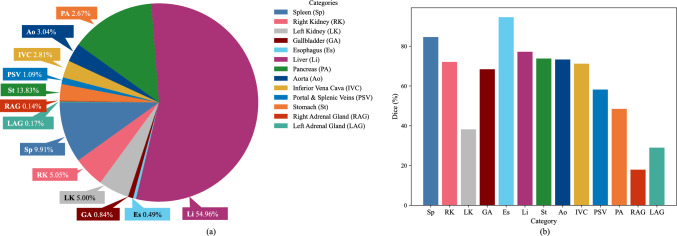
Methods: We propose a novel confidence-difficulty weight (CDifW) allocation method that considers confidence levels, balancing the training across different categories, influencing the loss function and volume-mixing process for pseudo-label generation. Additionally, we introduce a novel Double-Mix Pseudo-label Framework (DMPF), which strategically selects categories for image blending based on the distribution of voxel-counts per category and the weight of segmentation difficulty. DMPF is designed to enhance the segmentation performance of categories that are challenging to segment.
Result: Our approach was tested on two commonly used datasets: a Congenital Heart Disease (CHD) dataset and a Beyond-the-Cranial-Vault (BTCV) Abdomen dataset. Compared to the SOTA methods, our approach achieved an improvement of 5.1% and 7.0% in Dice score for the segmentation of difficult-to-segment categories on 5% of the labeled data in CHD and 40% of the labeled data in BTCV, respectively.
Conclusion: Our method improves segmentation performance in difficult categories within CT volumes by category-wise weights and weight-based mixture augmentation. Our method was validated across multiple datasets and is significant for advancing semi-supervised segmentation tasks in health care. The code is available at https://github.com/MoriLabNU/Double-Mix .
期刊介绍:
The International Journal for Computer Assisted Radiology and Surgery (IJCARS) is a peer-reviewed journal that provides a platform for closing the gap between medical and technical disciplines, and encourages interdisciplinary research and development activities in an international environment.






 京公网安备 11010802042870号
京ICP备2023020795号-1
京公网安备 11010802042870号
京ICP备2023020795号-1

 分享
分享
 求助内容:
求助内容: 应助结果提醒方式:
 扫码关注我们
