Charles Alba, Bing Xue, Joanna Abraham, Thomas Kannampallil, Chenyang Lu
{"title":"使用临床记录预测术后风险的大型语言模型的基本能力","authors":"Charles Alba, Bing Xue, Joanna Abraham, Thomas Kannampallil, Chenyang Lu","doi":"10.1038/s41746-025-01489-2","DOIUrl":null,"url":null,"abstract":"<p>Clinical notes recorded during a patient’s perioperative journey holds immense informational value. Advances in large language models (LLMs) offer opportunities for bridging this gap. Using 84,875 preoperative notes and its associated surgical cases from 2018 to 2021, we examine the performance of LLMs in predicting six postoperative risks using various fine-tuning strategies. Pretrained LLMs outperformed traditional word embeddings by an absolute AUROC of 38.3% and AUPRC of 33.2%. Self-supervised fine-tuning further improved performance by 3.2% and 1.5%. Incorporating labels into training further increased AUROC by 1.8% and AUPRC by 2%. The highest performance was achieved with a unified foundation model, with improvements of 3.6% for AUROC and 2.6% for AUPRC compared to self-supervision, highlighting the foundational capabilities of LLMs in predicting postoperative risks, which could be potentially beneficial when deployed for perioperative care.</p>","PeriodicalId":19349,"journal":{"name":"NPJ Digital Medicine","volume":"29 1","pages":""},"PeriodicalIF":15.1000,"publicationDate":"2025-02-11","publicationTypes":"Journal Article","fieldsOfStudy":null,"isOpenAccess":false,"openAccessPdf":"","citationCount":"0","resultStr":"{\"title\":\"The foundational capabilities of large language models in predicting postoperative risks using clinical notes\",\"authors\":\"Charles Alba, Bing Xue, Joanna Abraham, Thomas Kannampallil, Chenyang Lu\",\"doi\":\"10.1038/s41746-025-01489-2\",\"DOIUrl\":null,\"url\":null,\"abstract\":\"<p>Clinical notes recorded during a patient’s perioperative journey holds immense informational value. Advances in large language models (LLMs) offer opportunities for bridging this gap. Using 84,875 preoperative notes and its associated surgical cases from 2018 to 2021, we examine the performance of LLMs in predicting six postoperative risks using various fine-tuning strategies. Pretrained LLMs outperformed traditional word embeddings by an absolute AUROC of 38.3% and AUPRC of 33.2%. Self-supervised fine-tuning further improved performance by 3.2% and 1.5%. Incorporating labels into training further increased AUROC by 1.8% and AUPRC by 2%. The highest performance was achieved with a unified foundation model, with improvements of 3.6% for AUROC and 2.6% for AUPRC compared to self-supervision, highlighting the foundational capabilities of LLMs in predicting postoperative risks, which could be potentially beneficial when deployed for perioperative care.</p>\",\"PeriodicalId\":19349,\"journal\":{\"name\":\"NPJ Digital Medicine\",\"volume\":\"29 1\",\"pages\":\"\"},\"PeriodicalIF\":15.1000,\"publicationDate\":\"2025-02-11\",\"publicationTypes\":\"Journal Article\",\"fieldsOfStudy\":null,\"isOpenAccess\":false,\"openAccessPdf\":\"\",\"citationCount\":\"0\",\"resultStr\":null,\"platform\":\"Semanticscholar\",\"paperid\":null,\"PeriodicalName\":\"NPJ Digital Medicine\",\"FirstCategoryId\":\"3\",\"ListUrlMain\":\"https://doi.org/10.1038/s41746-025-01489-2\",\"RegionNum\":1,\"RegionCategory\":\"医学\",\"ArticlePicture\":[],\"TitleCN\":null,\"AbstractTextCN\":null,\"PMCID\":null,\"EPubDate\":\"\",\"PubModel\":\"\",\"JCR\":\"Q1\",\"JCRName\":\"HEALTH CARE SCIENCES & SERVICES\",\"Score\":null,\"Total\":0}","platform":"Semanticscholar","paperid":null,"PeriodicalName":"NPJ Digital Medicine","FirstCategoryId":"3","ListUrlMain":"https://doi.org/10.1038/s41746-025-01489-2","RegionNum":1,"RegionCategory":"医学","ArticlePicture":[],"TitleCN":null,"AbstractTextCN":null,"PMCID":null,"EPubDate":"","PubModel":"","JCR":"Q1","JCRName":"HEALTH CARE SCIENCES & SERVICES","Score":null,"Total":0}
The foundational capabilities of large language models in predicting postoperative risks using clinical notes
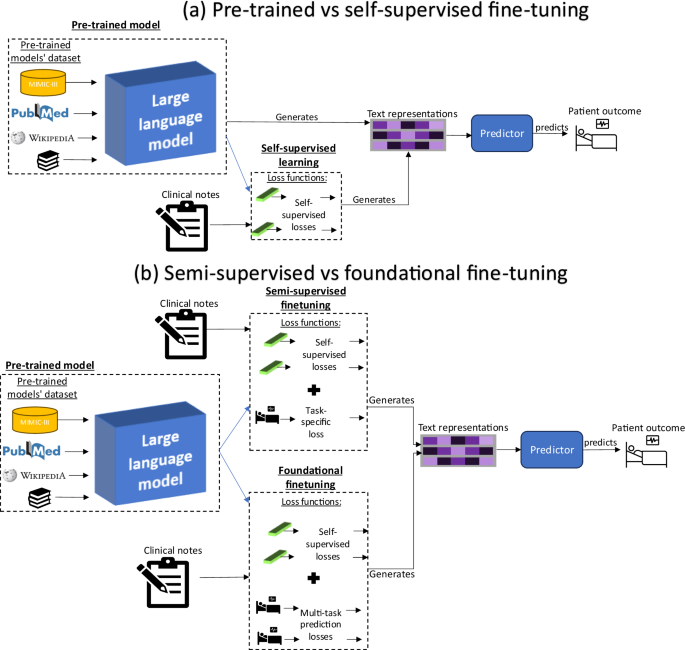
Clinical notes recorded during a patient’s perioperative journey holds immense informational value. Advances in large language models (LLMs) offer opportunities for bridging this gap. Using 84,875 preoperative notes and its associated surgical cases from 2018 to 2021, we examine the performance of LLMs in predicting six postoperative risks using various fine-tuning strategies. Pretrained LLMs outperformed traditional word embeddings by an absolute AUROC of 38.3% and AUPRC of 33.2%. Self-supervised fine-tuning further improved performance by 3.2% and 1.5%. Incorporating labels into training further increased AUROC by 1.8% and AUPRC by 2%. The highest performance was achieved with a unified foundation model, with improvements of 3.6% for AUROC and 2.6% for AUPRC compared to self-supervision, highlighting the foundational capabilities of LLMs in predicting postoperative risks, which could be potentially beneficial when deployed for perioperative care.
期刊介绍:
npj Digital Medicine is an online open-access journal that focuses on publishing peer-reviewed research in the field of digital medicine. The journal covers various aspects of digital medicine, including the application and implementation of digital and mobile technologies in clinical settings, virtual healthcare, and the use of artificial intelligence and informatics.
The primary goal of the journal is to support innovation and the advancement of healthcare through the integration of new digital and mobile technologies. When determining if a manuscript is suitable for publication, the journal considers four important criteria: novelty, clinical relevance, scientific rigor, and digital innovation.





 京公网安备 11010802042870号
京ICP备2023020795号-1
京公网安备 11010802042870号
京ICP备2023020795号-1

 分享
分享
 求助内容:
求助内容: 应助结果提醒方式:
 扫码关注我们
