{"title":"由光变形线性液晶聚合物实现的全光微流控技术","authors":"Lixin Jiang, Lang Qin, Feng Pan, Yanlei Yu","doi":"10.1021/accountsmr.4c00318","DOIUrl":null,"url":null,"abstract":"The microfluidic biochemical/immunoassay systems typically consist of microfluidic chips, fluid driving devices, and detection components. The core of the system is the microfluidic chips based on microfluidic technology, which are typically constructed with nonresponsive materials such as silicon, glass, and rigid plastics, thus requiring complex external air/liquid pumps to manipulate the samples. The external equipment renders the microfluidic systems cumbersome and increases the risk of biosample contamination. The all-optical microfluidic chip (AOMC) integrates all necessary microfluidic units and uses light to manipulate microfluids, which has the potential to completely solve the major problems of miniaturization and integration in microfluidic systems. The photocontrolled manipulation in AOMCs facilitates contactless interaction with liquids, eliminating the need for physical interconnects such as complex external electric, hydraulic, or pneumatic devices and replacing the traditional microfluidic components such as pumps, mixers, and separators, which offers AOMCs improved flexibility, robustness, and portability. However, impeded by photocontrolled principles and appropriate materials, AOMCs and photocontrolled biochemical/immunoassay analyzers have never been created.","PeriodicalId":72040,"journal":{"name":"Accounts of materials research","volume":"40 1","pages":""},"PeriodicalIF":14.7000,"publicationDate":"2025-02-12","publicationTypes":"Journal Article","fieldsOfStudy":null,"isOpenAccess":false,"openAccessPdf":"","citationCount":"0","resultStr":"{\"title\":\"All-Optical Microfluidic Technology Enabled by Photodeformable Linear Liquid Crystal Polymers\",\"authors\":\"Lixin Jiang, Lang Qin, Feng Pan, Yanlei Yu\",\"doi\":\"10.1021/accountsmr.4c00318\",\"DOIUrl\":null,\"url\":null,\"abstract\":\"The microfluidic biochemical/immunoassay systems typically consist of microfluidic chips, fluid driving devices, and detection components. The core of the system is the microfluidic chips based on microfluidic technology, which are typically constructed with nonresponsive materials such as silicon, glass, and rigid plastics, thus requiring complex external air/liquid pumps to manipulate the samples. The external equipment renders the microfluidic systems cumbersome and increases the risk of biosample contamination. The all-optical microfluidic chip (AOMC) integrates all necessary microfluidic units and uses light to manipulate microfluids, which has the potential to completely solve the major problems of miniaturization and integration in microfluidic systems. The photocontrolled manipulation in AOMCs facilitates contactless interaction with liquids, eliminating the need for physical interconnects such as complex external electric, hydraulic, or pneumatic devices and replacing the traditional microfluidic components such as pumps, mixers, and separators, which offers AOMCs improved flexibility, robustness, and portability. However, impeded by photocontrolled principles and appropriate materials, AOMCs and photocontrolled biochemical/immunoassay analyzers have never been created.\",\"PeriodicalId\":72040,\"journal\":{\"name\":\"Accounts of materials research\",\"volume\":\"40 1\",\"pages\":\"\"},\"PeriodicalIF\":14.7000,\"publicationDate\":\"2025-02-12\",\"publicationTypes\":\"Journal Article\",\"fieldsOfStudy\":null,\"isOpenAccess\":false,\"openAccessPdf\":\"\",\"citationCount\":\"0\",\"resultStr\":null,\"platform\":\"Semanticscholar\",\"paperid\":null,\"PeriodicalName\":\"Accounts of materials research\",\"FirstCategoryId\":\"1085\",\"ListUrlMain\":\"https://doi.org/10.1021/accountsmr.4c00318\",\"RegionNum\":0,\"RegionCategory\":null,\"ArticlePicture\":[],\"TitleCN\":null,\"AbstractTextCN\":null,\"PMCID\":null,\"EPubDate\":\"\",\"PubModel\":\"\",\"JCR\":\"Q1\",\"JCRName\":\"CHEMISTRY, MULTIDISCIPLINARY\",\"Score\":null,\"Total\":0}","platform":"Semanticscholar","paperid":null,"PeriodicalName":"Accounts of materials research","FirstCategoryId":"1085","ListUrlMain":"https://doi.org/10.1021/accountsmr.4c00318","RegionNum":0,"RegionCategory":null,"ArticlePicture":[],"TitleCN":null,"AbstractTextCN":null,"PMCID":null,"EPubDate":"","PubModel":"","JCR":"Q1","JCRName":"CHEMISTRY, MULTIDISCIPLINARY","Score":null,"Total":0}
All-Optical Microfluidic Technology Enabled by Photodeformable Linear Liquid Crystal Polymers
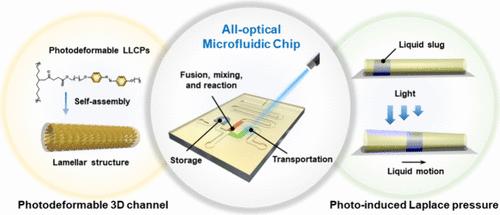
The microfluidic biochemical/immunoassay systems typically consist of microfluidic chips, fluid driving devices, and detection components. The core of the system is the microfluidic chips based on microfluidic technology, which are typically constructed with nonresponsive materials such as silicon, glass, and rigid plastics, thus requiring complex external air/liquid pumps to manipulate the samples. The external equipment renders the microfluidic systems cumbersome and increases the risk of biosample contamination. The all-optical microfluidic chip (AOMC) integrates all necessary microfluidic units and uses light to manipulate microfluids, which has the potential to completely solve the major problems of miniaturization and integration in microfluidic systems. The photocontrolled manipulation in AOMCs facilitates contactless interaction with liquids, eliminating the need for physical interconnects such as complex external electric, hydraulic, or pneumatic devices and replacing the traditional microfluidic components such as pumps, mixers, and separators, which offers AOMCs improved flexibility, robustness, and portability. However, impeded by photocontrolled principles and appropriate materials, AOMCs and photocontrolled biochemical/immunoassay analyzers have never been created.




 京公网安备 11010802042870号
京ICP备2023020795号-1
京公网安备 11010802042870号
京ICP备2023020795号-1

 分享
分享

 求助内容:
求助内容: 应助结果提醒方式:
 扫码关注我们
