Wenying Li, Jingchun Feng, Kexuan Wu, Si Zhang, Yuelu Jiang and Guozhong Wu*,
{"title":"沥青烯纳米聚集体与多糖动态异聚集过程中的平衡与时间演化","authors":"Wenying Li, Jingchun Feng, Kexuan Wu, Si Zhang, Yuelu Jiang and Guozhong Wu*, ","doi":"10.1021/acs.energyfuels.4c05668","DOIUrl":null,"url":null,"abstract":"<p >Asphaltene blockage and microbiologically induced corrosion (MIC) in oil pipes pose substantial flow assurance challenges, but their interrelationship remains poorly understood despite extensive individual research efforts. This study utilized molecular dynamics simulation and machine learning techniques to elucidate the effects of alginate, a representative biofilm polysaccharide associated with MIC, on asphaltene aggregation. Results underscored the ability of alginates to disperse large asphaltene nanoaggregates into smaller ones with more pronounced dispersion effects at higher concentrations. This was achieved through forming asphaltene–alginate heteroaggregates wherein asphaltene nanoaggregates were tightly wrapped by cross-linked alginate chains stabilized by Na<sup>+</sup> bridging. The presence of alginates significantly increased the solvent accessible surface area (SASA) of asphaltenes, while the heteroaggregation process resulted in abundant hydroxyl and carboxyl groups coating the surface of the asphaltene nanoaggregates. Furthermore, this study showed that the time-varying asphaltene aggregation parameters such as nanoaggregate number, intermolecular contact number, and SASA could be accurately predicted by alginate structural properties using optimized random forest models built from 3636 data sets extracted from molecular trajectories (<i>R</i><sup>2</sup> = 0.9628–0.9827). This enabled fast prediction of asphaltene aggregation when the polysaccharide composition and concentration changed during the MIC process. These findings provided theoretical support for developing strategies to address asphaltene-related issues in the presence of a biofilm polysaccharide.</p>","PeriodicalId":35,"journal":{"name":"Energy & Fuels","volume":"39 6","pages":"3056–3068 3056–3068"},"PeriodicalIF":5.3000,"publicationDate":"2025-02-03","publicationTypes":"Journal Article","fieldsOfStudy":null,"isOpenAccess":false,"openAccessPdf":"","citationCount":"0","resultStr":"{\"title\":\"Equilibrium and Temporal Evolution of Asphaltene Nanoaggregates during Dynamic Heteroaggregation with Polysaccharides\",\"authors\":\"Wenying Li, Jingchun Feng, Kexuan Wu, Si Zhang, Yuelu Jiang and Guozhong Wu*, \",\"doi\":\"10.1021/acs.energyfuels.4c05668\",\"DOIUrl\":null,\"url\":null,\"abstract\":\"<p >Asphaltene blockage and microbiologically induced corrosion (MIC) in oil pipes pose substantial flow assurance challenges, but their interrelationship remains poorly understood despite extensive individual research efforts. This study utilized molecular dynamics simulation and machine learning techniques to elucidate the effects of alginate, a representative biofilm polysaccharide associated with MIC, on asphaltene aggregation. Results underscored the ability of alginates to disperse large asphaltene nanoaggregates into smaller ones with more pronounced dispersion effects at higher concentrations. This was achieved through forming asphaltene–alginate heteroaggregates wherein asphaltene nanoaggregates were tightly wrapped by cross-linked alginate chains stabilized by Na<sup>+</sup> bridging. The presence of alginates significantly increased the solvent accessible surface area (SASA) of asphaltenes, while the heteroaggregation process resulted in abundant hydroxyl and carboxyl groups coating the surface of the asphaltene nanoaggregates. Furthermore, this study showed that the time-varying asphaltene aggregation parameters such as nanoaggregate number, intermolecular contact number, and SASA could be accurately predicted by alginate structural properties using optimized random forest models built from 3636 data sets extracted from molecular trajectories (<i>R</i><sup>2</sup> = 0.9628–0.9827). This enabled fast prediction of asphaltene aggregation when the polysaccharide composition and concentration changed during the MIC process. These findings provided theoretical support for developing strategies to address asphaltene-related issues in the presence of a biofilm polysaccharide.</p>\",\"PeriodicalId\":35,\"journal\":{\"name\":\"Energy & Fuels\",\"volume\":\"39 6\",\"pages\":\"3056–3068 3056–3068\"},\"PeriodicalIF\":5.3000,\"publicationDate\":\"2025-02-03\",\"publicationTypes\":\"Journal Article\",\"fieldsOfStudy\":null,\"isOpenAccess\":false,\"openAccessPdf\":\"\",\"citationCount\":\"0\",\"resultStr\":null,\"platform\":\"Semanticscholar\",\"paperid\":null,\"PeriodicalName\":\"Energy & Fuels\",\"FirstCategoryId\":\"5\",\"ListUrlMain\":\"https://pubs.acs.org/doi/10.1021/acs.energyfuels.4c05668\",\"RegionNum\":3,\"RegionCategory\":\"工程技术\",\"ArticlePicture\":[],\"TitleCN\":null,\"AbstractTextCN\":null,\"PMCID\":null,\"EPubDate\":\"\",\"PubModel\":\"\",\"JCR\":\"Q2\",\"JCRName\":\"ENERGY & FUELS\",\"Score\":null,\"Total\":0}","platform":"Semanticscholar","paperid":null,"PeriodicalName":"Energy & Fuels","FirstCategoryId":"5","ListUrlMain":"https://pubs.acs.org/doi/10.1021/acs.energyfuels.4c05668","RegionNum":3,"RegionCategory":"工程技术","ArticlePicture":[],"TitleCN":null,"AbstractTextCN":null,"PMCID":null,"EPubDate":"","PubModel":"","JCR":"Q2","JCRName":"ENERGY & FUELS","Score":null,"Total":0}
Equilibrium and Temporal Evolution of Asphaltene Nanoaggregates during Dynamic Heteroaggregation with Polysaccharides
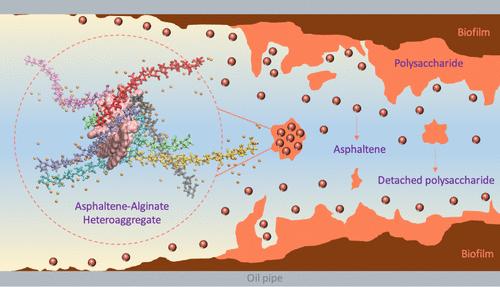
Asphaltene blockage and microbiologically induced corrosion (MIC) in oil pipes pose substantial flow assurance challenges, but their interrelationship remains poorly understood despite extensive individual research efforts. This study utilized molecular dynamics simulation and machine learning techniques to elucidate the effects of alginate, a representative biofilm polysaccharide associated with MIC, on asphaltene aggregation. Results underscored the ability of alginates to disperse large asphaltene nanoaggregates into smaller ones with more pronounced dispersion effects at higher concentrations. This was achieved through forming asphaltene–alginate heteroaggregates wherein asphaltene nanoaggregates were tightly wrapped by cross-linked alginate chains stabilized by Na+ bridging. The presence of alginates significantly increased the solvent accessible surface area (SASA) of asphaltenes, while the heteroaggregation process resulted in abundant hydroxyl and carboxyl groups coating the surface of the asphaltene nanoaggregates. Furthermore, this study showed that the time-varying asphaltene aggregation parameters such as nanoaggregate number, intermolecular contact number, and SASA could be accurately predicted by alginate structural properties using optimized random forest models built from 3636 data sets extracted from molecular trajectories (R2 = 0.9628–0.9827). This enabled fast prediction of asphaltene aggregation when the polysaccharide composition and concentration changed during the MIC process. These findings provided theoretical support for developing strategies to address asphaltene-related issues in the presence of a biofilm polysaccharide.
期刊介绍:
Energy & Fuels publishes reports of research in the technical area defined by the intersection of the disciplines of chemistry and chemical engineering and the application domain of non-nuclear energy and fuels. This includes research directed at the formation of, exploration for, and production of fossil fuels and biomass; the properties and structure or molecular composition of both raw fuels and refined products; the chemistry involved in the processing and utilization of fuels; fuel cells and their applications; and the analytical and instrumental techniques used in investigations of the foregoing areas.




 京公网安备 11010802042870号
京ICP备2023020795号-1
京公网安备 11010802042870号
京ICP备2023020795号-1

 分享
分享
 求助内容:
求助内容: 应助结果提醒方式:
 扫码关注我们
