{"title":"妊娠早期甘油三酯-葡萄糖-体重指数是不良妊娠结局的重要预测指标。","authors":"Zhaoran Meng, Minhuan Lin, Lizhu Song, Yiqing Chen, Songqing Deng, Shuting Xia, Xuewen Huang, Yanmin Luo","doi":"10.1186/s12884-025-07258-z","DOIUrl":null,"url":null,"abstract":"<p><strong>Background: </strong>Although insulin resistance has been associated with unfavorable pregnancy outcomes, the ability of non-insulin-based insulin resistance indicators to predict adverse pregnancy outcomes has yet to be thoroughly understood. The study aims to investigate the association and predictability of triglyceride glucose-body mass index (TyG-BMI), a biomarker of non-insulin-based insulin resistance, with the risks of adverse pregnancy outcomes.</p><p><strong>Method: </strong>The retrospective study included 1,136 subjects. Group-based trajectory modeling (GBTM) was employed to identify the TyG-BMI index trajectory. Logistic regression, restricted cubic spline (RCS) regression, and subgroup analysis were used to assess the association between the TyG-BMI index trajectory and the first-trimester TyG-BMI index with the risks of adverse pregnancy outcomes. Receiver-operating characteristic (ROC) curve analysis and the DeLong test were utilized to evaluate the prediction ability of the first-trimester TyG-BMI index for adverse pregnancy outcomes.</p><p><strong>Results: </strong>GBTM revealed three distinct trajectories of the TyG-BMI index. Using the \"low-stable\" trajectory as a reference, the \"high-stable\" trajectory was independently associated with an increased risk of gestational diabetes mellitus (GDM) (aOR = 2.01, 95% CI 1.20-3.37), hypertensive disorders of pregnancy (HDP) (aOR = 6.05, 95% CI 3.00-12.18), and large for gestational age (LGA) (aOR = 2.83, 95% CI 1.28-6.25). The highest quartile of the first-trimester TyG-BMI index was independently linked to elevated GDM (aOR = 3.27, 95% CI 1.92-5.59), HDP (aOR = 9.26, 95% CI 3.19-26.88), and LGA (aOR = 2.26, 95% CI 1.00-5.09)risks. Additionally, the third quartile of the first-trimester TyG-BMI index had 2.21-fold increased odds of GDM (aOR = 2.21, 95% CI 1.27-3.82). The first-trimester TyG-BMI index demonstrated a significant linear association with GDM, HDP, SGA, and LGA risks. Compared to the TyG-BMI index trajectory, the highest quartile of the first-trimester TyG-BMI index exhibited a stronger association with the risks of GDM and HDP (aOR = 3.09 and 7.39, respectively). Furthermore, according to the ROC curve, the first-trimester TyG-BMI index outperformed the TyG index and triglyceride/high-density lipoprotein cholesterol (TG/HDL-c) ratio at predicting HDP (0.726 [0.650-0.801] vs. 0.603 [0.527-0.679] vs. 0.615 [0.537-0.693]), LGA (0.619 [0.540-0.699] vs. 0.534 [0.454-0.613] vs. 0.540 [0.458-0.622]), and GDM (0.664 [0.622-0.705] vs. 0.632 [0.588-0.676] vs. 0.604 [0.560-0.649]). According to the DeLong test, the first-trimester TyG-BMI index was a more valuable predictor for LGA and HDP compared to TyG index and TG/HDL-c ratio.</p><p><strong>Conclusion: </strong>Higher levels of first-trimester TyG-BMI and a \"high-stable\" trajectory were linked to a greater risk of adverse pregnancy outcomes. Furthermore, as compared to TyG and TG/HDL-c, the first-trimester TyG-BMI index is a valuable predictor for HDP, GDM, and LGA.</p>","PeriodicalId":9033,"journal":{"name":"BMC Pregnancy and Childbirth","volume":"25 1","pages":"142"},"PeriodicalIF":3.1000,"publicationDate":"2025-02-11","publicationTypes":"Journal Article","fieldsOfStudy":null,"isOpenAccess":false,"openAccessPdf":"https://www.ncbi.nlm.nih.gov/pmc/articles/PMC11816746/pdf/","citationCount":"0","resultStr":"{\"title\":\"The first-trimester triglyceride glucose-body mass index is a valuable predictor for adverse pregnancy outcomes.\",\"authors\":\"Zhaoran Meng, Minhuan Lin, Lizhu Song, Yiqing Chen, Songqing Deng, Shuting Xia, Xuewen Huang, Yanmin Luo\",\"doi\":\"10.1186/s12884-025-07258-z\",\"DOIUrl\":null,\"url\":null,\"abstract\":\"<p><strong>Background: </strong>Although insulin resistance has been associated with unfavorable pregnancy outcomes, the ability of non-insulin-based insulin resistance indicators to predict adverse pregnancy outcomes has yet to be thoroughly understood. The study aims to investigate the association and predictability of triglyceride glucose-body mass index (TyG-BMI), a biomarker of non-insulin-based insulin resistance, with the risks of adverse pregnancy outcomes.</p><p><strong>Method: </strong>The retrospective study included 1,136 subjects. Group-based trajectory modeling (GBTM) was employed to identify the TyG-BMI index trajectory. Logistic regression, restricted cubic spline (RCS) regression, and subgroup analysis were used to assess the association between the TyG-BMI index trajectory and the first-trimester TyG-BMI index with the risks of adverse pregnancy outcomes. Receiver-operating characteristic (ROC) curve analysis and the DeLong test were utilized to evaluate the prediction ability of the first-trimester TyG-BMI index for adverse pregnancy outcomes.</p><p><strong>Results: </strong>GBTM revealed three distinct trajectories of the TyG-BMI index. Using the \\\"low-stable\\\" trajectory as a reference, the \\\"high-stable\\\" trajectory was independently associated with an increased risk of gestational diabetes mellitus (GDM) (aOR = 2.01, 95% CI 1.20-3.37), hypertensive disorders of pregnancy (HDP) (aOR = 6.05, 95% CI 3.00-12.18), and large for gestational age (LGA) (aOR = 2.83, 95% CI 1.28-6.25). The highest quartile of the first-trimester TyG-BMI index was independently linked to elevated GDM (aOR = 3.27, 95% CI 1.92-5.59), HDP (aOR = 9.26, 95% CI 3.19-26.88), and LGA (aOR = 2.26, 95% CI 1.00-5.09)risks. Additionally, the third quartile of the first-trimester TyG-BMI index had 2.21-fold increased odds of GDM (aOR = 2.21, 95% CI 1.27-3.82). The first-trimester TyG-BMI index demonstrated a significant linear association with GDM, HDP, SGA, and LGA risks. Compared to the TyG-BMI index trajectory, the highest quartile of the first-trimester TyG-BMI index exhibited a stronger association with the risks of GDM and HDP (aOR = 3.09 and 7.39, respectively). Furthermore, according to the ROC curve, the first-trimester TyG-BMI index outperformed the TyG index and triglyceride/high-density lipoprotein cholesterol (TG/HDL-c) ratio at predicting HDP (0.726 [0.650-0.801] vs. 0.603 [0.527-0.679] vs. 0.615 [0.537-0.693]), LGA (0.619 [0.540-0.699] vs. 0.534 [0.454-0.613] vs. 0.540 [0.458-0.622]), and GDM (0.664 [0.622-0.705] vs. 0.632 [0.588-0.676] vs. 0.604 [0.560-0.649]). According to the DeLong test, the first-trimester TyG-BMI index was a more valuable predictor for LGA and HDP compared to TyG index and TG/HDL-c ratio.</p><p><strong>Conclusion: </strong>Higher levels of first-trimester TyG-BMI and a \\\"high-stable\\\" trajectory were linked to a greater risk of adverse pregnancy outcomes. Furthermore, as compared to TyG and TG/HDL-c, the first-trimester TyG-BMI index is a valuable predictor for HDP, GDM, and LGA.</p>\",\"PeriodicalId\":9033,\"journal\":{\"name\":\"BMC Pregnancy and Childbirth\",\"volume\":\"25 1\",\"pages\":\"142\"},\"PeriodicalIF\":3.1000,\"publicationDate\":\"2025-02-11\",\"publicationTypes\":\"Journal Article\",\"fieldsOfStudy\":null,\"isOpenAccess\":false,\"openAccessPdf\":\"https://www.ncbi.nlm.nih.gov/pmc/articles/PMC11816746/pdf/\",\"citationCount\":\"0\",\"resultStr\":null,\"platform\":\"Semanticscholar\",\"paperid\":null,\"PeriodicalName\":\"BMC Pregnancy and Childbirth\",\"FirstCategoryId\":\"3\",\"ListUrlMain\":\"https://doi.org/10.1186/s12884-025-07258-z\",\"RegionNum\":2,\"RegionCategory\":\"医学\",\"ArticlePicture\":[],\"TitleCN\":null,\"AbstractTextCN\":null,\"PMCID\":null,\"EPubDate\":\"\",\"PubModel\":\"\",\"JCR\":\"Q1\",\"JCRName\":\"OBSTETRICS & GYNECOLOGY\",\"Score\":null,\"Total\":0}","platform":"Semanticscholar","paperid":null,"PeriodicalName":"BMC Pregnancy and Childbirth","FirstCategoryId":"3","ListUrlMain":"https://doi.org/10.1186/s12884-025-07258-z","RegionNum":2,"RegionCategory":"医学","ArticlePicture":[],"TitleCN":null,"AbstractTextCN":null,"PMCID":null,"EPubDate":"","PubModel":"","JCR":"Q1","JCRName":"OBSTETRICS & GYNECOLOGY","Score":null,"Total":0}
引用次数: 0
摘要
背景:虽然胰岛素抵抗与不良妊娠结局相关,但非胰岛素基础的胰岛素抵抗指标预测不良妊娠结局的能力尚未完全了解。该研究旨在调查甘油三酯葡萄糖体重指数(TyG-BMI)与不良妊娠结局风险的关系和可预测性,TyG-BMI是非胰岛素基础胰岛素抵抗的生物标志物。方法:回顾性研究纳入1136例受试者。采用基于分组的轨迹模型(GBTM)识别TyG-BMI指数轨迹。采用Logistic回归、限制性三次样条(RCS)回归和亚组分析评估TyG-BMI指数轨迹和孕早期TyG-BMI指数与不良妊娠结局风险的相关性。采用受试者工作特征(Receiver-operating characteristic, ROC)曲线分析和DeLong检验评价孕早期TyG-BMI指数对不良妊娠结局的预测能力。结果:GBTM显示了TyG-BMI指数的三个不同轨迹。以“低稳定”轨迹为参照,“高稳定”轨迹与妊娠期糖尿病(GDM) (aOR = 2.01, 95% CI 1.20-3.37)、妊娠期高血压疾病(HDP) (aOR = 6.05, 95% CI 3.00-12.18)、胎龄大(LGA) (aOR = 2.83, 95% CI 1.28-6.25)的风险增加独立相关。孕早期TyG-BMI指数最高的四分位数与GDM (aOR = 3.27, 95% CI 1.92-5.59)、HDP (aOR = 9.26, 95% CI 3.19-26.88)和LGA (aOR = 2.26, 95% CI 1.00-5.09)风险升高独立相关。此外,孕早期TyG-BMI指数的第三个四分位数发生GDM的几率增加了2.21倍(aOR = 2.21, 95% CI 1.27-3.82)。孕早期TyG-BMI指数与GDM、HDP、SGA和LGA风险呈显著线性相关。与TyG-BMI指数轨迹相比,孕早期TyG-BMI指数最高的四分位数与GDM和HDP风险的相关性更强(aOR分别为3.09和7.39)。此外,根据ROC曲线,孕早期TyG- bmi指数在预测HDP (0.726 [0.650-0.801] vs. 0.603 [0.527-0.679] vs. 0.615[0.537-0.693])、LGA (0.619 [0.540-0.699] vs. 0.534 [0.454-0.613] vs. 0.540[0.458-0.622])和GDM (0.664 [0.622-0.705] vs. 0.632 [0.588-0.676] vs. 0.604[0.560-0.649])方面优于TyG指数和甘油三酯/高密度脂蛋白胆固醇(TG/HDL-c)比值。根据DeLong检验,与TyG指数和TG/HDL-c比值相比,孕早期TyG- bmi指数是LGA和HDP更有价值的预测指标。结论:孕早期较高的TyG-BMI水平和“高稳定”的轨迹与不良妊娠结局的风险增加有关。此外,与TyG和TG/HDL-c相比,孕早期TyG- bmi指数是HDP、GDM和LGA的一个有价值的预测指标。
The first-trimester triglyceride glucose-body mass index is a valuable predictor for adverse pregnancy outcomes.
Background: Although insulin resistance has been associated with unfavorable pregnancy outcomes, the ability of non-insulin-based insulin resistance indicators to predict adverse pregnancy outcomes has yet to be thoroughly understood. The study aims to investigate the association and predictability of triglyceride glucose-body mass index (TyG-BMI), a biomarker of non-insulin-based insulin resistance, with the risks of adverse pregnancy outcomes.
Method: The retrospective study included 1,136 subjects. Group-based trajectory modeling (GBTM) was employed to identify the TyG-BMI index trajectory. Logistic regression, restricted cubic spline (RCS) regression, and subgroup analysis were used to assess the association between the TyG-BMI index trajectory and the first-trimester TyG-BMI index with the risks of adverse pregnancy outcomes. Receiver-operating characteristic (ROC) curve analysis and the DeLong test were utilized to evaluate the prediction ability of the first-trimester TyG-BMI index for adverse pregnancy outcomes.
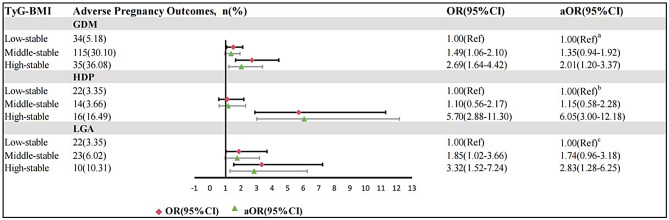
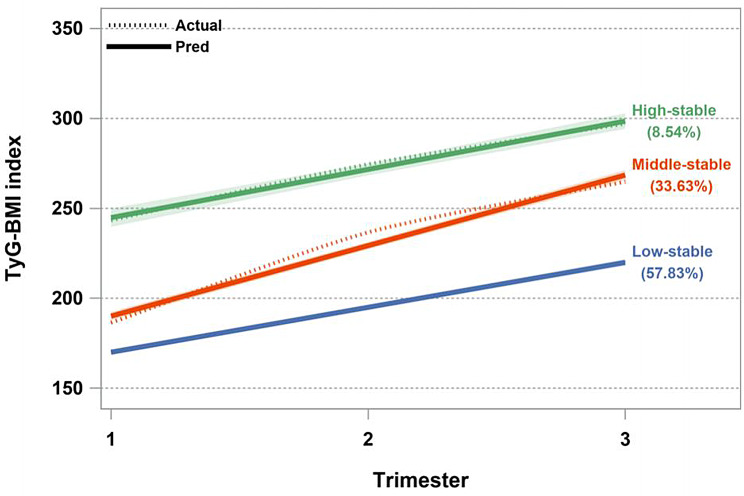
Results: GBTM revealed three distinct trajectories of the TyG-BMI index. Using the "low-stable" trajectory as a reference, the "high-stable" trajectory was independently associated with an increased risk of gestational diabetes mellitus (GDM) (aOR = 2.01, 95% CI 1.20-3.37), hypertensive disorders of pregnancy (HDP) (aOR = 6.05, 95% CI 3.00-12.18), and large for gestational age (LGA) (aOR = 2.83, 95% CI 1.28-6.25). The highest quartile of the first-trimester TyG-BMI index was independently linked to elevated GDM (aOR = 3.27, 95% CI 1.92-5.59), HDP (aOR = 9.26, 95% CI 3.19-26.88), and LGA (aOR = 2.26, 95% CI 1.00-5.09)risks. Additionally, the third quartile of the first-trimester TyG-BMI index had 2.21-fold increased odds of GDM (aOR = 2.21, 95% CI 1.27-3.82). The first-trimester TyG-BMI index demonstrated a significant linear association with GDM, HDP, SGA, and LGA risks. Compared to the TyG-BMI index trajectory, the highest quartile of the first-trimester TyG-BMI index exhibited a stronger association with the risks of GDM and HDP (aOR = 3.09 and 7.39, respectively). Furthermore, according to the ROC curve, the first-trimester TyG-BMI index outperformed the TyG index and triglyceride/high-density lipoprotein cholesterol (TG/HDL-c) ratio at predicting HDP (0.726 [0.650-0.801] vs. 0.603 [0.527-0.679] vs. 0.615 [0.537-0.693]), LGA (0.619 [0.540-0.699] vs. 0.534 [0.454-0.613] vs. 0.540 [0.458-0.622]), and GDM (0.664 [0.622-0.705] vs. 0.632 [0.588-0.676] vs. 0.604 [0.560-0.649]). According to the DeLong test, the first-trimester TyG-BMI index was a more valuable predictor for LGA and HDP compared to TyG index and TG/HDL-c ratio.
Conclusion: Higher levels of first-trimester TyG-BMI and a "high-stable" trajectory were linked to a greater risk of adverse pregnancy outcomes. Furthermore, as compared to TyG and TG/HDL-c, the first-trimester TyG-BMI index is a valuable predictor for HDP, GDM, and LGA.
期刊介绍:
BMC Pregnancy & Childbirth is an open access, peer-reviewed journal that considers articles on all aspects of pregnancy and childbirth. The journal welcomes submissions on the biomedical aspects of pregnancy, breastfeeding, labor, maternal health, maternity care, trends and sociological aspects of pregnancy and childbirth.





 京公网安备 11010802042870号
京ICP备2023020795号-1
京公网安备 11010802042870号
京ICP备2023020795号-1

 分享
分享
 求助内容:
求助内容: 应助结果提醒方式:
 扫码关注我们
