Parham Torabinavid, Mohammad Hossein Khosropanah, Ashkan Azimzadeh, Abdol-Mohammad Kajbafzadeh
{"title":"利用组织工程方法进行肾脏再生的当前策略:系统综述。","authors":"Parham Torabinavid, Mohammad Hossein Khosropanah, Ashkan Azimzadeh, Abdol-Mohammad Kajbafzadeh","doi":"10.1186/s12882-025-03968-w","DOIUrl":null,"url":null,"abstract":"<p><strong>Introduction: </strong>Over the past two decades, there has been a notable rise in the number of individuals afflicted with End-Stage Renal Disease, resulting in an increased demand for renal replacement therapies. While periodic dialysis is beneficial, it can negatively impact a patient's quality of life and does not fully replicate the secretory functions of the kidneys. Additionally, the scarcity of organ donors and complications associated with organ transplants have underscored the importance of tissue engineering. Regenerative medicine is revolutionized by developing decellularized organs and tissue engineering, which is considered a cutting-edge area of study with enormous potential. Developing bioengineered kidneys using tissue engineering approaches for renal replacement therapy is promising.</p><p><strong>Method and materials: </strong>We aimed to systematically review the essential preclinical data to promote the translation of tissue engineering research for kidney repair from the laboratory to clinical practice. A PubMed search strategy was systematically implemented without any linguistic restrictions. The assessment focused on complete circumferential and inlay procedures, thoroughly evaluating parameters such as cell seeding, decellularization techniques, recellularization protocols, and biomaterial types.</p><p><strong>Results: </strong>Of the 1,484 studies retrieved from the following primary searches, 105 were included. Kidneys were harvested from eight different species. Nine studies performed kidney decellularization from discarded human kidneys. Sixty-four studies performed whole organ decellularization. Some studies used acellular scaffolds to produce hydrogels, sheets, and solutions. Decellularization is achieved through physical, chemical, or enzymatic treatment or a combination of them. Sterilization of acellular scaffolds was also thoroughly and comparatively evaluated. Lastly, different recellularization protocols and types of cells used for further cell seeding were demonstrated.</p><p><strong>Conclusion: </strong>A comprehensive review of the existing literature about kidney tissue engineering was conducted to evaluate its effectiveness in preclinical investigations. Our findings indicate that enhancements in the design of preclinical studies are necessary to facilitate the successful translation of tissue engineering technologies into clinical applications.</p>","PeriodicalId":9089,"journal":{"name":"BMC Nephrology","volume":"26 1","pages":"66"},"PeriodicalIF":2.4000,"publicationDate":"2025-02-11","publicationTypes":"Journal Article","fieldsOfStudy":null,"isOpenAccess":false,"openAccessPdf":"https://www.ncbi.nlm.nih.gov/pmc/articles/PMC11816546/pdf/","citationCount":"0","resultStr":"{\"title\":\"Current strategies on kidney regeneration using tissue engineering approaches: a systematic review.\",\"authors\":\"Parham Torabinavid, Mohammad Hossein Khosropanah, Ashkan Azimzadeh, Abdol-Mohammad Kajbafzadeh\",\"doi\":\"10.1186/s12882-025-03968-w\",\"DOIUrl\":null,\"url\":null,\"abstract\":\"<p><strong>Introduction: </strong>Over the past two decades, there has been a notable rise in the number of individuals afflicted with End-Stage Renal Disease, resulting in an increased demand for renal replacement therapies. While periodic dialysis is beneficial, it can negatively impact a patient's quality of life and does not fully replicate the secretory functions of the kidneys. Additionally, the scarcity of organ donors and complications associated with organ transplants have underscored the importance of tissue engineering. Regenerative medicine is revolutionized by developing decellularized organs and tissue engineering, which is considered a cutting-edge area of study with enormous potential. Developing bioengineered kidneys using tissue engineering approaches for renal replacement therapy is promising.</p><p><strong>Method and materials: </strong>We aimed to systematically review the essential preclinical data to promote the translation of tissue engineering research for kidney repair from the laboratory to clinical practice. A PubMed search strategy was systematically implemented without any linguistic restrictions. The assessment focused on complete circumferential and inlay procedures, thoroughly evaluating parameters such as cell seeding, decellularization techniques, recellularization protocols, and biomaterial types.</p><p><strong>Results: </strong>Of the 1,484 studies retrieved from the following primary searches, 105 were included. Kidneys were harvested from eight different species. Nine studies performed kidney decellularization from discarded human kidneys. Sixty-four studies performed whole organ decellularization. Some studies used acellular scaffolds to produce hydrogels, sheets, and solutions. Decellularization is achieved through physical, chemical, or enzymatic treatment or a combination of them. Sterilization of acellular scaffolds was also thoroughly and comparatively evaluated. Lastly, different recellularization protocols and types of cells used for further cell seeding were demonstrated.</p><p><strong>Conclusion: </strong>A comprehensive review of the existing literature about kidney tissue engineering was conducted to evaluate its effectiveness in preclinical investigations. Our findings indicate that enhancements in the design of preclinical studies are necessary to facilitate the successful translation of tissue engineering technologies into clinical applications.</p>\",\"PeriodicalId\":9089,\"journal\":{\"name\":\"BMC Nephrology\",\"volume\":\"26 1\",\"pages\":\"66\"},\"PeriodicalIF\":2.4000,\"publicationDate\":\"2025-02-11\",\"publicationTypes\":\"Journal Article\",\"fieldsOfStudy\":null,\"isOpenAccess\":false,\"openAccessPdf\":\"https://www.ncbi.nlm.nih.gov/pmc/articles/PMC11816546/pdf/\",\"citationCount\":\"0\",\"resultStr\":null,\"platform\":\"Semanticscholar\",\"paperid\":null,\"PeriodicalName\":\"BMC Nephrology\",\"FirstCategoryId\":\"3\",\"ListUrlMain\":\"https://doi.org/10.1186/s12882-025-03968-w\",\"RegionNum\":4,\"RegionCategory\":\"医学\",\"ArticlePicture\":[],\"TitleCN\":null,\"AbstractTextCN\":null,\"PMCID\":null,\"EPubDate\":\"\",\"PubModel\":\"\",\"JCR\":\"Q2\",\"JCRName\":\"UROLOGY & NEPHROLOGY\",\"Score\":null,\"Total\":0}","platform":"Semanticscholar","paperid":null,"PeriodicalName":"BMC Nephrology","FirstCategoryId":"3","ListUrlMain":"https://doi.org/10.1186/s12882-025-03968-w","RegionNum":4,"RegionCategory":"医学","ArticlePicture":[],"TitleCN":null,"AbstractTextCN":null,"PMCID":null,"EPubDate":"","PubModel":"","JCR":"Q2","JCRName":"UROLOGY & NEPHROLOGY","Score":null,"Total":0}
Current strategies on kidney regeneration using tissue engineering approaches: a systematic review.
Introduction: Over the past two decades, there has been a notable rise in the number of individuals afflicted with End-Stage Renal Disease, resulting in an increased demand for renal replacement therapies. While periodic dialysis is beneficial, it can negatively impact a patient's quality of life and does not fully replicate the secretory functions of the kidneys. Additionally, the scarcity of organ donors and complications associated with organ transplants have underscored the importance of tissue engineering. Regenerative medicine is revolutionized by developing decellularized organs and tissue engineering, which is considered a cutting-edge area of study with enormous potential. Developing bioengineered kidneys using tissue engineering approaches for renal replacement therapy is promising.
Method and materials: We aimed to systematically review the essential preclinical data to promote the translation of tissue engineering research for kidney repair from the laboratory to clinical practice. A PubMed search strategy was systematically implemented without any linguistic restrictions. The assessment focused on complete circumferential and inlay procedures, thoroughly evaluating parameters such as cell seeding, decellularization techniques, recellularization protocols, and biomaterial types.
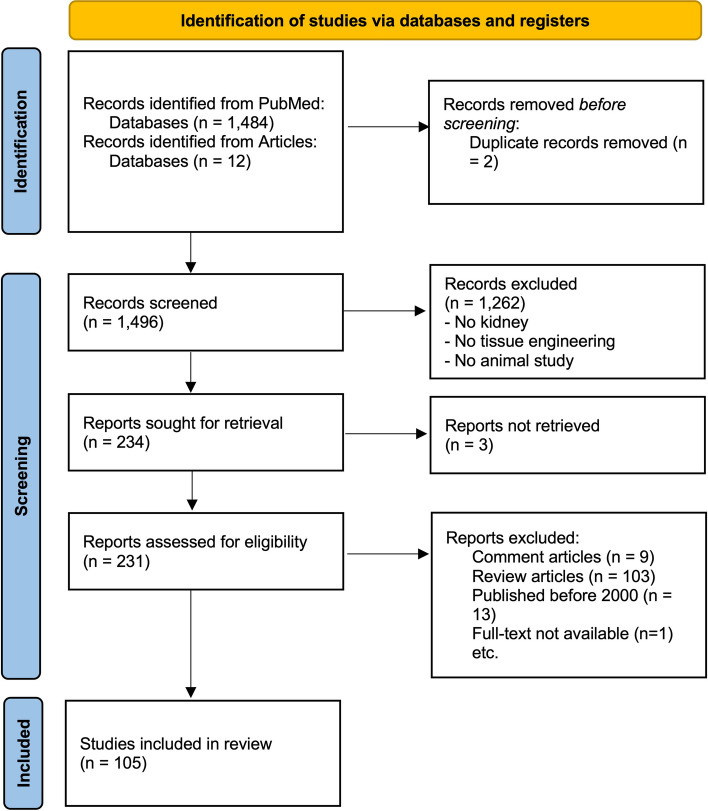
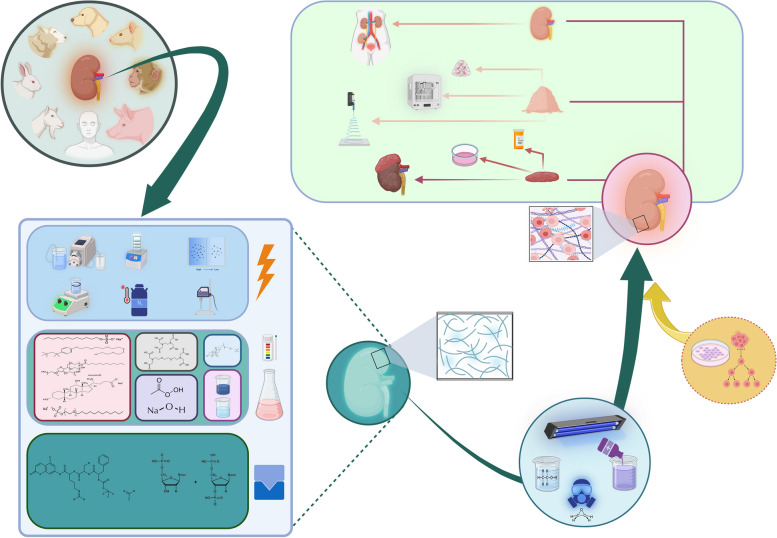
Results: Of the 1,484 studies retrieved from the following primary searches, 105 were included. Kidneys were harvested from eight different species. Nine studies performed kidney decellularization from discarded human kidneys. Sixty-four studies performed whole organ decellularization. Some studies used acellular scaffolds to produce hydrogels, sheets, and solutions. Decellularization is achieved through physical, chemical, or enzymatic treatment or a combination of them. Sterilization of acellular scaffolds was also thoroughly and comparatively evaluated. Lastly, different recellularization protocols and types of cells used for further cell seeding were demonstrated.
Conclusion: A comprehensive review of the existing literature about kidney tissue engineering was conducted to evaluate its effectiveness in preclinical investigations. Our findings indicate that enhancements in the design of preclinical studies are necessary to facilitate the successful translation of tissue engineering technologies into clinical applications.
期刊介绍:
BMC Nephrology is an open access journal publishing original peer-reviewed research articles in all aspects of the prevention, diagnosis and management of kidney and associated disorders, as well as related molecular genetics, pathophysiology, and epidemiology.





 京公网安备 11010802042870号
京ICP备2023020795号-1
京公网安备 11010802042870号
京ICP备2023020795号-1

 分享
分享
 求助内容:
求助内容: 应助结果提醒方式:
 扫码关注我们
