Yue Shu, Jing Huang, Yi-Miao Zhang, Fang Wang, Xin Wang, Li-Qiang Meng, Xu-Yang Cheng, Gang Liu, Ming-Hui Zhao, Zhao Cui
{"title":"COVID-19感染后膜性肾病复发和加重的危险因素","authors":"Yue Shu, Jing Huang, Yi-Miao Zhang, Fang Wang, Xin Wang, Li-Qiang Meng, Xu-Yang Cheng, Gang Liu, Ming-Hui Zhao, Zhao Cui","doi":"10.1186/s12882-025-04000-x","DOIUrl":null,"url":null,"abstract":"<p><strong>Background: </strong>Relapse of membranous nephropathy (MN) and other glomerular diseases has been observed after COVID-19 infection. The risk factors contributing to disease progression in MN patients after contracting COVID-19 remain unclear.</p><p><strong>Methods: </strong>This retrospective study included 656 consecutive patients with biopsy-proven primary MN who received treatment and were regularly followed up for over six months. Logistic regression analyses were conducted to identify risk factors for disease progression.</p><p><strong>Results: </strong>Among the cohort, 555 patients (84.6%) contracted COVID-19 from November 11th, 2022, to February 22nd, 2023. Of them, 112 patients (20.2%) experienced a > 50% increase in proteinuria, including 30 patients (5.4%) who experienced nephrotic syndrome relapse. Sixteen patients (2.9%) showed immune aggravation with elevated anti-PLA2R antibody levels, and five patients (0.9%) had immune relapse characterized by antibody reoccurrence. Kidney dysfunction, defined as an eGFR reduction > 30% from baseline, occurred in 10 patients (1.8%), with two patients (0.4%) progressing to ESKD. Four patients (0.7%) died of respiratory failure. Overall, 132 patients (24.0%) experienced disease progression after COVID-19 infection. Multivariate logistic regression identified longer fever duration (OR 1.118, 95% CI 1.029-1.356, P = 0.018), withdrawal of immunosuppressants and/or steroids (OR 2.571, 95% CI 1.377-4.799, P = 0.003) and extended drug cessation (OR 1.113, 95% CI 1.045-1.186, P = 0.001) as independent risk factors for MN progression.</p><p><strong>Conclusions: </strong>These findings suggest prompt antiviral treatment and minimizing the duration of immunosuppressant withdrawal to optimize kidney outcomes in MN patients with COVID-19.</p>","PeriodicalId":9089,"journal":{"name":"BMC Nephrology","volume":"26 1","pages":"71"},"PeriodicalIF":2.9000,"publicationDate":"2025-02-11","publicationTypes":"Journal Article","fieldsOfStudy":null,"isOpenAccess":false,"openAccessPdf":"https://www.ncbi.nlm.nih.gov/pmc/articles/PMC11817977/pdf/","citationCount":"0","resultStr":"{\"title\":\"Risk factors for relapse and aggravation in membranous nephropathy after COVID-19 infection.\",\"authors\":\"Yue Shu, Jing Huang, Yi-Miao Zhang, Fang Wang, Xin Wang, Li-Qiang Meng, Xu-Yang Cheng, Gang Liu, Ming-Hui Zhao, Zhao Cui\",\"doi\":\"10.1186/s12882-025-04000-x\",\"DOIUrl\":null,\"url\":null,\"abstract\":\"<p><strong>Background: </strong>Relapse of membranous nephropathy (MN) and other glomerular diseases has been observed after COVID-19 infection. The risk factors contributing to disease progression in MN patients after contracting COVID-19 remain unclear.</p><p><strong>Methods: </strong>This retrospective study included 656 consecutive patients with biopsy-proven primary MN who received treatment and were regularly followed up for over six months. Logistic regression analyses were conducted to identify risk factors for disease progression.</p><p><strong>Results: </strong>Among the cohort, 555 patients (84.6%) contracted COVID-19 from November 11th, 2022, to February 22nd, 2023. Of them, 112 patients (20.2%) experienced a > 50% increase in proteinuria, including 30 patients (5.4%) who experienced nephrotic syndrome relapse. Sixteen patients (2.9%) showed immune aggravation with elevated anti-PLA2R antibody levels, and five patients (0.9%) had immune relapse characterized by antibody reoccurrence. Kidney dysfunction, defined as an eGFR reduction > 30% from baseline, occurred in 10 patients (1.8%), with two patients (0.4%) progressing to ESKD. Four patients (0.7%) died of respiratory failure. Overall, 132 patients (24.0%) experienced disease progression after COVID-19 infection. Multivariate logistic regression identified longer fever duration (OR 1.118, 95% CI 1.029-1.356, P = 0.018), withdrawal of immunosuppressants and/or steroids (OR 2.571, 95% CI 1.377-4.799, P = 0.003) and extended drug cessation (OR 1.113, 95% CI 1.045-1.186, P = 0.001) as independent risk factors for MN progression.</p><p><strong>Conclusions: </strong>These findings suggest prompt antiviral treatment and minimizing the duration of immunosuppressant withdrawal to optimize kidney outcomes in MN patients with COVID-19.</p>\",\"PeriodicalId\":9089,\"journal\":{\"name\":\"BMC Nephrology\",\"volume\":\"26 1\",\"pages\":\"71\"},\"PeriodicalIF\":2.9000,\"publicationDate\":\"2025-02-11\",\"publicationTypes\":\"Journal Article\",\"fieldsOfStudy\":null,\"isOpenAccess\":false,\"openAccessPdf\":\"https://www.ncbi.nlm.nih.gov/pmc/articles/PMC11817977/pdf/\",\"citationCount\":\"0\",\"resultStr\":null,\"platform\":\"Semanticscholar\",\"paperid\":null,\"PeriodicalName\":\"BMC Nephrology\",\"FirstCategoryId\":\"3\",\"ListUrlMain\":\"https://doi.org/10.1186/s12882-025-04000-x\",\"RegionNum\":4,\"RegionCategory\":\"医学\",\"ArticlePicture\":[],\"TitleCN\":null,\"AbstractTextCN\":null,\"PMCID\":null,\"EPubDate\":\"\",\"PubModel\":\"\",\"JCR\":\"Q2\",\"JCRName\":\"UROLOGY & NEPHROLOGY\",\"Score\":null,\"Total\":0}","platform":"Semanticscholar","paperid":null,"PeriodicalName":"BMC Nephrology","FirstCategoryId":"3","ListUrlMain":"https://doi.org/10.1186/s12882-025-04000-x","RegionNum":4,"RegionCategory":"医学","ArticlePicture":[],"TitleCN":null,"AbstractTextCN":null,"PMCID":null,"EPubDate":"","PubModel":"","JCR":"Q2","JCRName":"UROLOGY & NEPHROLOGY","Score":null,"Total":0}
引用次数: 0
摘要
背景:膜性肾病(MN)和其他肾小球疾病在COVID-19感染后复发。导致MN患者感染COVID-19后疾病进展的危险因素尚不清楚。方法:本回顾性研究纳入656例经活检证实的原发性MN患者,这些患者接受了治疗并定期随访超过6个月。进行逻辑回归分析以确定疾病进展的危险因素。结果:从2022年11月11日至2023年2月22日,队列中有555例(84.6%)感染COVID-19。其中,112例(20.2%)患者蛋白尿增加50%,其中30例(5.4%)患者肾病综合征复发。16例(2.9%)患者表现为免疫加重,抗pla2r抗体水平升高,5例(0.9%)患者表现为免疫复发,抗体再次出现。肾功能不正常,定义为eGFR较基线降低30%,10例患者(1.8%)发生肾功能不正常,2例患者(0.4%)进展为ESKD。4例(0.7%)患者死于呼吸衰竭。总体而言,132名患者(24.0%)在COVID-19感染后出现疾病进展。多因素logistic回归发现,较长的发热时间(OR 1.118, 95% CI 1.029-1.356, P = 0.018)、停用免疫抑制剂和/或类固醇(OR 2.571, 95% CI 1.377-4.799, P = 0.003)和延长停药时间(OR 1.113, 95% CI 1.045-1.186, P = 0.001)是MN进展的独立危险因素。结论:这些研究结果表明,及时抗病毒治疗和缩短免疫抑制剂停药时间可以优化MN COVID-19患者的肾脏预后。
Risk factors for relapse and aggravation in membranous nephropathy after COVID-19 infection.
Background: Relapse of membranous nephropathy (MN) and other glomerular diseases has been observed after COVID-19 infection. The risk factors contributing to disease progression in MN patients after contracting COVID-19 remain unclear.
Methods: This retrospective study included 656 consecutive patients with biopsy-proven primary MN who received treatment and were regularly followed up for over six months. Logistic regression analyses were conducted to identify risk factors for disease progression.
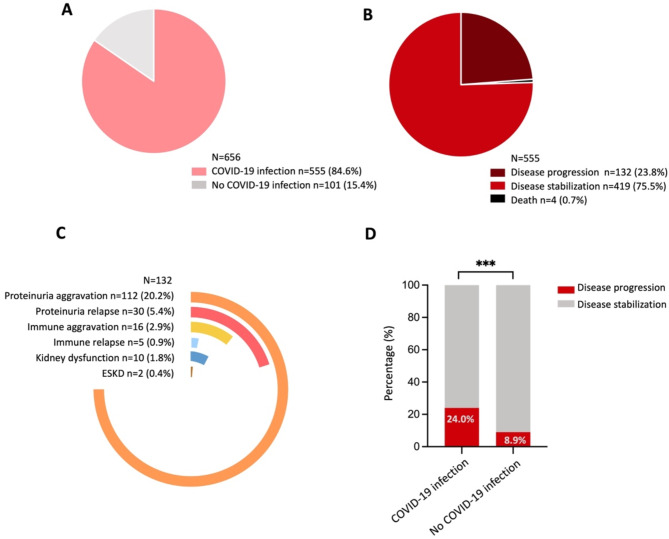
Results: Among the cohort, 555 patients (84.6%) contracted COVID-19 from November 11th, 2022, to February 22nd, 2023. Of them, 112 patients (20.2%) experienced a > 50% increase in proteinuria, including 30 patients (5.4%) who experienced nephrotic syndrome relapse. Sixteen patients (2.9%) showed immune aggravation with elevated anti-PLA2R antibody levels, and five patients (0.9%) had immune relapse characterized by antibody reoccurrence. Kidney dysfunction, defined as an eGFR reduction > 30% from baseline, occurred in 10 patients (1.8%), with two patients (0.4%) progressing to ESKD. Four patients (0.7%) died of respiratory failure. Overall, 132 patients (24.0%) experienced disease progression after COVID-19 infection. Multivariate logistic regression identified longer fever duration (OR 1.118, 95% CI 1.029-1.356, P = 0.018), withdrawal of immunosuppressants and/or steroids (OR 2.571, 95% CI 1.377-4.799, P = 0.003) and extended drug cessation (OR 1.113, 95% CI 1.045-1.186, P = 0.001) as independent risk factors for MN progression.
Conclusions: These findings suggest prompt antiviral treatment and minimizing the duration of immunosuppressant withdrawal to optimize kidney outcomes in MN patients with COVID-19.
期刊介绍:
BMC Nephrology is an open access journal publishing original peer-reviewed research articles in all aspects of the prevention, diagnosis and management of kidney and associated disorders, as well as related molecular genetics, pathophysiology, and epidemiology.





 京公网安备 11010802042870号
京ICP备2023020795号-1
京公网安备 11010802042870号
京ICP备2023020795号-1

 分享
分享
 求助内容:
求助内容: 应助结果提醒方式:
 扫码关注我们
