Chenyang Shi, Zhengguang Li, Mengran Wang, Shu Hong, Bo Hong, Yaxuan Fu, Die Liu, Rui Tan, Pingshan Wang and Yanqing Lai
{"title":"用于安全和高温锂离子电池的电解质定制和界面工程","authors":"Chenyang Shi, Zhengguang Li, Mengran Wang, Shu Hong, Bo Hong, Yaxuan Fu, Die Liu, Rui Tan, Pingshan Wang and Yanqing Lai","doi":"10.1039/D4EE05263C","DOIUrl":null,"url":null,"abstract":"<p >The deployment of lithium-ion batteries, essential for military and space exploration applications, faces restrictions due to safety issues and performance degradation stemming from the uncontrollable side reactions between electrolytes and electrodes, particularly at high temperatures. Current research focuses on interfacial modification and non-flammable electrolyte development, which fails to simultaneously improve both safety and cyclic performance. This work introduces a synergistic approach by incorporating weakly polar methyl 2,2-difluoro-2-(fluorosulfonyl)acetate (MDFSA) and non-flammable 2-(2,2,2-trifluoroethoxy)-1,3,2-dioxaphospholane 2-oxide (TFP) to achieve a localized high-concentration electrolyte (LHCE) that can stabilize both anode and cathode interfaces and thus improve the cycling life and safety of batteries, particularly at evaluated temperatures. As a result, the NCM811|Gr pouch cell with MDFSA-containing LHCE exhibits a high capacity retention rate of 79.6% at 60 °C after 1200 cycles due to the formation of thermally and structurally stable interfaces on the electrodes, outperforming pouch cells utilizing commercial carbonate-based (capacity retention: 23.7% after 125 cycles). Additionally, pouch cells in the charging state also exhibit commendable safety performance, indicating potential for practical applications.</p>","PeriodicalId":72,"journal":{"name":"Energy & Environmental Science","volume":" 7","pages":" 3248-3258"},"PeriodicalIF":30.8000,"publicationDate":"2025-02-13","publicationTypes":"Journal Article","fieldsOfStudy":null,"isOpenAccess":false,"openAccessPdf":"https://pubs.rsc.org/en/content/articlepdf/2025/ee/d4ee05263c?page=search","citationCount":"0","resultStr":"{\"title\":\"Electrolyte tailoring and interfacial engineering for safe and high-temperature lithium-ion batteries†\",\"authors\":\"Chenyang Shi, Zhengguang Li, Mengran Wang, Shu Hong, Bo Hong, Yaxuan Fu, Die Liu, Rui Tan, Pingshan Wang and Yanqing Lai\",\"doi\":\"10.1039/D4EE05263C\",\"DOIUrl\":null,\"url\":null,\"abstract\":\"<p >The deployment of lithium-ion batteries, essential for military and space exploration applications, faces restrictions due to safety issues and performance degradation stemming from the uncontrollable side reactions between electrolytes and electrodes, particularly at high temperatures. Current research focuses on interfacial modification and non-flammable electrolyte development, which fails to simultaneously improve both safety and cyclic performance. This work introduces a synergistic approach by incorporating weakly polar methyl 2,2-difluoro-2-(fluorosulfonyl)acetate (MDFSA) and non-flammable 2-(2,2,2-trifluoroethoxy)-1,3,2-dioxaphospholane 2-oxide (TFP) to achieve a localized high-concentration electrolyte (LHCE) that can stabilize both anode and cathode interfaces and thus improve the cycling life and safety of batteries, particularly at evaluated temperatures. As a result, the NCM811|Gr pouch cell with MDFSA-containing LHCE exhibits a high capacity retention rate of 79.6% at 60 °C after 1200 cycles due to the formation of thermally and structurally stable interfaces on the electrodes, outperforming pouch cells utilizing commercial carbonate-based (capacity retention: 23.7% after 125 cycles). Additionally, pouch cells in the charging state also exhibit commendable safety performance, indicating potential for practical applications.</p>\",\"PeriodicalId\":72,\"journal\":{\"name\":\"Energy & Environmental Science\",\"volume\":\" 7\",\"pages\":\" 3248-3258\"},\"PeriodicalIF\":30.8000,\"publicationDate\":\"2025-02-13\",\"publicationTypes\":\"Journal Article\",\"fieldsOfStudy\":null,\"isOpenAccess\":false,\"openAccessPdf\":\"https://pubs.rsc.org/en/content/articlepdf/2025/ee/d4ee05263c?page=search\",\"citationCount\":\"0\",\"resultStr\":null,\"platform\":\"Semanticscholar\",\"paperid\":null,\"PeriodicalName\":\"Energy & Environmental Science\",\"FirstCategoryId\":\"88\",\"ListUrlMain\":\"https://pubs.rsc.org/en/content/articlelanding/2025/ee/d4ee05263c\",\"RegionNum\":1,\"RegionCategory\":\"材料科学\",\"ArticlePicture\":[],\"TitleCN\":null,\"AbstractTextCN\":null,\"PMCID\":null,\"EPubDate\":\"\",\"PubModel\":\"\",\"JCR\":\"Q1\",\"JCRName\":\"CHEMISTRY, MULTIDISCIPLINARY\",\"Score\":null,\"Total\":0}","platform":"Semanticscholar","paperid":null,"PeriodicalName":"Energy & Environmental Science","FirstCategoryId":"88","ListUrlMain":"https://pubs.rsc.org/en/content/articlelanding/2025/ee/d4ee05263c","RegionNum":1,"RegionCategory":"材料科学","ArticlePicture":[],"TitleCN":null,"AbstractTextCN":null,"PMCID":null,"EPubDate":"","PubModel":"","JCR":"Q1","JCRName":"CHEMISTRY, MULTIDISCIPLINARY","Score":null,"Total":0}
Electrolyte tailoring and interfacial engineering for safe and high-temperature lithium-ion batteries†
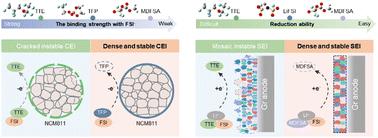
The deployment of lithium-ion batteries, essential for military and space exploration applications, faces restrictions due to safety issues and performance degradation stemming from the uncontrollable side reactions between electrolytes and electrodes, particularly at high temperatures. Current research focuses on interfacial modification and non-flammable electrolyte development, which fails to simultaneously improve both safety and cyclic performance. This work introduces a synergistic approach by incorporating weakly polar methyl 2,2-difluoro-2-(fluorosulfonyl)acetate (MDFSA) and non-flammable 2-(2,2,2-trifluoroethoxy)-1,3,2-dioxaphospholane 2-oxide (TFP) to achieve a localized high-concentration electrolyte (LHCE) that can stabilize both anode and cathode interfaces and thus improve the cycling life and safety of batteries, particularly at evaluated temperatures. As a result, the NCM811|Gr pouch cell with MDFSA-containing LHCE exhibits a high capacity retention rate of 79.6% at 60 °C after 1200 cycles due to the formation of thermally and structurally stable interfaces on the electrodes, outperforming pouch cells utilizing commercial carbonate-based (capacity retention: 23.7% after 125 cycles). Additionally, pouch cells in the charging state also exhibit commendable safety performance, indicating potential for practical applications.
期刊介绍:
Energy & Environmental Science, a peer-reviewed scientific journal, publishes original research and review articles covering interdisciplinary topics in the (bio)chemical and (bio)physical sciences, as well as chemical engineering disciplines. Published monthly by the Royal Society of Chemistry (RSC), a not-for-profit publisher, Energy & Environmental Science is recognized as a leading journal. It boasts an impressive impact factor of 8.500 as of 2009, ranking 8th among 140 journals in the category "Chemistry, Multidisciplinary," second among 71 journals in "Energy & Fuels," second among 128 journals in "Engineering, Chemical," and first among 181 scientific journals in "Environmental Sciences."
Energy & Environmental Science publishes various types of articles, including Research Papers (original scientific work), Review Articles, Perspectives, and Minireviews (feature review-type articles of broad interest), Communications (original scientific work of an urgent nature), Opinions (personal, often speculative viewpoints or hypotheses on current topics), and Analysis Articles (in-depth examination of energy-related issues).




 京公网安备 11010802042870号
京ICP备2023020795号-1
京公网安备 11010802042870号
京ICP备2023020795号-1

 分享
分享
 求助内容:
求助内容: 应助结果提醒方式:
 扫码关注我们
