Yue Xu , Hang Yang , Yunxuan Li , Yuying Qi , Fangling Zhao , Yun Hong , Binbin Cheng , Zebei Lu , Jiaming Zhang , Chunyi Guo , Jie Fu , Qinrong Lin , Chunhong Chen , Ningning Shi , Jianping Cai , Ke Li , Shuanghu Wang , Ruijuan Gao , Dapeng Dai
{"title":"具有抗aml活性的高效双GSPT1/BRD4降解物的发现","authors":"Yue Xu , Hang Yang , Yunxuan Li , Yuying Qi , Fangling Zhao , Yun Hong , Binbin Cheng , Zebei Lu , Jiaming Zhang , Chunyi Guo , Jie Fu , Qinrong Lin , Chunhong Chen , Ningning Shi , Jianping Cai , Ke Li , Shuanghu Wang , Ruijuan Gao , Dapeng Dai","doi":"10.1016/j.ejmech.2025.117381","DOIUrl":null,"url":null,"abstract":"<div><div>Translational readthrough (TR) regulation has emerged as a promising therapeutic strategy for cancer treatment. Utilizing a constructed monoclonal cell line AG-9, designed for screening compounds that induce TR, we identified a BRD4-targeted PROTAC molecule, dBET57, that promotes TR by degrading GSPT1. Notably, dBET57 exhibited significant antiproliferative activity against acute myeloid leukemia (AML) and non-Hodgkin lymphoma (NHL) cells across a diverse panel of tumor cell lines. Building on these findings, we optimized the structure of dBET57, leading to the development of analogs with enhanced dual-target degradation capabilities. Most of these optimized degraders demonstrated superior antiproliferative activity in vitro against various AML and NHL cell lines when compared to dBET57. Among them, DP-15 emerged as a particularly promising candidate, exhibiting significant anticancer activity against both AML and NHL cells while maintaining acceptable safety profiles for normal leukocytes. Furthermore, DP-15 demonstrated enhanced antitumor efficacy in mouse cell-derived xenograft (CDX) models. Our findings highlight the potential of dual BRD4 and GSPT1 degraders, such as DP-15, as effective therapeutic agents for the treatment of hematological malignancies.</div></div>","PeriodicalId":314,"journal":{"name":"European Journal of Medicinal Chemistry","volume":"288 ","pages":"Article 117381"},"PeriodicalIF":5.9000,"publicationDate":"2025-04-15","publicationTypes":"Journal Article","fieldsOfStudy":null,"isOpenAccess":false,"openAccessPdf":"","citationCount":"0","resultStr":"{\"title\":\"Discovery of highly potent dual GSPT1/BRD4 degraders with anti-AML activity\",\"authors\":\"Yue Xu , Hang Yang , Yunxuan Li , Yuying Qi , Fangling Zhao , Yun Hong , Binbin Cheng , Zebei Lu , Jiaming Zhang , Chunyi Guo , Jie Fu , Qinrong Lin , Chunhong Chen , Ningning Shi , Jianping Cai , Ke Li , Shuanghu Wang , Ruijuan Gao , Dapeng Dai\",\"doi\":\"10.1016/j.ejmech.2025.117381\",\"DOIUrl\":null,\"url\":null,\"abstract\":\"<div><div>Translational readthrough (TR) regulation has emerged as a promising therapeutic strategy for cancer treatment. Utilizing a constructed monoclonal cell line AG-9, designed for screening compounds that induce TR, we identified a BRD4-targeted PROTAC molecule, dBET57, that promotes TR by degrading GSPT1. Notably, dBET57 exhibited significant antiproliferative activity against acute myeloid leukemia (AML) and non-Hodgkin lymphoma (NHL) cells across a diverse panel of tumor cell lines. Building on these findings, we optimized the structure of dBET57, leading to the development of analogs with enhanced dual-target degradation capabilities. Most of these optimized degraders demonstrated superior antiproliferative activity in vitro against various AML and NHL cell lines when compared to dBET57. Among them, DP-15 emerged as a particularly promising candidate, exhibiting significant anticancer activity against both AML and NHL cells while maintaining acceptable safety profiles for normal leukocytes. Furthermore, DP-15 demonstrated enhanced antitumor efficacy in mouse cell-derived xenograft (CDX) models. Our findings highlight the potential of dual BRD4 and GSPT1 degraders, such as DP-15, as effective therapeutic agents for the treatment of hematological malignancies.</div></div>\",\"PeriodicalId\":314,\"journal\":{\"name\":\"European Journal of Medicinal Chemistry\",\"volume\":\"288 \",\"pages\":\"Article 117381\"},\"PeriodicalIF\":5.9000,\"publicationDate\":\"2025-04-15\",\"publicationTypes\":\"Journal Article\",\"fieldsOfStudy\":null,\"isOpenAccess\":false,\"openAccessPdf\":\"\",\"citationCount\":\"0\",\"resultStr\":null,\"platform\":\"Semanticscholar\",\"paperid\":null,\"PeriodicalName\":\"European Journal of Medicinal Chemistry\",\"FirstCategoryId\":\"3\",\"ListUrlMain\":\"https://www.sciencedirect.com/science/article/pii/S0223523425001461\",\"RegionNum\":2,\"RegionCategory\":\"医学\",\"ArticlePicture\":[],\"TitleCN\":null,\"AbstractTextCN\":null,\"PMCID\":null,\"EPubDate\":\"2025/2/12 0:00:00\",\"PubModel\":\"Epub\",\"JCR\":\"Q1\",\"JCRName\":\"CHEMISTRY, MEDICINAL\",\"Score\":null,\"Total\":0}","platform":"Semanticscholar","paperid":null,"PeriodicalName":"European Journal of Medicinal Chemistry","FirstCategoryId":"3","ListUrlMain":"https://www.sciencedirect.com/science/article/pii/S0223523425001461","RegionNum":2,"RegionCategory":"医学","ArticlePicture":[],"TitleCN":null,"AbstractTextCN":null,"PMCID":null,"EPubDate":"2025/2/12 0:00:00","PubModel":"Epub","JCR":"Q1","JCRName":"CHEMISTRY, MEDICINAL","Score":null,"Total":0}
Discovery of highly potent dual GSPT1/BRD4 degraders with anti-AML activity
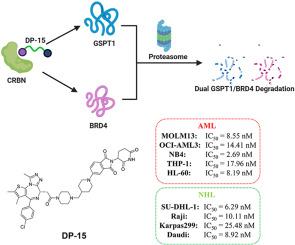
Translational readthrough (TR) regulation has emerged as a promising therapeutic strategy for cancer treatment. Utilizing a constructed monoclonal cell line AG-9, designed for screening compounds that induce TR, we identified a BRD4-targeted PROTAC molecule, dBET57, that promotes TR by degrading GSPT1. Notably, dBET57 exhibited significant antiproliferative activity against acute myeloid leukemia (AML) and non-Hodgkin lymphoma (NHL) cells across a diverse panel of tumor cell lines. Building on these findings, we optimized the structure of dBET57, leading to the development of analogs with enhanced dual-target degradation capabilities. Most of these optimized degraders demonstrated superior antiproliferative activity in vitro against various AML and NHL cell lines when compared to dBET57. Among them, DP-15 emerged as a particularly promising candidate, exhibiting significant anticancer activity against both AML and NHL cells while maintaining acceptable safety profiles for normal leukocytes. Furthermore, DP-15 demonstrated enhanced antitumor efficacy in mouse cell-derived xenograft (CDX) models. Our findings highlight the potential of dual BRD4 and GSPT1 degraders, such as DP-15, as effective therapeutic agents for the treatment of hematological malignancies.
期刊介绍:
The European Journal of Medicinal Chemistry is a global journal that publishes studies on all aspects of medicinal chemistry. It provides a medium for publication of original papers and also welcomes critical review papers.
A typical paper would report on the organic synthesis, characterization and pharmacological evaluation of compounds. Other topics of interest are drug design, QSAR, molecular modeling, drug-receptor interactions, molecular aspects of drug metabolism, prodrug synthesis and drug targeting. The journal expects manuscripts to present the rational for a study, provide insight into the design of compounds or understanding of mechanism, or clarify the targets.





 京公网安备 11010802042870号
京ICP备2023020795号-1
京公网安备 11010802042870号
京ICP备2023020795号-1

 分享
分享
 求助内容:
求助内容: 应助结果提醒方式:
 扫码关注我们
