{"title":"富gc短串联重复RNA逆转录酶读透的高灵敏度荧光检测","authors":"Weiqi Qiu, Catherine Hazard, Yujing Li, Peng Jin, Huiqing Zhou","doi":"10.1021/acs.analchem.4c06236","DOIUrl":null,"url":null,"abstract":"Short tandem repeat (STR) RNAs play a pivotal role in the pathology of STR expansion-associated disorders. However, disease-related STR sequences are often GC-rich (>66% GC), which makes sample preparation and detection challenging. GC-rich STR RNAs, particularly those composed entirely of GC (100% GC), frequently cause interruptions during reverse transcription. Additionally, the GC-rich STR DNA sequences generate low-yield and heterogeneous products when amplified via polymerase chain reaction. The lack of robust processivity of polymerases for GC-only STR poses major challenges in preparing samples and detecting such sequences with physiologically relevant lengths. Herein, we report the <i>in vitro</i> preparation of r(CGG)<sub>29</sub> and r(G<sub>4</sub>C<sub>2</sub>)<sub>15</sub> RNAs, which had repeat numbers relevant to the human <i>FMR1</i> and <i>C9ORF72</i> genes, respectively, and achieved high yield and homogeneity of the prepared GC-only STR RNAs. Using the prepared RNAs, a fluorescence-based detection platform is developed that uses reverse transcriptases (RTases) to identify read-through cDNA products with high sensitivity, requiring minimal RNA input. Further, we demonstrate the versatile applications of this detection platform and provide structural insights into the r(CGG)<sub>29</sub> and r(G<sub>4</sub>C<sub>2</sub>)<sub>15</sub> RNAs during RTase processing. The findings of this study will enhance our ability to characterize and target disease-relevant STR RNAs <i>in vitro</i> and pave the way for future efforts in the directed evolution of RTases aimed at improving the detection of endogenous-expanded GC-rich STR RNAs.","PeriodicalId":27,"journal":{"name":"Analytical Chemistry","volume":"59 1","pages":""},"PeriodicalIF":6.7000,"publicationDate":"2025-02-13","publicationTypes":"Journal Article","fieldsOfStudy":null,"isOpenAccess":false,"openAccessPdf":"","citationCount":"0","resultStr":"{\"title\":\"High-Sensitivity Fluorescence-Based Detection of Reverse Transcriptase Read-Through of GC-Rich Short Tandem Repeat RNA\",\"authors\":\"Weiqi Qiu, Catherine Hazard, Yujing Li, Peng Jin, Huiqing Zhou\",\"doi\":\"10.1021/acs.analchem.4c06236\",\"DOIUrl\":null,\"url\":null,\"abstract\":\"Short tandem repeat (STR) RNAs play a pivotal role in the pathology of STR expansion-associated disorders. However, disease-related STR sequences are often GC-rich (>66% GC), which makes sample preparation and detection challenging. GC-rich STR RNAs, particularly those composed entirely of GC (100% GC), frequently cause interruptions during reverse transcription. Additionally, the GC-rich STR DNA sequences generate low-yield and heterogeneous products when amplified via polymerase chain reaction. The lack of robust processivity of polymerases for GC-only STR poses major challenges in preparing samples and detecting such sequences with physiologically relevant lengths. Herein, we report the <i>in vitro</i> preparation of r(CGG)<sub>29</sub> and r(G<sub>4</sub>C<sub>2</sub>)<sub>15</sub> RNAs, which had repeat numbers relevant to the human <i>FMR1</i> and <i>C9ORF72</i> genes, respectively, and achieved high yield and homogeneity of the prepared GC-only STR RNAs. Using the prepared RNAs, a fluorescence-based detection platform is developed that uses reverse transcriptases (RTases) to identify read-through cDNA products with high sensitivity, requiring minimal RNA input. Further, we demonstrate the versatile applications of this detection platform and provide structural insights into the r(CGG)<sub>29</sub> and r(G<sub>4</sub>C<sub>2</sub>)<sub>15</sub> RNAs during RTase processing. The findings of this study will enhance our ability to characterize and target disease-relevant STR RNAs <i>in vitro</i> and pave the way for future efforts in the directed evolution of RTases aimed at improving the detection of endogenous-expanded GC-rich STR RNAs.\",\"PeriodicalId\":27,\"journal\":{\"name\":\"Analytical Chemistry\",\"volume\":\"59 1\",\"pages\":\"\"},\"PeriodicalIF\":6.7000,\"publicationDate\":\"2025-02-13\",\"publicationTypes\":\"Journal Article\",\"fieldsOfStudy\":null,\"isOpenAccess\":false,\"openAccessPdf\":\"\",\"citationCount\":\"0\",\"resultStr\":null,\"platform\":\"Semanticscholar\",\"paperid\":null,\"PeriodicalName\":\"Analytical Chemistry\",\"FirstCategoryId\":\"92\",\"ListUrlMain\":\"https://doi.org/10.1021/acs.analchem.4c06236\",\"RegionNum\":1,\"RegionCategory\":\"化学\",\"ArticlePicture\":[],\"TitleCN\":null,\"AbstractTextCN\":null,\"PMCID\":null,\"EPubDate\":\"\",\"PubModel\":\"\",\"JCR\":\"Q1\",\"JCRName\":\"CHEMISTRY, ANALYTICAL\",\"Score\":null,\"Total\":0}","platform":"Semanticscholar","paperid":null,"PeriodicalName":"Analytical Chemistry","FirstCategoryId":"92","ListUrlMain":"https://doi.org/10.1021/acs.analchem.4c06236","RegionNum":1,"RegionCategory":"化学","ArticlePicture":[],"TitleCN":null,"AbstractTextCN":null,"PMCID":null,"EPubDate":"","PubModel":"","JCR":"Q1","JCRName":"CHEMISTRY, ANALYTICAL","Score":null,"Total":0}
High-Sensitivity Fluorescence-Based Detection of Reverse Transcriptase Read-Through of GC-Rich Short Tandem Repeat RNA
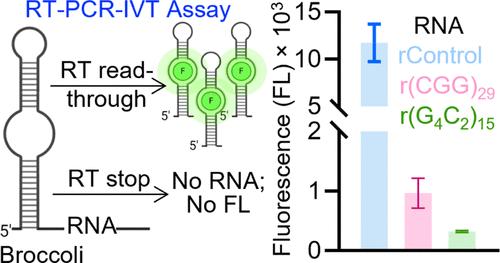
Short tandem repeat (STR) RNAs play a pivotal role in the pathology of STR expansion-associated disorders. However, disease-related STR sequences are often GC-rich (>66% GC), which makes sample preparation and detection challenging. GC-rich STR RNAs, particularly those composed entirely of GC (100% GC), frequently cause interruptions during reverse transcription. Additionally, the GC-rich STR DNA sequences generate low-yield and heterogeneous products when amplified via polymerase chain reaction. The lack of robust processivity of polymerases for GC-only STR poses major challenges in preparing samples and detecting such sequences with physiologically relevant lengths. Herein, we report the in vitro preparation of r(CGG)29 and r(G4C2)15 RNAs, which had repeat numbers relevant to the human FMR1 and C9ORF72 genes, respectively, and achieved high yield and homogeneity of the prepared GC-only STR RNAs. Using the prepared RNAs, a fluorescence-based detection platform is developed that uses reverse transcriptases (RTases) to identify read-through cDNA products with high sensitivity, requiring minimal RNA input. Further, we demonstrate the versatile applications of this detection platform and provide structural insights into the r(CGG)29 and r(G4C2)15 RNAs during RTase processing. The findings of this study will enhance our ability to characterize and target disease-relevant STR RNAs in vitro and pave the way for future efforts in the directed evolution of RTases aimed at improving the detection of endogenous-expanded GC-rich STR RNAs.
期刊介绍:
Analytical Chemistry, a peer-reviewed research journal, focuses on disseminating new and original knowledge across all branches of analytical chemistry. Fundamental articles may explore general principles of chemical measurement science and need not directly address existing or potential analytical methodology. They can be entirely theoretical or report experimental results. Contributions may cover various phases of analytical operations, including sampling, bioanalysis, electrochemistry, mass spectrometry, microscale and nanoscale systems, environmental analysis, separations, spectroscopy, chemical reactions and selectivity, instrumentation, imaging, surface analysis, and data processing. Papers discussing known analytical methods should present a significant, original application of the method, a notable improvement, or results on an important analyte.




 京公网安备 11010802042870号
京ICP备2023020795号-1
京公网安备 11010802042870号
京ICP备2023020795号-1

 分享
分享
 求助内容:
求助内容: 应助结果提醒方式:
 扫码关注我们
