Sarah I. Mueller , Eduard de las Heras García , Lies Hamelink , Lisa Wyseure , David H. Moed , Ivaylo P. Hitsov , Gergana Chapanova , Thomas Diekow , Christian Kaiser , Laurence Palmowski , Thomas Wintgens
{"title":"工业应用中各种地表水离子交换脱矿预处理的评价","authors":"Sarah I. Mueller , Eduard de las Heras García , Lies Hamelink , Lisa Wyseure , David H. Moed , Ivaylo P. Hitsov , Gergana Chapanova , Thomas Diekow , Christian Kaiser , Laurence Palmowski , Thomas Wintgens","doi":"10.1016/j.jwpe.2025.107224","DOIUrl":null,"url":null,"abstract":"<div><div>This study evaluates pretreatment strategies before ion exchange demineralization for producing high-quality demineralized water from surface water in industrial applications. It focuses on water quality improvements and compares the treatment system's resource efficiencies (water, energy, CO<sub>2</sub>-equivalent emissions and costs). Four pretreatment methods were examined: (Scenario 0) an existing system using coagulation/flocculation and sandfiltration, (Scenario 1) the addition of a scavenger resin to the existing system to improve organics removal, (Scenario 2) employing biologically activated carbon filtration (BACF) and scavenger resin as a chemical-less alternative, and (Scenario 3) application of BACF with ultrafiltration (UF) barrier. Two of the four scenarios achieve the required water qualities (i.e., TOC ≤ 0.2 mg/L): Scenario 1 and 3. BACF and UF (Scenario 3) showed the best water quality achievements; both technologies complement each other regarding removing organic fractions. Water efficiencies between 93 % (Scenario 2) and 97 % (Scenario 0) can be achieved, where the sludge-water return is crucial, particularly for Scenario 3. CO<sub>2</sub>-equivalent emissions, combining energy, materials and chemicals used, but also costs, are consistently increased by adding enhanced pretreatments. Specific emissions and estimated costs are slightly lower for Scenario 3 (0.7 kg<sub>CO2-eq</sub>/m<sup>3</sup><sub>Prod</sub>, 1.4 €/m<sup>3</sup><sub>Prod</sub>) than Scenario 1 (0.8 kg<sub>CO2-eq</sub>/m<sup>3</sup><sub>Prod</sub>, 1.5 €/m<sup>3</sup><sub>Prod</sub>).</div></div>","PeriodicalId":17528,"journal":{"name":"Journal of water process engineering","volume":"71 ","pages":"Article 107224"},"PeriodicalIF":6.7000,"publicationDate":"2025-03-01","publicationTypes":"Journal Article","fieldsOfStudy":null,"isOpenAccess":false,"openAccessPdf":"","citationCount":"0","resultStr":"{\"title\":\"Evaluation of various pretreatments of surface water for ion exchange demineralization in industrial applications\",\"authors\":\"Sarah I. Mueller , Eduard de las Heras García , Lies Hamelink , Lisa Wyseure , David H. Moed , Ivaylo P. Hitsov , Gergana Chapanova , Thomas Diekow , Christian Kaiser , Laurence Palmowski , Thomas Wintgens\",\"doi\":\"10.1016/j.jwpe.2025.107224\",\"DOIUrl\":null,\"url\":null,\"abstract\":\"<div><div>This study evaluates pretreatment strategies before ion exchange demineralization for producing high-quality demineralized water from surface water in industrial applications. It focuses on water quality improvements and compares the treatment system's resource efficiencies (water, energy, CO<sub>2</sub>-equivalent emissions and costs). Four pretreatment methods were examined: (Scenario 0) an existing system using coagulation/flocculation and sandfiltration, (Scenario 1) the addition of a scavenger resin to the existing system to improve organics removal, (Scenario 2) employing biologically activated carbon filtration (BACF) and scavenger resin as a chemical-less alternative, and (Scenario 3) application of BACF with ultrafiltration (UF) barrier. Two of the four scenarios achieve the required water qualities (i.e., TOC ≤ 0.2 mg/L): Scenario 1 and 3. BACF and UF (Scenario 3) showed the best water quality achievements; both technologies complement each other regarding removing organic fractions. Water efficiencies between 93 % (Scenario 2) and 97 % (Scenario 0) can be achieved, where the sludge-water return is crucial, particularly for Scenario 3. CO<sub>2</sub>-equivalent emissions, combining energy, materials and chemicals used, but also costs, are consistently increased by adding enhanced pretreatments. Specific emissions and estimated costs are slightly lower for Scenario 3 (0.7 kg<sub>CO2-eq</sub>/m<sup>3</sup><sub>Prod</sub>, 1.4 €/m<sup>3</sup><sub>Prod</sub>) than Scenario 1 (0.8 kg<sub>CO2-eq</sub>/m<sup>3</sup><sub>Prod</sub>, 1.5 €/m<sup>3</sup><sub>Prod</sub>).</div></div>\",\"PeriodicalId\":17528,\"journal\":{\"name\":\"Journal of water process engineering\",\"volume\":\"71 \",\"pages\":\"Article 107224\"},\"PeriodicalIF\":6.7000,\"publicationDate\":\"2025-03-01\",\"publicationTypes\":\"Journal Article\",\"fieldsOfStudy\":null,\"isOpenAccess\":false,\"openAccessPdf\":\"\",\"citationCount\":\"0\",\"resultStr\":null,\"platform\":\"Semanticscholar\",\"paperid\":null,\"PeriodicalName\":\"Journal of water process engineering\",\"FirstCategoryId\":\"5\",\"ListUrlMain\":\"https://www.sciencedirect.com/science/article/pii/S221471442500296X\",\"RegionNum\":2,\"RegionCategory\":\"工程技术\",\"ArticlePicture\":[],\"TitleCN\":null,\"AbstractTextCN\":null,\"PMCID\":null,\"EPubDate\":\"2025/2/14 0:00:00\",\"PubModel\":\"Epub\",\"JCR\":\"Q1\",\"JCRName\":\"ENGINEERING, CHEMICAL\",\"Score\":null,\"Total\":0}","platform":"Semanticscholar","paperid":null,"PeriodicalName":"Journal of water process engineering","FirstCategoryId":"5","ListUrlMain":"https://www.sciencedirect.com/science/article/pii/S221471442500296X","RegionNum":2,"RegionCategory":"工程技术","ArticlePicture":[],"TitleCN":null,"AbstractTextCN":null,"PMCID":null,"EPubDate":"2025/2/14 0:00:00","PubModel":"Epub","JCR":"Q1","JCRName":"ENGINEERING, CHEMICAL","Score":null,"Total":0}
Evaluation of various pretreatments of surface water for ion exchange demineralization in industrial applications
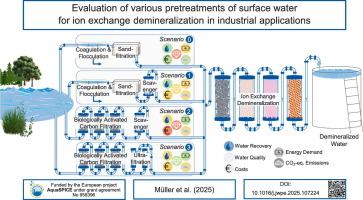
This study evaluates pretreatment strategies before ion exchange demineralization for producing high-quality demineralized water from surface water in industrial applications. It focuses on water quality improvements and compares the treatment system's resource efficiencies (water, energy, CO2-equivalent emissions and costs). Four pretreatment methods were examined: (Scenario 0) an existing system using coagulation/flocculation and sandfiltration, (Scenario 1) the addition of a scavenger resin to the existing system to improve organics removal, (Scenario 2) employing biologically activated carbon filtration (BACF) and scavenger resin as a chemical-less alternative, and (Scenario 3) application of BACF with ultrafiltration (UF) barrier. Two of the four scenarios achieve the required water qualities (i.e., TOC ≤ 0.2 mg/L): Scenario 1 and 3. BACF and UF (Scenario 3) showed the best water quality achievements; both technologies complement each other regarding removing organic fractions. Water efficiencies between 93 % (Scenario 2) and 97 % (Scenario 0) can be achieved, where the sludge-water return is crucial, particularly for Scenario 3. CO2-equivalent emissions, combining energy, materials and chemicals used, but also costs, are consistently increased by adding enhanced pretreatments. Specific emissions and estimated costs are slightly lower for Scenario 3 (0.7 kgCO2-eq/m3Prod, 1.4 €/m3Prod) than Scenario 1 (0.8 kgCO2-eq/m3Prod, 1.5 €/m3Prod).
期刊介绍:
The Journal of Water Process Engineering aims to publish refereed, high-quality research papers with significant novelty and impact in all areas of the engineering of water and wastewater processing . Papers on advanced and novel treatment processes and technologies are particularly welcome. The Journal considers papers in areas such as nanotechnology and biotechnology applications in water, novel oxidation and separation processes, membrane processes (except those for desalination) , catalytic processes for the removal of water contaminants, sustainable processes, water reuse and recycling, water use and wastewater minimization, integrated/hybrid technology, process modeling of water treatment and novel treatment processes. Submissions on the subject of adsorbents, including standard measurements of adsorption kinetics and equilibrium will only be considered if there is a genuine case for novelty and contribution, for example highly novel, sustainable adsorbents and their use: papers on activated carbon-type materials derived from natural matter, or surfactant-modified clays and related minerals, would not fulfil this criterion. The Journal particularly welcomes contributions involving environmentally, economically and socially sustainable technology for water treatment, including those which are energy-efficient, with minimal or no chemical consumption, and capable of water recycling and reuse that minimizes the direct disposal of wastewater to the aquatic environment. Papers that describe novel ideas for solving issues related to water quality and availability are also welcome, as are those that show the transfer of techniques from other disciplines. The Journal will consider papers dealing with processes for various water matrices including drinking water (except desalination), domestic, urban and industrial wastewaters, in addition to their residues. It is expected that the journal will be of particular relevance to chemical and process engineers working in the field. The Journal welcomes Full Text papers, Short Communications, State-of-the-Art Reviews and Letters to Editors and Case Studies




 京公网安备 11010802042870号
京ICP备2023020795号-1
京公网安备 11010802042870号
京ICP备2023020795号-1

 分享
分享
 求助内容:
求助内容: 应助结果提醒方式:
 扫码关注我们
