Yu Zhang, Yangang Sun, Luyao Pan, Zhaoxia Wen, Song Yao
{"title":"设计锰掺杂Bi/Bi2O2CO3微球以改善可见光诱导降解","authors":"Yu Zhang, Yangang Sun, Luyao Pan, Zhaoxia Wen, Song Yao","doi":"10.1016/j.jpcs.2025.112625","DOIUrl":null,"url":null,"abstract":"<div><div>Manganese was doped on the microspheres of Bi self-doped Bi<sub>2</sub>O<sub>2</sub>CO<sub>3</sub> (Bi/BOC) nanosheets by one-step hydrothermal method. A comprehensive analysis was performed on the crystal structure, morphology, electrochemical behavior, and light absorption characteristics of the samples. The photocatalytic activity of Bi/BOC-Mn2 showed notable improvement, leading to a substantial increase in the ciprofloxacin (CIP) degradation rate. Under visible light exposure, CIP degradation reached 93.43 %. The boost in photocatalytic performance arises from the enhanced separation of charge carriers and a broader spectrum of light absorption. Additionally, the photocatalytic mechanism of CIP was investigated through active material capture experiments, identifying superoxide radicals (<strong>•</strong>O<sub>2</sub><sup>−</sup>), electron e<sup>–</sup> and holes (h<sup>+</sup>) as key reactive species. This study presents an innovative strategy for developing efficient photocatalysts to break down organic pollutants.</div></div>","PeriodicalId":16811,"journal":{"name":"Journal of Physics and Chemistry of Solids","volume":"200 ","pages":"Article 112625"},"PeriodicalIF":4.9000,"publicationDate":"2025-05-01","publicationTypes":"Journal Article","fieldsOfStudy":null,"isOpenAccess":false,"openAccessPdf":"","citationCount":"0","resultStr":"{\"title\":\"Designing manganese-doped Bi/Bi2O2CO3 microspheres for improved visible-light-induced degradation\",\"authors\":\"Yu Zhang, Yangang Sun, Luyao Pan, Zhaoxia Wen, Song Yao\",\"doi\":\"10.1016/j.jpcs.2025.112625\",\"DOIUrl\":null,\"url\":null,\"abstract\":\"<div><div>Manganese was doped on the microspheres of Bi self-doped Bi<sub>2</sub>O<sub>2</sub>CO<sub>3</sub> (Bi/BOC) nanosheets by one-step hydrothermal method. A comprehensive analysis was performed on the crystal structure, morphology, electrochemical behavior, and light absorption characteristics of the samples. The photocatalytic activity of Bi/BOC-Mn2 showed notable improvement, leading to a substantial increase in the ciprofloxacin (CIP) degradation rate. Under visible light exposure, CIP degradation reached 93.43 %. The boost in photocatalytic performance arises from the enhanced separation of charge carriers and a broader spectrum of light absorption. Additionally, the photocatalytic mechanism of CIP was investigated through active material capture experiments, identifying superoxide radicals (<strong>•</strong>O<sub>2</sub><sup>−</sup>), electron e<sup>–</sup> and holes (h<sup>+</sup>) as key reactive species. This study presents an innovative strategy for developing efficient photocatalysts to break down organic pollutants.</div></div>\",\"PeriodicalId\":16811,\"journal\":{\"name\":\"Journal of Physics and Chemistry of Solids\",\"volume\":\"200 \",\"pages\":\"Article 112625\"},\"PeriodicalIF\":4.9000,\"publicationDate\":\"2025-05-01\",\"publicationTypes\":\"Journal Article\",\"fieldsOfStudy\":null,\"isOpenAccess\":false,\"openAccessPdf\":\"\",\"citationCount\":\"0\",\"resultStr\":null,\"platform\":\"Semanticscholar\",\"paperid\":null,\"PeriodicalName\":\"Journal of Physics and Chemistry of Solids\",\"FirstCategoryId\":\"88\",\"ListUrlMain\":\"https://www.sciencedirect.com/science/article/pii/S0022369725000769\",\"RegionNum\":3,\"RegionCategory\":\"材料科学\",\"ArticlePicture\":[],\"TitleCN\":null,\"AbstractTextCN\":null,\"PMCID\":null,\"EPubDate\":\"2025/2/10 0:00:00\",\"PubModel\":\"Epub\",\"JCR\":\"Q2\",\"JCRName\":\"CHEMISTRY, MULTIDISCIPLINARY\",\"Score\":null,\"Total\":0}","platform":"Semanticscholar","paperid":null,"PeriodicalName":"Journal of Physics and Chemistry of Solids","FirstCategoryId":"88","ListUrlMain":"https://www.sciencedirect.com/science/article/pii/S0022369725000769","RegionNum":3,"RegionCategory":"材料科学","ArticlePicture":[],"TitleCN":null,"AbstractTextCN":null,"PMCID":null,"EPubDate":"2025/2/10 0:00:00","PubModel":"Epub","JCR":"Q2","JCRName":"CHEMISTRY, MULTIDISCIPLINARY","Score":null,"Total":0}
Designing manganese-doped Bi/Bi2O2CO3 microspheres for improved visible-light-induced degradation
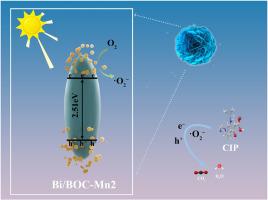
Manganese was doped on the microspheres of Bi self-doped Bi2O2CO3 (Bi/BOC) nanosheets by one-step hydrothermal method. A comprehensive analysis was performed on the crystal structure, morphology, electrochemical behavior, and light absorption characteristics of the samples. The photocatalytic activity of Bi/BOC-Mn2 showed notable improvement, leading to a substantial increase in the ciprofloxacin (CIP) degradation rate. Under visible light exposure, CIP degradation reached 93.43 %. The boost in photocatalytic performance arises from the enhanced separation of charge carriers and a broader spectrum of light absorption. Additionally, the photocatalytic mechanism of CIP was investigated through active material capture experiments, identifying superoxide radicals (•O2−), electron e– and holes (h+) as key reactive species. This study presents an innovative strategy for developing efficient photocatalysts to break down organic pollutants.
期刊介绍:
The Journal of Physics and Chemistry of Solids is a well-established international medium for publication of archival research in condensed matter and materials sciences. Areas of interest broadly include experimental and theoretical research on electronic, magnetic, spectroscopic and structural properties as well as the statistical mechanics and thermodynamics of materials. The focus is on gaining physical and chemical insight into the properties and potential applications of condensed matter systems.
Within the broad scope of the journal, beyond regular contributions, the editors have identified submissions in the following areas of physics and chemistry of solids to be of special current interest to the journal:
Low-dimensional systems
Exotic states of quantum electron matter including topological phases
Energy conversion and storage
Interfaces, nanoparticles and catalysts.




 京公网安备 11010802042870号
京ICP备2023020795号-1
京公网安备 11010802042870号
京ICP备2023020795号-1

 分享
分享
 求助内容:
求助内容: 应助结果提醒方式:
 扫码关注我们
