Yamei Ding, Mingyu Xie, Ping He, Ziqi Zhao, Huiwen Lin and Li Tao
{"title":"具有大跨度荧光开关和质子化/去质子化双光子发射的宽带隙量子点","authors":"Yamei Ding, Mingyu Xie, Ping He, Ziqi Zhao, Huiwen Lin and Li Tao","doi":"10.1039/D4TC04911J","DOIUrl":null,"url":null,"abstract":"<p >Wide-bandgap quantum dots (QDs) have recognized as the third generation of low-dimensional semiconductors with reliable optical response, outstanding stability and biocompatibility for long-term biosensing in health care applications, especially in extreme environments. However, the applicable scenarios are limited, because optical switching over a large span from the wide bandgap (deep UV region) to the visible region is challenging due to the stable framework and the high breakdown difficulty. In this work, we adopted a facile protonation/deprotonation treatment process, which is suitable for different biogenic environments, to modulate the one-photon and two-photon fluorescence of wide-bandgap QDs. Two fluorescent centers are coordinative to control one-photon emission from deep blue (410 nm) to yellow (585 nm) emission with a wide large-span modulation, superior to most reports under different acid–base environments. The electron transition between electron-donating amine (–NH<small><sub>2</sub></small>) groups and H<small><sup>+</sup></small> (–OH) changes the degree of nonradiative transition, narrowing the breadth of the full width at half maximum (FWHM) by 34.4%. Moreover, our QDs exhibit two-photon fluorescence at 710 nm, which have never reported before for wide-bandgap nitrides. It shows pH-independent two-photon fluorescence because of the intrinsic electron–phonon coupling of the π-conjugated structure. This work introduces a simple design strategy to realize fluorescence control over a large span in wide-bandgap nanomaterials, enabling distensible applications in biological health and pH related linear or nonlinear optical fields.</p>","PeriodicalId":84,"journal":{"name":"Journal of Materials Chemistry C","volume":" 7","pages":" 3193-3198"},"PeriodicalIF":5.1000,"publicationDate":"2025-01-20","publicationTypes":"Journal Article","fieldsOfStudy":null,"isOpenAccess":false,"openAccessPdf":"https://pubs.rsc.org/en/content/articlepdf/2025/tc/d4tc04911j?page=search","citationCount":"0","resultStr":"{\"title\":\"Wide-bandgap quantum dots with large-span fluorescence switching and two-photon emission via protonation/deprotonation†\",\"authors\":\"Yamei Ding, Mingyu Xie, Ping He, Ziqi Zhao, Huiwen Lin and Li Tao\",\"doi\":\"10.1039/D4TC04911J\",\"DOIUrl\":null,\"url\":null,\"abstract\":\"<p >Wide-bandgap quantum dots (QDs) have recognized as the third generation of low-dimensional semiconductors with reliable optical response, outstanding stability and biocompatibility for long-term biosensing in health care applications, especially in extreme environments. However, the applicable scenarios are limited, because optical switching over a large span from the wide bandgap (deep UV region) to the visible region is challenging due to the stable framework and the high breakdown difficulty. In this work, we adopted a facile protonation/deprotonation treatment process, which is suitable for different biogenic environments, to modulate the one-photon and two-photon fluorescence of wide-bandgap QDs. Two fluorescent centers are coordinative to control one-photon emission from deep blue (410 nm) to yellow (585 nm) emission with a wide large-span modulation, superior to most reports under different acid–base environments. The electron transition between electron-donating amine (–NH<small><sub>2</sub></small>) groups and H<small><sup>+</sup></small> (–OH) changes the degree of nonradiative transition, narrowing the breadth of the full width at half maximum (FWHM) by 34.4%. Moreover, our QDs exhibit two-photon fluorescence at 710 nm, which have never reported before for wide-bandgap nitrides. It shows pH-independent two-photon fluorescence because of the intrinsic electron–phonon coupling of the π-conjugated structure. This work introduces a simple design strategy to realize fluorescence control over a large span in wide-bandgap nanomaterials, enabling distensible applications in biological health and pH related linear or nonlinear optical fields.</p>\",\"PeriodicalId\":84,\"journal\":{\"name\":\"Journal of Materials Chemistry C\",\"volume\":\" 7\",\"pages\":\" 3193-3198\"},\"PeriodicalIF\":5.1000,\"publicationDate\":\"2025-01-20\",\"publicationTypes\":\"Journal Article\",\"fieldsOfStudy\":null,\"isOpenAccess\":false,\"openAccessPdf\":\"https://pubs.rsc.org/en/content/articlepdf/2025/tc/d4tc04911j?page=search\",\"citationCount\":\"0\",\"resultStr\":null,\"platform\":\"Semanticscholar\",\"paperid\":null,\"PeriodicalName\":\"Journal of Materials Chemistry C\",\"FirstCategoryId\":\"1\",\"ListUrlMain\":\"https://pubs.rsc.org/en/content/articlelanding/2025/tc/d4tc04911j\",\"RegionNum\":2,\"RegionCategory\":\"材料科学\",\"ArticlePicture\":[],\"TitleCN\":null,\"AbstractTextCN\":null,\"PMCID\":null,\"EPubDate\":\"\",\"PubModel\":\"\",\"JCR\":\"Q2\",\"JCRName\":\"MATERIALS SCIENCE, MULTIDISCIPLINARY\",\"Score\":null,\"Total\":0}","platform":"Semanticscholar","paperid":null,"PeriodicalName":"Journal of Materials Chemistry C","FirstCategoryId":"1","ListUrlMain":"https://pubs.rsc.org/en/content/articlelanding/2025/tc/d4tc04911j","RegionNum":2,"RegionCategory":"材料科学","ArticlePicture":[],"TitleCN":null,"AbstractTextCN":null,"PMCID":null,"EPubDate":"","PubModel":"","JCR":"Q2","JCRName":"MATERIALS SCIENCE, MULTIDISCIPLINARY","Score":null,"Total":0}
Wide-bandgap quantum dots with large-span fluorescence switching and two-photon emission via protonation/deprotonation†
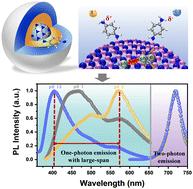
Wide-bandgap quantum dots (QDs) have recognized as the third generation of low-dimensional semiconductors with reliable optical response, outstanding stability and biocompatibility for long-term biosensing in health care applications, especially in extreme environments. However, the applicable scenarios are limited, because optical switching over a large span from the wide bandgap (deep UV region) to the visible region is challenging due to the stable framework and the high breakdown difficulty. In this work, we adopted a facile protonation/deprotonation treatment process, which is suitable for different biogenic environments, to modulate the one-photon and two-photon fluorescence of wide-bandgap QDs. Two fluorescent centers are coordinative to control one-photon emission from deep blue (410 nm) to yellow (585 nm) emission with a wide large-span modulation, superior to most reports under different acid–base environments. The electron transition between electron-donating amine (–NH2) groups and H+ (–OH) changes the degree of nonradiative transition, narrowing the breadth of the full width at half maximum (FWHM) by 34.4%. Moreover, our QDs exhibit two-photon fluorescence at 710 nm, which have never reported before for wide-bandgap nitrides. It shows pH-independent two-photon fluorescence because of the intrinsic electron–phonon coupling of the π-conjugated structure. This work introduces a simple design strategy to realize fluorescence control over a large span in wide-bandgap nanomaterials, enabling distensible applications in biological health and pH related linear or nonlinear optical fields.
期刊介绍:
The Journal of Materials Chemistry is divided into three distinct sections, A, B, and C, each catering to specific applications of the materials under study:
Journal of Materials Chemistry A focuses primarily on materials intended for applications in energy and sustainability.
Journal of Materials Chemistry B specializes in materials designed for applications in biology and medicine.
Journal of Materials Chemistry C is dedicated to materials suitable for applications in optical, magnetic, and electronic devices.
Example topic areas within the scope of Journal of Materials Chemistry C are listed below. This list is neither exhaustive nor exclusive.
Bioelectronics
Conductors
Detectors
Dielectrics
Displays
Ferroelectrics
Lasers
LEDs
Lighting
Liquid crystals
Memory
Metamaterials
Multiferroics
Photonics
Photovoltaics
Semiconductors
Sensors
Single molecule conductors
Spintronics
Superconductors
Thermoelectrics
Topological insulators
Transistors




 京公网安备 11010802042870号
京ICP备2023020795号-1
京公网安备 11010802042870号
京ICP备2023020795号-1

 分享
分享
 求助内容:
求助内容: 应助结果提醒方式:
 扫码关注我们
