{"title":"低比例钇微弧氧化涂层通过BMP/Smad途径增强钛植入体的骨整合。","authors":"Chenyang Zhang, Chenghui Qian, Guang Yang, Yiying Zhu, Binbin Kang, Xiaohong Chen, Si Chen","doi":"10.1021/acsbiomaterials.4c02461","DOIUrl":null,"url":null,"abstract":"<p><p>Adding metal ions is a promising strategy to enhance the biological performance of titanium implants. In this study, we aimed to explore the effects of yttrium on the osseointegration of titanium implants. First, a series of yttrium-doped titanium surfaces were fabricated via microarc oxidation (MAO) by incorporating yttrium acetate into the electrolyte, and then the surface characteristics of different substrates were evaluated. Subsequently, the cellular behaviors of different coatings were assessed, and the osteointegration effects were examined using a rat model. Finally, high-throughput sequencing was employed to elucidate the underlying mechanisms of the yttrium-doped MAO coatings. As the results indicated, the proportion of yttrium in the coatings increased as the concentration of yttrium acetate improved. Surface characterization revealed that the yttrium-doped MAO coatings exhibited a homogeneous porous morphology, with comparable roughness and wettability to those of the undoped MAO coating, while the morphology became inconsistent when the yttrium acetate concentration reached 30 mM. The <i>in vitro</i> assays demonstrated that the addition of yttrium notably improved the cell adhesion, spreading, proliferation, and osteogenic differentiation of MAO coatings when doped with a low proportion, accompanied by enhanced osseointegration according to the <i>in vivo</i> experiments. Further exploration revealed a significant enrichment of osseointegration-related signaling factors and the activation of BMP/Smad signaling in the effects of yttrium-doped titanium coatings, which was attributed to the excessive accumulation of phosphorylated Smad1/5/9 in the nucleus. In summary, our work demonstrates that the use of MAO coatings doped with a low proportion of yttrium can enhance the osseointegration of titanium implants, providing an efficient strategy to optimize titanium implant performance.</p>","PeriodicalId":8,"journal":{"name":"ACS Biomaterials Science & Engineering","volume":" ","pages":"1869-1881"},"PeriodicalIF":5.5000,"publicationDate":"2025-03-10","publicationTypes":"Journal Article","fieldsOfStudy":null,"isOpenAccess":false,"openAccessPdf":"https://www.ncbi.nlm.nih.gov/pmc/articles/PMC11897939/pdf/","citationCount":"0","resultStr":"{\"title\":\"Microarc Oxidation Coatings Doped with a Low Proportion of Yttrium Enhance the Osseointegration of Titanium Implants through the BMP/Smad Pathway.\",\"authors\":\"Chenyang Zhang, Chenghui Qian, Guang Yang, Yiying Zhu, Binbin Kang, Xiaohong Chen, Si Chen\",\"doi\":\"10.1021/acsbiomaterials.4c02461\",\"DOIUrl\":null,\"url\":null,\"abstract\":\"<p><p>Adding metal ions is a promising strategy to enhance the biological performance of titanium implants. In this study, we aimed to explore the effects of yttrium on the osseointegration of titanium implants. First, a series of yttrium-doped titanium surfaces were fabricated via microarc oxidation (MAO) by incorporating yttrium acetate into the electrolyte, and then the surface characteristics of different substrates were evaluated. Subsequently, the cellular behaviors of different coatings were assessed, and the osteointegration effects were examined using a rat model. Finally, high-throughput sequencing was employed to elucidate the underlying mechanisms of the yttrium-doped MAO coatings. As the results indicated, the proportion of yttrium in the coatings increased as the concentration of yttrium acetate improved. Surface characterization revealed that the yttrium-doped MAO coatings exhibited a homogeneous porous morphology, with comparable roughness and wettability to those of the undoped MAO coating, while the morphology became inconsistent when the yttrium acetate concentration reached 30 mM. The <i>in vitro</i> assays demonstrated that the addition of yttrium notably improved the cell adhesion, spreading, proliferation, and osteogenic differentiation of MAO coatings when doped with a low proportion, accompanied by enhanced osseointegration according to the <i>in vivo</i> experiments. Further exploration revealed a significant enrichment of osseointegration-related signaling factors and the activation of BMP/Smad signaling in the effects of yttrium-doped titanium coatings, which was attributed to the excessive accumulation of phosphorylated Smad1/5/9 in the nucleus. In summary, our work demonstrates that the use of MAO coatings doped with a low proportion of yttrium can enhance the osseointegration of titanium implants, providing an efficient strategy to optimize titanium implant performance.</p>\",\"PeriodicalId\":8,\"journal\":{\"name\":\"ACS Biomaterials Science & Engineering\",\"volume\":\" \",\"pages\":\"1869-1881\"},\"PeriodicalIF\":5.5000,\"publicationDate\":\"2025-03-10\",\"publicationTypes\":\"Journal Article\",\"fieldsOfStudy\":null,\"isOpenAccess\":false,\"openAccessPdf\":\"https://www.ncbi.nlm.nih.gov/pmc/articles/PMC11897939/pdf/\",\"citationCount\":\"0\",\"resultStr\":null,\"platform\":\"Semanticscholar\",\"paperid\":null,\"PeriodicalName\":\"ACS Biomaterials Science & Engineering\",\"FirstCategoryId\":\"5\",\"ListUrlMain\":\"https://doi.org/10.1021/acsbiomaterials.4c02461\",\"RegionNum\":2,\"RegionCategory\":\"医学\",\"ArticlePicture\":[],\"TitleCN\":null,\"AbstractTextCN\":null,\"PMCID\":null,\"EPubDate\":\"2025/2/13 0:00:00\",\"PubModel\":\"Epub\",\"JCR\":\"Q2\",\"JCRName\":\"MATERIALS SCIENCE, BIOMATERIALS\",\"Score\":null,\"Total\":0}","platform":"Semanticscholar","paperid":null,"PeriodicalName":"ACS Biomaterials Science & Engineering","FirstCategoryId":"5","ListUrlMain":"https://doi.org/10.1021/acsbiomaterials.4c02461","RegionNum":2,"RegionCategory":"医学","ArticlePicture":[],"TitleCN":null,"AbstractTextCN":null,"PMCID":null,"EPubDate":"2025/2/13 0:00:00","PubModel":"Epub","JCR":"Q2","JCRName":"MATERIALS SCIENCE, BIOMATERIALS","Score":null,"Total":0}
Microarc Oxidation Coatings Doped with a Low Proportion of Yttrium Enhance the Osseointegration of Titanium Implants through the BMP/Smad Pathway.
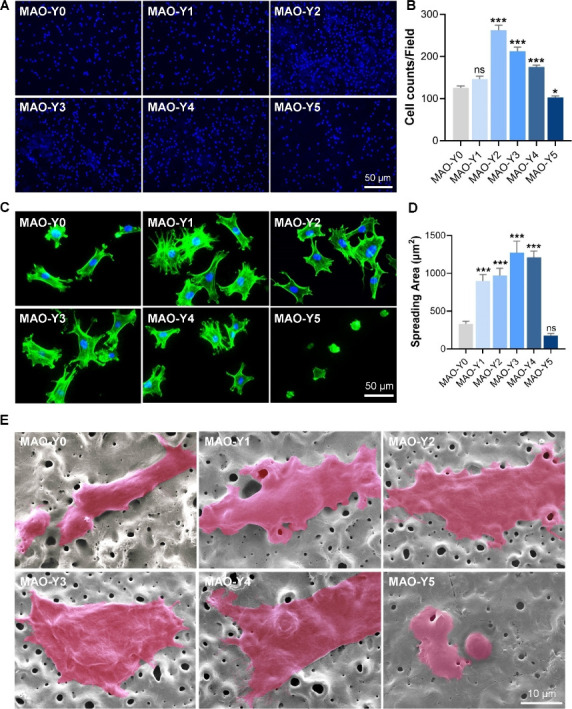
Adding metal ions is a promising strategy to enhance the biological performance of titanium implants. In this study, we aimed to explore the effects of yttrium on the osseointegration of titanium implants. First, a series of yttrium-doped titanium surfaces were fabricated via microarc oxidation (MAO) by incorporating yttrium acetate into the electrolyte, and then the surface characteristics of different substrates were evaluated. Subsequently, the cellular behaviors of different coatings were assessed, and the osteointegration effects were examined using a rat model. Finally, high-throughput sequencing was employed to elucidate the underlying mechanisms of the yttrium-doped MAO coatings. As the results indicated, the proportion of yttrium in the coatings increased as the concentration of yttrium acetate improved. Surface characterization revealed that the yttrium-doped MAO coatings exhibited a homogeneous porous morphology, with comparable roughness and wettability to those of the undoped MAO coating, while the morphology became inconsistent when the yttrium acetate concentration reached 30 mM. The in vitro assays demonstrated that the addition of yttrium notably improved the cell adhesion, spreading, proliferation, and osteogenic differentiation of MAO coatings when doped with a low proportion, accompanied by enhanced osseointegration according to the in vivo experiments. Further exploration revealed a significant enrichment of osseointegration-related signaling factors and the activation of BMP/Smad signaling in the effects of yttrium-doped titanium coatings, which was attributed to the excessive accumulation of phosphorylated Smad1/5/9 in the nucleus. In summary, our work demonstrates that the use of MAO coatings doped with a low proportion of yttrium can enhance the osseointegration of titanium implants, providing an efficient strategy to optimize titanium implant performance.
期刊介绍:
ACS Biomaterials Science & Engineering is the leading journal in the field of biomaterials, serving as an international forum for publishing cutting-edge research and innovative ideas on a broad range of topics:
Applications and Health – implantable tissues and devices, prosthesis, health risks, toxicology
Bio-interactions and Bio-compatibility – material-biology interactions, chemical/morphological/structural communication, mechanobiology, signaling and biological responses, immuno-engineering, calcification, coatings, corrosion and degradation of biomaterials and devices, biophysical regulation of cell functions
Characterization, Synthesis, and Modification – new biomaterials, bioinspired and biomimetic approaches to biomaterials, exploiting structural hierarchy and architectural control, combinatorial strategies for biomaterials discovery, genetic biomaterials design, synthetic biology, new composite systems, bionics, polymer synthesis
Controlled Release and Delivery Systems – biomaterial-based drug and gene delivery, bio-responsive delivery of regulatory molecules, pharmaceutical engineering
Healthcare Advances – clinical translation, regulatory issues, patient safety, emerging trends
Imaging and Diagnostics – imaging agents and probes, theranostics, biosensors, monitoring
Manufacturing and Technology – 3D printing, inks, organ-on-a-chip, bioreactor/perfusion systems, microdevices, BioMEMS, optics and electronics interfaces with biomaterials, systems integration
Modeling and Informatics Tools – scaling methods to guide biomaterial design, predictive algorithms for structure-function, biomechanics, integrating bioinformatics with biomaterials discovery, metabolomics in the context of biomaterials
Tissue Engineering and Regenerative Medicine – basic and applied studies, cell therapies, scaffolds, vascularization, bioartificial organs, transplantation and functionality, cellular agriculture






 京公网安备 11010802042870号
京ICP备2023020795号-1
京公网安备 11010802042870号
京ICP备2023020795号-1

 分享
分享
 求助内容:
求助内容: 应助结果提醒方式:
 扫码关注我们
