Ján Michael Kormaník, Daniel Herman, Erik Andris, Martin Culka, Ondrej Gutten, Milan Kožíšek, Lucie Bednárová, Pavel Srb, Václav Veverka, Lubomír Rulíšek
{"title":"从蛋白质片段中设计锌结合肽。","authors":"Ján Michael Kormaník, Daniel Herman, Erik Andris, Martin Culka, Ondrej Gutten, Milan Kožíšek, Lucie Bednárová, Pavel Srb, Václav Veverka, Lubomír Rulíšek","doi":"10.1002/cbic.202401014","DOIUrl":null,"url":null,"abstract":"<p>We designed a minimalistic zinc(II)-binding peptide featuring the Cys<sub>2</sub>His<sub>2</sub> zinc-finger motif. To this aim, several tens of thousands of (His/Cys)-X<sub><i>n</i></sub>-(His/Cys) protein fragments (<i>n</i>=2–20) were first extracted from the 3D protein structures deposited in Protein Data Bank (PDB). Based on geometrical constraints positioning two Cys (C) and two His (H) side chains at the vertices of a tetrahedron, approximately 22 000 sequences of the (H/C)-X<sub><i>i</i></sub>-(H/C)-X<sub><i>j</i></sub>-(H/C)-X<sub><i>k</i></sub>-(H/C) type, satisfying <i>N</i><sub>metal–binding H</sub>=<i>N</i><sub>metal-binding C</sub>=2, were processed. Several other criteria, such as the secondary structure content and predicted fold stability, were then used to select the best candidates. To prove the viability of the computational design experimentally, three peptides were synthesized and subjected to isothermal calorimetry (ITC) measurements to determine the binding constants with Zn<sup>2+</sup>, including the entropy and enthalpy terms. For the strongest Zn<sup>2+</sup> ions binding peptide, <b>P1</b>, the dissociation constant was shown to be in the nanomolar range (<i>K<sub>D</sub></i>=~220 nM; corresponding to Δ<i>G</i><sub>bind</sub>=−9.1 kcal mol<sup>−1</sup>). In addition, ITC showed that the [<b>P1</b> : Zn<sup>2+</sup>] complex forms in 1 : 1 stoichiometry and two protons are released upon binding, which suggests that the zinc coordination involves both cysteines. NMR experiments also indicated that the structure of the [<b>P1</b> : Zn<sup>2+</sup>] complex might be quite similar to the computationally predicted one. In summary, our proof-of-principle study highlights the usefulness of our computational protocol for designing novel metal-binding peptides.</p>","PeriodicalId":140,"journal":{"name":"ChemBioChem","volume":"26 7","pages":""},"PeriodicalIF":2.8000,"publicationDate":"2025-02-12","publicationTypes":"Journal Article","fieldsOfStudy":null,"isOpenAccess":false,"openAccessPdf":"https://onlinelibrary.wiley.com/doi/epdf/10.1002/cbic.202401014","citationCount":"0","resultStr":"{\"title\":\"Design of Zn-Binding Peptide(s) from Protein Fragments\",\"authors\":\"Ján Michael Kormaník, Daniel Herman, Erik Andris, Martin Culka, Ondrej Gutten, Milan Kožíšek, Lucie Bednárová, Pavel Srb, Václav Veverka, Lubomír Rulíšek\",\"doi\":\"10.1002/cbic.202401014\",\"DOIUrl\":null,\"url\":null,\"abstract\":\"<p>We designed a minimalistic zinc(II)-binding peptide featuring the Cys<sub>2</sub>His<sub>2</sub> zinc-finger motif. To this aim, several tens of thousands of (His/Cys)-X<sub><i>n</i></sub>-(His/Cys) protein fragments (<i>n</i>=2–20) were first extracted from the 3D protein structures deposited in Protein Data Bank (PDB). Based on geometrical constraints positioning two Cys (C) and two His (H) side chains at the vertices of a tetrahedron, approximately 22 000 sequences of the (H/C)-X<sub><i>i</i></sub>-(H/C)-X<sub><i>j</i></sub>-(H/C)-X<sub><i>k</i></sub>-(H/C) type, satisfying <i>N</i><sub>metal–binding H</sub>=<i>N</i><sub>metal-binding C</sub>=2, were processed. Several other criteria, such as the secondary structure content and predicted fold stability, were then used to select the best candidates. To prove the viability of the computational design experimentally, three peptides were synthesized and subjected to isothermal calorimetry (ITC) measurements to determine the binding constants with Zn<sup>2+</sup>, including the entropy and enthalpy terms. For the strongest Zn<sup>2+</sup> ions binding peptide, <b>P1</b>, the dissociation constant was shown to be in the nanomolar range (<i>K<sub>D</sub></i>=~220 nM; corresponding to Δ<i>G</i><sub>bind</sub>=−9.1 kcal mol<sup>−1</sup>). In addition, ITC showed that the [<b>P1</b> : Zn<sup>2+</sup>] complex forms in 1 : 1 stoichiometry and two protons are released upon binding, which suggests that the zinc coordination involves both cysteines. NMR experiments also indicated that the structure of the [<b>P1</b> : Zn<sup>2+</sup>] complex might be quite similar to the computationally predicted one. In summary, our proof-of-principle study highlights the usefulness of our computational protocol for designing novel metal-binding peptides.</p>\",\"PeriodicalId\":140,\"journal\":{\"name\":\"ChemBioChem\",\"volume\":\"26 7\",\"pages\":\"\"},\"PeriodicalIF\":2.8000,\"publicationDate\":\"2025-02-12\",\"publicationTypes\":\"Journal Article\",\"fieldsOfStudy\":null,\"isOpenAccess\":false,\"openAccessPdf\":\"https://onlinelibrary.wiley.com/doi/epdf/10.1002/cbic.202401014\",\"citationCount\":\"0\",\"resultStr\":null,\"platform\":\"Semanticscholar\",\"paperid\":null,\"PeriodicalName\":\"ChemBioChem\",\"FirstCategoryId\":\"99\",\"ListUrlMain\":\"https://chemistry-europe.onlinelibrary.wiley.com/doi/10.1002/cbic.202401014\",\"RegionNum\":4,\"RegionCategory\":\"生物学\",\"ArticlePicture\":[],\"TitleCN\":null,\"AbstractTextCN\":null,\"PMCID\":null,\"EPubDate\":\"\",\"PubModel\":\"\",\"JCR\":\"Q3\",\"JCRName\":\"BIOCHEMISTRY & MOLECULAR BIOLOGY\",\"Score\":null,\"Total\":0}","platform":"Semanticscholar","paperid":null,"PeriodicalName":"ChemBioChem","FirstCategoryId":"99","ListUrlMain":"https://chemistry-europe.onlinelibrary.wiley.com/doi/10.1002/cbic.202401014","RegionNum":4,"RegionCategory":"生物学","ArticlePicture":[],"TitleCN":null,"AbstractTextCN":null,"PMCID":null,"EPubDate":"","PubModel":"","JCR":"Q3","JCRName":"BIOCHEMISTRY & MOLECULAR BIOLOGY","Score":null,"Total":0}
引用次数: 0
摘要
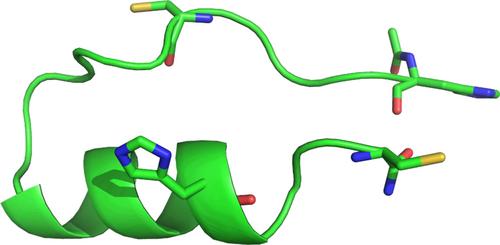
我们设计了具有Cys2His2锌指基序的锌(II)结合肽。数万个(His/Cys)‑Xn‑(His/Cys)蛋白片段(n = 2 ~ 20)从存放在protein Data Bank中的3D蛋白结构中提取。基于在四面体顶点定位两条Cys (C)和两条His (H)侧链的几何约束,处理了约22000条(H/C) - Xi - (H/C) - Xj - (H/C) - Xk - (H/C)型序列,满足Nmetal-binding H = Nmetal-binding C = 2。为了证明计算设计的可行性,我们合成了3个多肽,并用等温量热法(ITC)测定了Zn2+的结合常数,包括熵和焓项。对于最强的Zn2+结合肽P1,解离常数在纳摩尔范围内(KD = ~220 nM;对应DGbind = - 9.1 kcal·mol - 1)。此外,ITC显示[P1:Zn2+]复合物以1:1的化学计量形式形成,结合时释放两个质子,这表明锌配位涉及两种半胱氨酸。核磁共振实验还表明,[P1:Zn2+]配合物的结构可能与计算预测的结构非常相似。总之,我们的原理验证研究强调了我们的计算协议在设计新型金属结合肽方面的有用性。
Design of Zn-Binding Peptide(s) from Protein Fragments
We designed a minimalistic zinc(II)-binding peptide featuring the Cys2His2 zinc-finger motif. To this aim, several tens of thousands of (His/Cys)-Xn-(His/Cys) protein fragments (n=2–20) were first extracted from the 3D protein structures deposited in Protein Data Bank (PDB). Based on geometrical constraints positioning two Cys (C) and two His (H) side chains at the vertices of a tetrahedron, approximately 22 000 sequences of the (H/C)-Xi-(H/C)-Xj-(H/C)-Xk-(H/C) type, satisfying Nmetal–binding H=Nmetal-binding C=2, were processed. Several other criteria, such as the secondary structure content and predicted fold stability, were then used to select the best candidates. To prove the viability of the computational design experimentally, three peptides were synthesized and subjected to isothermal calorimetry (ITC) measurements to determine the binding constants with Zn2+, including the entropy and enthalpy terms. For the strongest Zn2+ ions binding peptide, P1, the dissociation constant was shown to be in the nanomolar range (KD=~220 nM; corresponding to ΔGbind=−9.1 kcal mol−1). In addition, ITC showed that the [P1 : Zn2+] complex forms in 1 : 1 stoichiometry and two protons are released upon binding, which suggests that the zinc coordination involves both cysteines. NMR experiments also indicated that the structure of the [P1 : Zn2+] complex might be quite similar to the computationally predicted one. In summary, our proof-of-principle study highlights the usefulness of our computational protocol for designing novel metal-binding peptides.
期刊介绍:
ChemBioChem (Impact Factor 2018: 2.641) publishes important breakthroughs across all areas at the interface of chemistry and biology, including the fields of chemical biology, bioorganic chemistry, bioinorganic chemistry, synthetic biology, biocatalysis, bionanotechnology, and biomaterials. It is published on behalf of Chemistry Europe, an association of 16 European chemical societies, and supported by the Asian Chemical Editorial Society (ACES).







 京公网安备 11010802042870号
京ICP备2023020795号-1
京公网安备 11010802042870号
京ICP备2023020795号-1

 分享
分享
 求助内容:
求助内容: 应助结果提醒方式:
 扫码关注我们
