Jesse Lloyd Goldshear, Siddhi S Ganesh, Annick Borquez, Lillian Gelberg, Karen F Corsi, Ricky N Bluthenthal
{"title":"加利福尼亚州洛杉矶和科罗拉多州丹佛市无住房吸毒者的物质困难、被迫流离失所和负面健康结果:潜在阶层分析。","authors":"Jesse Lloyd Goldshear, Siddhi S Ganesh, Annick Borquez, Lillian Gelberg, Karen F Corsi, Ricky N Bluthenthal","doi":"10.1186/s12889-025-21626-6","DOIUrl":null,"url":null,"abstract":"<p><strong>Background: </strong>Homelessness is a growing concern in the United States, especially among people who use drugs (PWUD). The degree of material hardship among this population may be linked to worse health outcomes. PWUD experiencing homelessness in urban areas are increasingly subjected to policies and social treatment, such as forced displacement, which may worsen material hardship. It is critical to describe hardship among PWUD and examine if it is linked to health outcomes.</p><p><strong>Methods: </strong>Data were collected as part of a prospective cohort study of PWUD in Los Angeles, California and Denver, Colorado (n = 476). Analysis sample size was smaller (N = 395) after selecting for people experiencing homelessness and for whom data were complete. Five indicators assessing hardship (difficulty finding food, clothing, restrooms, places to wash/shower, and shelter) in the past three months were obtained from participants at baseline and were used in latent class analysis (LCA). We chose a base latent class model after examination of global fit statistics. We then built three auxiliary models using the three-step Bolck-Croon-Hagenaars (BCH) method to test the relationship of latent class membership to several hypothesized social and health variables in this same three month time period.</p><p><strong>Results: </strong>Fit statistics, minimum classification probabilities, and ease of interpretation indicated a three-class solution for level of material difficulty. We termed these classes \"High Difficulty\" (n = 82), \"Mixed Difficulty\" (n = 215), and \"Low Difficulty\" (n = 98). Average classification probabilities indicated good class separability. \"High Difficulty\" participants had high probabilities of usually having difficulty accessing all five resources. \"Mixed Difficulty\" participants indicated a range of difficulty accessing all resources, with restrooms and bathing facilities being the most difficult. \"Low Difficulty\" participants were defined by high probabilities of never having access difficulty. In auxiliary analyses, there were significant (p < 0.05) differences in experiences of displacement, opioid withdrawal symptoms, nonfatal overdose, and violent victimization between classes.</p><p><strong>Conclusions: </strong>This LCA indicates that among PWUD experiencing homelessness there exist distinct differences in resource access and material hardship, and that these differences are linked with political, social, substance use, and other health outcomes. We add to the literature on the relationship between poverty and health among PWUD. Policies which increase difficulty accessing necessary material resources may negatively impact health in this population.</p>","PeriodicalId":9039,"journal":{"name":"BMC Public Health","volume":"25 1","pages":"591"},"PeriodicalIF":4.4000,"publicationDate":"2025-02-13","publicationTypes":"Journal Article","fieldsOfStudy":null,"isOpenAccess":false,"openAccessPdf":"https://www.ncbi.nlm.nih.gov/pmc/articles/PMC11823192/pdf/","citationCount":"0","resultStr":"{\"title\":\"Material hardship, forced displacement, and negative health outcomes among unhoused people who use drugs in Los Angeles, California and Denver, Colorado: a latent class analysis.\",\"authors\":\"Jesse Lloyd Goldshear, Siddhi S Ganesh, Annick Borquez, Lillian Gelberg, Karen F Corsi, Ricky N Bluthenthal\",\"doi\":\"10.1186/s12889-025-21626-6\",\"DOIUrl\":null,\"url\":null,\"abstract\":\"<p><strong>Background: </strong>Homelessness is a growing concern in the United States, especially among people who use drugs (PWUD). The degree of material hardship among this population may be linked to worse health outcomes. PWUD experiencing homelessness in urban areas are increasingly subjected to policies and social treatment, such as forced displacement, which may worsen material hardship. It is critical to describe hardship among PWUD and examine if it is linked to health outcomes.</p><p><strong>Methods: </strong>Data were collected as part of a prospective cohort study of PWUD in Los Angeles, California and Denver, Colorado (n = 476). Analysis sample size was smaller (N = 395) after selecting for people experiencing homelessness and for whom data were complete. Five indicators assessing hardship (difficulty finding food, clothing, restrooms, places to wash/shower, and shelter) in the past three months were obtained from participants at baseline and were used in latent class analysis (LCA). We chose a base latent class model after examination of global fit statistics. We then built three auxiliary models using the three-step Bolck-Croon-Hagenaars (BCH) method to test the relationship of latent class membership to several hypothesized social and health variables in this same three month time period.</p><p><strong>Results: </strong>Fit statistics, minimum classification probabilities, and ease of interpretation indicated a three-class solution for level of material difficulty. We termed these classes \\\"High Difficulty\\\" (n = 82), \\\"Mixed Difficulty\\\" (n = 215), and \\\"Low Difficulty\\\" (n = 98). Average classification probabilities indicated good class separability. \\\"High Difficulty\\\" participants had high probabilities of usually having difficulty accessing all five resources. \\\"Mixed Difficulty\\\" participants indicated a range of difficulty accessing all resources, with restrooms and bathing facilities being the most difficult. \\\"Low Difficulty\\\" participants were defined by high probabilities of never having access difficulty. In auxiliary analyses, there were significant (p < 0.05) differences in experiences of displacement, opioid withdrawal symptoms, nonfatal overdose, and violent victimization between classes.</p><p><strong>Conclusions: </strong>This LCA indicates that among PWUD experiencing homelessness there exist distinct differences in resource access and material hardship, and that these differences are linked with political, social, substance use, and other health outcomes. We add to the literature on the relationship between poverty and health among PWUD. Policies which increase difficulty accessing necessary material resources may negatively impact health in this population.</p>\",\"PeriodicalId\":9039,\"journal\":{\"name\":\"BMC Public Health\",\"volume\":\"25 1\",\"pages\":\"591\"},\"PeriodicalIF\":4.4000,\"publicationDate\":\"2025-02-13\",\"publicationTypes\":\"Journal Article\",\"fieldsOfStudy\":null,\"isOpenAccess\":false,\"openAccessPdf\":\"https://www.ncbi.nlm.nih.gov/pmc/articles/PMC11823192/pdf/\",\"citationCount\":\"0\",\"resultStr\":null,\"platform\":\"Semanticscholar\",\"paperid\":null,\"PeriodicalName\":\"BMC Public Health\",\"FirstCategoryId\":\"3\",\"ListUrlMain\":\"https://doi.org/10.1186/s12889-025-21626-6\",\"RegionNum\":2,\"RegionCategory\":\"医学\",\"ArticlePicture\":[],\"TitleCN\":null,\"AbstractTextCN\":null,\"PMCID\":null,\"EPubDate\":\"\",\"PubModel\":\"\",\"JCR\":\"Q1\",\"JCRName\":\"PUBLIC, ENVIRONMENTAL & OCCUPATIONAL HEALTH\",\"Score\":null,\"Total\":0}","platform":"Semanticscholar","paperid":null,"PeriodicalName":"BMC Public Health","FirstCategoryId":"3","ListUrlMain":"https://doi.org/10.1186/s12889-025-21626-6","RegionNum":2,"RegionCategory":"医学","ArticlePicture":[],"TitleCN":null,"AbstractTextCN":null,"PMCID":null,"EPubDate":"","PubModel":"","JCR":"Q1","JCRName":"PUBLIC, ENVIRONMENTAL & OCCUPATIONAL HEALTH","Score":null,"Total":0}
Material hardship, forced displacement, and negative health outcomes among unhoused people who use drugs in Los Angeles, California and Denver, Colorado: a latent class analysis.
Background: Homelessness is a growing concern in the United States, especially among people who use drugs (PWUD). The degree of material hardship among this population may be linked to worse health outcomes. PWUD experiencing homelessness in urban areas are increasingly subjected to policies and social treatment, such as forced displacement, which may worsen material hardship. It is critical to describe hardship among PWUD and examine if it is linked to health outcomes.
Methods: Data were collected as part of a prospective cohort study of PWUD in Los Angeles, California and Denver, Colorado (n = 476). Analysis sample size was smaller (N = 395) after selecting for people experiencing homelessness and for whom data were complete. Five indicators assessing hardship (difficulty finding food, clothing, restrooms, places to wash/shower, and shelter) in the past three months were obtained from participants at baseline and were used in latent class analysis (LCA). We chose a base latent class model after examination of global fit statistics. We then built three auxiliary models using the three-step Bolck-Croon-Hagenaars (BCH) method to test the relationship of latent class membership to several hypothesized social and health variables in this same three month time period.
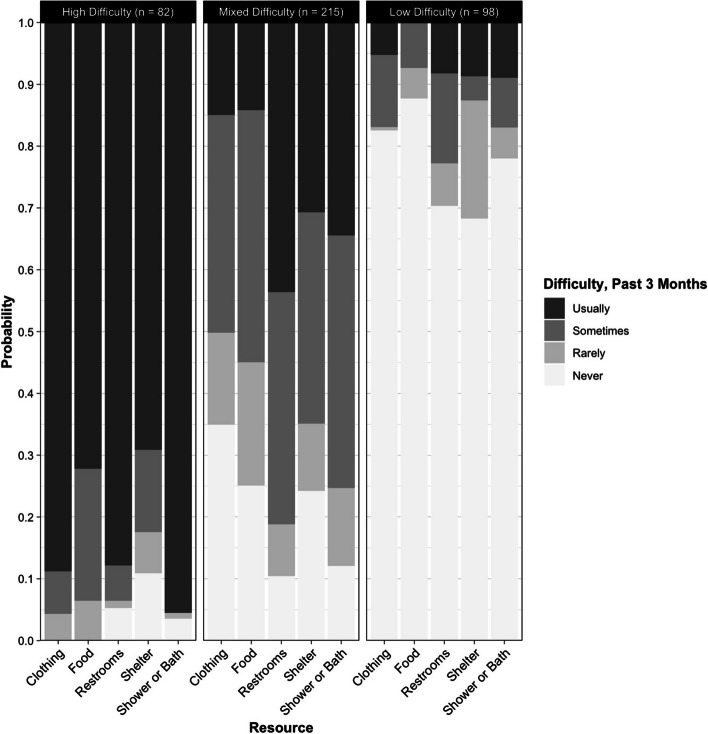
Results: Fit statistics, minimum classification probabilities, and ease of interpretation indicated a three-class solution for level of material difficulty. We termed these classes "High Difficulty" (n = 82), "Mixed Difficulty" (n = 215), and "Low Difficulty" (n = 98). Average classification probabilities indicated good class separability. "High Difficulty" participants had high probabilities of usually having difficulty accessing all five resources. "Mixed Difficulty" participants indicated a range of difficulty accessing all resources, with restrooms and bathing facilities being the most difficult. "Low Difficulty" participants were defined by high probabilities of never having access difficulty. In auxiliary analyses, there were significant (p < 0.05) differences in experiences of displacement, opioid withdrawal symptoms, nonfatal overdose, and violent victimization between classes.
Conclusions: This LCA indicates that among PWUD experiencing homelessness there exist distinct differences in resource access and material hardship, and that these differences are linked with political, social, substance use, and other health outcomes. We add to the literature on the relationship between poverty and health among PWUD. Policies which increase difficulty accessing necessary material resources may negatively impact health in this population.
期刊介绍:
BMC Public Health is an open access, peer-reviewed journal that considers articles on the epidemiology of disease and the understanding of all aspects of public health. The journal has a special focus on the social determinants of health, the environmental, behavioral, and occupational correlates of health and disease, and the impact of health policies, practices and interventions on the community.




 京公网安备 11010802042870号
京ICP备2023020795号-1
京公网安备 11010802042870号
京ICP备2023020795号-1

 分享
分享
 求助内容:
求助内容: 应助结果提醒方式:
 扫码关注我们
