{"title":"大学生体育锻炼与心理资本的关系:感知社会支持和自我控制的中介作用。","authors":"Yan Lin, Mengjiao He, Weiqing Zhou, Minghao Zhang, Qing Wang, Yingying Chen, Lina Wang, Hua Guo","doi":"10.1186/s12889-025-21856-8","DOIUrl":null,"url":null,"abstract":"<p><strong>Background: </strong>The mental health of college students significantly impacts their life, academic performance, and even employment prospects. Research indicates that physical exercise can promote mental health, but the pathways of its influence require further exploration. This study investigates the relationship between physical exercise and psychological capital in college students, focusing on the mediating roles of perceived social support and self-control.</p><p><strong>Objectives: </strong>This study seeks to investigate the relationship between physical exercise and psychological capital among university students, with a further in-depth analysis of the mediating roles played by perceived social support and self-control within this dynamic.</p><p><strong>Methods: </strong>Using cluster sampling, we surveyed 898 college students from five universities in Xinxiang, Henan Province, employing the Physical Activity Rating Scale (PARS-3), the Perceived Social Support Scale (PSSS), the Revised Self-Control Scale (SCS), and the Psychological Capital Questionnaire (PCQ). Data were analyzed using SPSS 26.0 and Amos 23.0, and common method bias was tested using Harman's single-factor test. The significance of the mediation effects was tested using the bootstrap sampling method.</p><p><strong>Results: </strong>(1) Physical exercise is significantly correlated with psychological capital (r = 0.786, p < 0.01); (2) Perceived social support and self-control mediate the relationship between physical exercise and psychological capital; (3) The mediation effect consists of two indirect effects: physical exercise → perceived social support → psychological capital (β = 0.404, 95% CI: 0.336-0.473) and physical exercise → self-control → psychological capital (β = 0.158, 95% CI: 0.067-0.242).</p><p><strong>Conclusion: </strong>Physical exercise can directly enhance the psychological capital of college students and can indirectly influence psychological capital through perceived social support or self-control. The mediating effect of perceived social support is stronger than that of self-control.</p>","PeriodicalId":9039,"journal":{"name":"BMC Public Health","volume":"25 1","pages":"581"},"PeriodicalIF":3.6000,"publicationDate":"2025-02-12","publicationTypes":"Journal Article","fieldsOfStudy":null,"isOpenAccess":false,"openAccessPdf":"https://www.ncbi.nlm.nih.gov/pmc/articles/PMC11823263/pdf/","citationCount":"0","resultStr":"{\"title\":\"The relationship between physical exercise and psychological capital in college students: the mediating role of perceived social support and self-control.\",\"authors\":\"Yan Lin, Mengjiao He, Weiqing Zhou, Minghao Zhang, Qing Wang, Yingying Chen, Lina Wang, Hua Guo\",\"doi\":\"10.1186/s12889-025-21856-8\",\"DOIUrl\":null,\"url\":null,\"abstract\":\"<p><strong>Background: </strong>The mental health of college students significantly impacts their life, academic performance, and even employment prospects. Research indicates that physical exercise can promote mental health, but the pathways of its influence require further exploration. This study investigates the relationship between physical exercise and psychological capital in college students, focusing on the mediating roles of perceived social support and self-control.</p><p><strong>Objectives: </strong>This study seeks to investigate the relationship between physical exercise and psychological capital among university students, with a further in-depth analysis of the mediating roles played by perceived social support and self-control within this dynamic.</p><p><strong>Methods: </strong>Using cluster sampling, we surveyed 898 college students from five universities in Xinxiang, Henan Province, employing the Physical Activity Rating Scale (PARS-3), the Perceived Social Support Scale (PSSS), the Revised Self-Control Scale (SCS), and the Psychological Capital Questionnaire (PCQ). Data were analyzed using SPSS 26.0 and Amos 23.0, and common method bias was tested using Harman's single-factor test. The significance of the mediation effects was tested using the bootstrap sampling method.</p><p><strong>Results: </strong>(1) Physical exercise is significantly correlated with psychological capital (r = 0.786, p < 0.01); (2) Perceived social support and self-control mediate the relationship between physical exercise and psychological capital; (3) The mediation effect consists of two indirect effects: physical exercise → perceived social support → psychological capital (β = 0.404, 95% CI: 0.336-0.473) and physical exercise → self-control → psychological capital (β = 0.158, 95% CI: 0.067-0.242).</p><p><strong>Conclusion: </strong>Physical exercise can directly enhance the psychological capital of college students and can indirectly influence psychological capital through perceived social support or self-control. The mediating effect of perceived social support is stronger than that of self-control.</p>\",\"PeriodicalId\":9039,\"journal\":{\"name\":\"BMC Public Health\",\"volume\":\"25 1\",\"pages\":\"581\"},\"PeriodicalIF\":3.6000,\"publicationDate\":\"2025-02-12\",\"publicationTypes\":\"Journal Article\",\"fieldsOfStudy\":null,\"isOpenAccess\":false,\"openAccessPdf\":\"https://www.ncbi.nlm.nih.gov/pmc/articles/PMC11823263/pdf/\",\"citationCount\":\"0\",\"resultStr\":null,\"platform\":\"Semanticscholar\",\"paperid\":null,\"PeriodicalName\":\"BMC Public Health\",\"FirstCategoryId\":\"3\",\"ListUrlMain\":\"https://doi.org/10.1186/s12889-025-21856-8\",\"RegionNum\":2,\"RegionCategory\":\"医学\",\"ArticlePicture\":[],\"TitleCN\":null,\"AbstractTextCN\":null,\"PMCID\":null,\"EPubDate\":\"\",\"PubModel\":\"\",\"JCR\":\"Q1\",\"JCRName\":\"PUBLIC, ENVIRONMENTAL & OCCUPATIONAL HEALTH\",\"Score\":null,\"Total\":0}","platform":"Semanticscholar","paperid":null,"PeriodicalName":"BMC Public Health","FirstCategoryId":"3","ListUrlMain":"https://doi.org/10.1186/s12889-025-21856-8","RegionNum":2,"RegionCategory":"医学","ArticlePicture":[],"TitleCN":null,"AbstractTextCN":null,"PMCID":null,"EPubDate":"","PubModel":"","JCR":"Q1","JCRName":"PUBLIC, ENVIRONMENTAL & OCCUPATIONAL HEALTH","Score":null,"Total":0}
The relationship between physical exercise and psychological capital in college students: the mediating role of perceived social support and self-control.
Background: The mental health of college students significantly impacts their life, academic performance, and even employment prospects. Research indicates that physical exercise can promote mental health, but the pathways of its influence require further exploration. This study investigates the relationship between physical exercise and psychological capital in college students, focusing on the mediating roles of perceived social support and self-control.
Objectives: This study seeks to investigate the relationship between physical exercise and psychological capital among university students, with a further in-depth analysis of the mediating roles played by perceived social support and self-control within this dynamic.
Methods: Using cluster sampling, we surveyed 898 college students from five universities in Xinxiang, Henan Province, employing the Physical Activity Rating Scale (PARS-3), the Perceived Social Support Scale (PSSS), the Revised Self-Control Scale (SCS), and the Psychological Capital Questionnaire (PCQ). Data were analyzed using SPSS 26.0 and Amos 23.0, and common method bias was tested using Harman's single-factor test. The significance of the mediation effects was tested using the bootstrap sampling method.
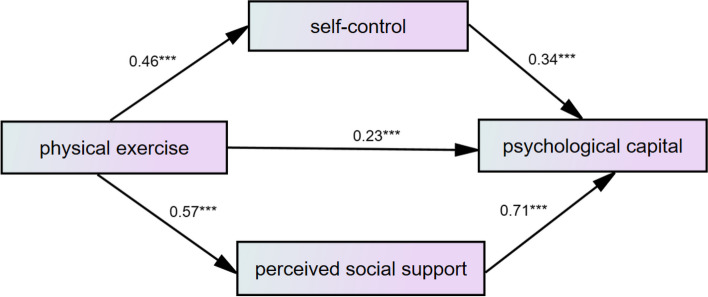
Results: (1) Physical exercise is significantly correlated with psychological capital (r = 0.786, p < 0.01); (2) Perceived social support and self-control mediate the relationship between physical exercise and psychological capital; (3) The mediation effect consists of two indirect effects: physical exercise → perceived social support → psychological capital (β = 0.404, 95% CI: 0.336-0.473) and physical exercise → self-control → psychological capital (β = 0.158, 95% CI: 0.067-0.242).
Conclusion: Physical exercise can directly enhance the psychological capital of college students and can indirectly influence psychological capital through perceived social support or self-control. The mediating effect of perceived social support is stronger than that of self-control.
期刊介绍:
BMC Public Health is an open access, peer-reviewed journal that considers articles on the epidemiology of disease and the understanding of all aspects of public health. The journal has a special focus on the social determinants of health, the environmental, behavioral, and occupational correlates of health and disease, and the impact of health policies, practices and interventions on the community.




 京公网安备 11010802042870号
京ICP备2023020795号-1
京公网安备 11010802042870号
京ICP备2023020795号-1

 分享
分享
 求助内容:
求助内容: 应助结果提醒方式:
 扫码关注我们
