{"title":"构建基于logistic回归的流产妇女后续早期流产预测模型。","authors":"Nan Ding, Peili Wang, Xiaoping Wang, Fang Wang","doi":"10.1186/s40001-025-02361-5","DOIUrl":null,"url":null,"abstract":"<p><strong>Objectives: </strong>The aim of this study is to construct a nomogram for predicting subsequent early pregnancy loss in women with a history of pregnancy loss, which may increase well-being and the capacity for managing reproductive options.</p><p><strong>Materials and methods: </strong>We conducted a retrospective analysis of medical records from women with a history of pregnancy loss at the Reproductive Medicine Center of Lanzhou University Second Hospital between January 2019 and December 2022. A cohort of 718 patients was selected for the study. We structured our data into a training set of 575 cases (80% of the cohort) and a test set of 143 cases (20%). To identify significant predictors, we applied a stepwise forward algorithm guided by the Akaike Information Criterion (AIC) to the training set. Model validation was conducted using the test set. For the validation process, we employed various methods to assess the predictive power and accuracy of the model. Receiver Operating Characteristic (ROC) curves provided insights into the model's ability to distinguish between outcomes effectively. Calibration curves assessed the accuracy of the probability predictions against actual outcomes. The clinical utility of the model was further evaluated through Decision Curve Analysis, which quantified the net benefits at various threshold probabilities. In addition, a nomogram was developed to visually represent the risk factors.</p><p><strong>Results: </strong>Among the 36 candidate variables initially considered, 10 key predictors were identified through logistic regression analysis and incorporated into the nomogram. These selected variables include age, education, thrombin time (TT), antithrombin III (AT-III), D-dimer levels, 25-hydroxy Vitamin D, immunoglobulin G(IgG), complement components C4, anti-cardiolipin antibody (ACA) and lupus anticoagulant (LA). In addition, based on clinical experience, the number of previous pregnancy losses was also included as a predictive variable. The prediction model revealed an area under the curve (AUC) of approximately 0.717 for the training set and 0.725 for the validation set. Calibration analysis indicated satisfactory goodness-of-fit, with a Hosmer-Lemeshow test yielding a χ2 value of 7.78 (p = 0.55). Decision curve analysis confirmed the clinical utility of the nomogram. Internal validation confirmed the robust performance of the predictive model.</p><p><strong>Conclusions: </strong>The constructed nomogram provides a valuable tool for predicting subsequent early pregnancy loss in women with a history of pregnancy loss. This nomogram can assist clinicians and patients in making informed decisions regarding the management of pregnancy and improving clinical outcomes.</p><p><strong>Trial registration: </strong>This study was registered in the Chinese Clinical Trial Registry under the registration number ChiCTR2000039414 on October 27, 2020. The registration was done retrospectively.</p>","PeriodicalId":11949,"journal":{"name":"European Journal of Medical Research","volume":"30 1","pages":"99"},"PeriodicalIF":3.4000,"publicationDate":"2025-02-12","publicationTypes":"Journal Article","fieldsOfStudy":null,"isOpenAccess":false,"openAccessPdf":"https://www.ncbi.nlm.nih.gov/pmc/articles/PMC11823067/pdf/","citationCount":"0","resultStr":"{\"title\":\"Constructing a logistic regression-based prediction model for subsequent early pregnancy loss in women with pregnancy loss.\",\"authors\":\"Nan Ding, Peili Wang, Xiaoping Wang, Fang Wang\",\"doi\":\"10.1186/s40001-025-02361-5\",\"DOIUrl\":null,\"url\":null,\"abstract\":\"<p><strong>Objectives: </strong>The aim of this study is to construct a nomogram for predicting subsequent early pregnancy loss in women with a history of pregnancy loss, which may increase well-being and the capacity for managing reproductive options.</p><p><strong>Materials and methods: </strong>We conducted a retrospective analysis of medical records from women with a history of pregnancy loss at the Reproductive Medicine Center of Lanzhou University Second Hospital between January 2019 and December 2022. A cohort of 718 patients was selected for the study. We structured our data into a training set of 575 cases (80% of the cohort) and a test set of 143 cases (20%). To identify significant predictors, we applied a stepwise forward algorithm guided by the Akaike Information Criterion (AIC) to the training set. Model validation was conducted using the test set. For the validation process, we employed various methods to assess the predictive power and accuracy of the model. Receiver Operating Characteristic (ROC) curves provided insights into the model's ability to distinguish between outcomes effectively. Calibration curves assessed the accuracy of the probability predictions against actual outcomes. The clinical utility of the model was further evaluated through Decision Curve Analysis, which quantified the net benefits at various threshold probabilities. In addition, a nomogram was developed to visually represent the risk factors.</p><p><strong>Results: </strong>Among the 36 candidate variables initially considered, 10 key predictors were identified through logistic regression analysis and incorporated into the nomogram. These selected variables include age, education, thrombin time (TT), antithrombin III (AT-III), D-dimer levels, 25-hydroxy Vitamin D, immunoglobulin G(IgG), complement components C4, anti-cardiolipin antibody (ACA) and lupus anticoagulant (LA). In addition, based on clinical experience, the number of previous pregnancy losses was also included as a predictive variable. The prediction model revealed an area under the curve (AUC) of approximately 0.717 for the training set and 0.725 for the validation set. Calibration analysis indicated satisfactory goodness-of-fit, with a Hosmer-Lemeshow test yielding a χ2 value of 7.78 (p = 0.55). Decision curve analysis confirmed the clinical utility of the nomogram. Internal validation confirmed the robust performance of the predictive model.</p><p><strong>Conclusions: </strong>The constructed nomogram provides a valuable tool for predicting subsequent early pregnancy loss in women with a history of pregnancy loss. This nomogram can assist clinicians and patients in making informed decisions regarding the management of pregnancy and improving clinical outcomes.</p><p><strong>Trial registration: </strong>This study was registered in the Chinese Clinical Trial Registry under the registration number ChiCTR2000039414 on October 27, 2020. The registration was done retrospectively.</p>\",\"PeriodicalId\":11949,\"journal\":{\"name\":\"European Journal of Medical Research\",\"volume\":\"30 1\",\"pages\":\"99\"},\"PeriodicalIF\":3.4000,\"publicationDate\":\"2025-02-12\",\"publicationTypes\":\"Journal Article\",\"fieldsOfStudy\":null,\"isOpenAccess\":false,\"openAccessPdf\":\"https://www.ncbi.nlm.nih.gov/pmc/articles/PMC11823067/pdf/\",\"citationCount\":\"0\",\"resultStr\":null,\"platform\":\"Semanticscholar\",\"paperid\":null,\"PeriodicalName\":\"European Journal of Medical Research\",\"FirstCategoryId\":\"3\",\"ListUrlMain\":\"https://doi.org/10.1186/s40001-025-02361-5\",\"RegionNum\":3,\"RegionCategory\":\"医学\",\"ArticlePicture\":[],\"TitleCN\":null,\"AbstractTextCN\":null,\"PMCID\":null,\"EPubDate\":\"\",\"PubModel\":\"\",\"JCR\":\"Q2\",\"JCRName\":\"MEDICINE, RESEARCH & EXPERIMENTAL\",\"Score\":null,\"Total\":0}","platform":"Semanticscholar","paperid":null,"PeriodicalName":"European Journal of Medical Research","FirstCategoryId":"3","ListUrlMain":"https://doi.org/10.1186/s40001-025-02361-5","RegionNum":3,"RegionCategory":"医学","ArticlePicture":[],"TitleCN":null,"AbstractTextCN":null,"PMCID":null,"EPubDate":"","PubModel":"","JCR":"Q2","JCRName":"MEDICINE, RESEARCH & EXPERIMENTAL","Score":null,"Total":0}
引用次数: 0
摘要
目的:本研究的目的是构建一个nomogram来预测有流产史的女性随后的早期流产,这可能会增加她们的幸福感和管理生育选择的能力。材料与方法:回顾性分析2019年1月至2022年12月兰州大学第二医院生殖医学中心有流产史妇女的病历。该研究选择了718名患者。我们将数据分为575例(占队列的80%)的训练集和143例(占20%)的测试集。为了识别显著的预测因子,我们对训练集应用了一种由赤池信息准则(Akaike Information Criterion, AIC)指导的逐步前向算法。使用测试集对模型进行验证。在验证过程中,我们采用了各种方法来评估模型的预测能力和准确性。受试者工作特征(ROC)曲线提供了模型有效区分结果的能力。校正曲线评估概率预测与实际结果的准确性。通过决策曲线分析进一步评估该模型的临床效用,该分析量化了不同阈值概率下的净收益。此外,还开发了一种图来直观地表示危险因素。结果:在最初考虑的36个候选变量中,通过逻辑回归分析确定了10个关键预测因子,并纳入了正态图。这些选择的变量包括年龄、教育程度、凝血酶时间(TT)、抗凝血酶III (AT-III)、D-二聚体水平、25-羟基维生素D、免疫球蛋白G(IgG)、补体成分C4、抗心磷脂抗体(ACA)和狼疮抗凝剂(LA)。此外,根据临床经验,既往流产次数也被纳入预测变量。预测模型显示,训练集的曲线下面积(AUC)约为0.717,验证集的AUC约为0.725。校正分析表明拟合优度令人满意,Hosmer-Lemeshow检验的χ2值为7.78 (p = 0.55)。决策曲线分析证实了nomogram的临床应用价值。内部验证证实了预测模型的鲁棒性。结论:构建的nomogram为预测有流产史的女性早期流产提供了一个有价值的工具。该图可以帮助临床医生和患者对妊娠管理和改善临床结果做出明智的决定。试验注册:本研究于2020年10月27日在中国临床试验注册中心注册,注册号为ChiCTR2000039414。回顾性登记。
Constructing a logistic regression-based prediction model for subsequent early pregnancy loss in women with pregnancy loss.
Objectives: The aim of this study is to construct a nomogram for predicting subsequent early pregnancy loss in women with a history of pregnancy loss, which may increase well-being and the capacity for managing reproductive options.
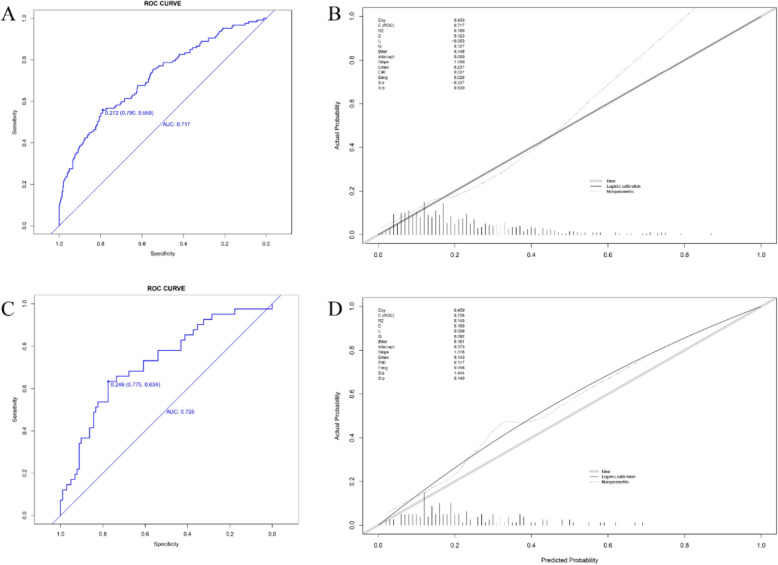
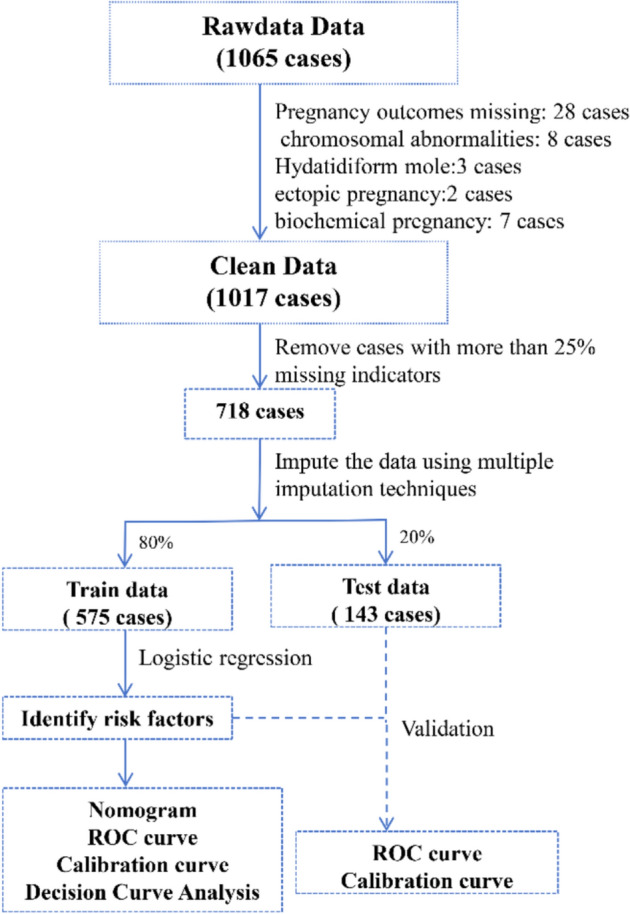
Materials and methods: We conducted a retrospective analysis of medical records from women with a history of pregnancy loss at the Reproductive Medicine Center of Lanzhou University Second Hospital between January 2019 and December 2022. A cohort of 718 patients was selected for the study. We structured our data into a training set of 575 cases (80% of the cohort) and a test set of 143 cases (20%). To identify significant predictors, we applied a stepwise forward algorithm guided by the Akaike Information Criterion (AIC) to the training set. Model validation was conducted using the test set. For the validation process, we employed various methods to assess the predictive power and accuracy of the model. Receiver Operating Characteristic (ROC) curves provided insights into the model's ability to distinguish between outcomes effectively. Calibration curves assessed the accuracy of the probability predictions against actual outcomes. The clinical utility of the model was further evaluated through Decision Curve Analysis, which quantified the net benefits at various threshold probabilities. In addition, a nomogram was developed to visually represent the risk factors.
Results: Among the 36 candidate variables initially considered, 10 key predictors were identified through logistic regression analysis and incorporated into the nomogram. These selected variables include age, education, thrombin time (TT), antithrombin III (AT-III), D-dimer levels, 25-hydroxy Vitamin D, immunoglobulin G(IgG), complement components C4, anti-cardiolipin antibody (ACA) and lupus anticoagulant (LA). In addition, based on clinical experience, the number of previous pregnancy losses was also included as a predictive variable. The prediction model revealed an area under the curve (AUC) of approximately 0.717 for the training set and 0.725 for the validation set. Calibration analysis indicated satisfactory goodness-of-fit, with a Hosmer-Lemeshow test yielding a χ2 value of 7.78 (p = 0.55). Decision curve analysis confirmed the clinical utility of the nomogram. Internal validation confirmed the robust performance of the predictive model.
Conclusions: The constructed nomogram provides a valuable tool for predicting subsequent early pregnancy loss in women with a history of pregnancy loss. This nomogram can assist clinicians and patients in making informed decisions regarding the management of pregnancy and improving clinical outcomes.
Trial registration: This study was registered in the Chinese Clinical Trial Registry under the registration number ChiCTR2000039414 on October 27, 2020. The registration was done retrospectively.
期刊介绍:
European Journal of Medical Research publishes translational and clinical research of international interest across all medical disciplines, enabling clinicians and other researchers to learn about developments and innovations within these disciplines and across the boundaries between disciplines. The journal publishes high quality research and reviews and aims to ensure that the results of all well-conducted research are published, regardless of their outcome.





 京公网安备 11010802042870号
京ICP备2023020795号-1
京公网安备 11010802042870号
京ICP备2023020795号-1

 分享
分享
 求助内容:
求助内容: 应助结果提醒方式:
 扫码关注我们
