Cristina Torres, Elizabeth Lyden, Gayle Gillett, Mark E Rupp, Trevor C Van Schooneveld
{"title":"放弃尿培养:使用尿路感染顺序面板持续减少caui。","authors":"Cristina Torres, Elizabeth Lyden, Gayle Gillett, Mark E Rupp, Trevor C Van Schooneveld","doi":"10.1017/ice.2025.2","DOIUrl":null,"url":null,"abstract":"<p><strong>Objective: </strong>We introduced a urinary tract infection (UTI) panel requiring symptom documentation and identification of special populations linked to reflex urine culturing and evaluated its impact on catheter-associated UTI (CAUTI) including during the COVID-19 pandemic.</p><p><strong>Design: </strong>Quasi-experimental encompassing 3 periods: pre-panel (January 2014-March 2015), post-panel (April 2015-March 2020), and post-panel COVID (April 2020-June 2022).</p><p><strong>Setting/participants: </strong>Tertiary care center inpatients.</p><p><strong>Methods: </strong>Poisson regression and interrupted time series (ITS) analysis evaluated changes in catheter days (CD), urine cultures (UC), and CAUTI measured by 1,000 CD and patient days (PD). National Health Safety Network standardized infection ratio (SIR) and standardized utilization ratio (SUR) data were analyzed.</p><p><strong>Results: </strong>UC per 1,000 PD decreased after implementation (pre-panel 36.9 vs 16.6 post-panel vs 14.4 post-panel COVID, all <i>P</i> < .001). CD declined pre-panel versus post-panel (RR 0.37, <i>P</i> < .001) but not from post-panel to post-panel COVID (RR 0.94, <i>P</i> = .88). UTI panel implementation was associated with a 40% decrease in CAUTI rates per 1,000 CD (<i>P</i> < .001). During the COVID-19 pandemic (post-panel COVID), a nonsignificant increase of 13% (<i>P</i> = .61) in CAUTI was noted but remained 32% lower than pre-panel (<i>P</i> = .02). The slope of change using ITS changed from negative to positive but was nonsignificant (<i>P</i> = .26). CAUTI rates per 1,000 PD demonstrated greater reductions (pre- vs post-panel (RR 0.37; 95% CI, 0.29-0.47) and pre- vs post-panel COVID (RR 0.35; 95% CI, 0.26-0.46)). SIRs were unavailable before 2016, but median SIRs post-panel compared to post-panel COVID were similar (1.05 vs 1.56, respectively, <i>P</i> = .067).</p><p><strong>Conclusions: </strong>Implementation of the UTI panel was associated with a reduction in both UC and CAUTI with the impact maintained despite the COVID-19 pandemic.</p>","PeriodicalId":13663,"journal":{"name":"Infection Control and Hospital Epidemiology","volume":" ","pages":"377-383"},"PeriodicalIF":2.9000,"publicationDate":"2025-04-01","publicationTypes":"Journal Article","fieldsOfStudy":null,"isOpenAccess":false,"openAccessPdf":"https://www.ncbi.nlm.nih.gov/pmc/articles/PMC12015623/pdf/","citationCount":"0","resultStr":"{\"title\":\"Dropping the urine culture: sustained CAUTI reduction using a UTI order panel.\",\"authors\":\"Cristina Torres, Elizabeth Lyden, Gayle Gillett, Mark E Rupp, Trevor C Van Schooneveld\",\"doi\":\"10.1017/ice.2025.2\",\"DOIUrl\":null,\"url\":null,\"abstract\":\"<p><strong>Objective: </strong>We introduced a urinary tract infection (UTI) panel requiring symptom documentation and identification of special populations linked to reflex urine culturing and evaluated its impact on catheter-associated UTI (CAUTI) including during the COVID-19 pandemic.</p><p><strong>Design: </strong>Quasi-experimental encompassing 3 periods: pre-panel (January 2014-March 2015), post-panel (April 2015-March 2020), and post-panel COVID (April 2020-June 2022).</p><p><strong>Setting/participants: </strong>Tertiary care center inpatients.</p><p><strong>Methods: </strong>Poisson regression and interrupted time series (ITS) analysis evaluated changes in catheter days (CD), urine cultures (UC), and CAUTI measured by 1,000 CD and patient days (PD). National Health Safety Network standardized infection ratio (SIR) and standardized utilization ratio (SUR) data were analyzed.</p><p><strong>Results: </strong>UC per 1,000 PD decreased after implementation (pre-panel 36.9 vs 16.6 post-panel vs 14.4 post-panel COVID, all <i>P</i> < .001). CD declined pre-panel versus post-panel (RR 0.37, <i>P</i> < .001) but not from post-panel to post-panel COVID (RR 0.94, <i>P</i> = .88). UTI panel implementation was associated with a 40% decrease in CAUTI rates per 1,000 CD (<i>P</i> < .001). During the COVID-19 pandemic (post-panel COVID), a nonsignificant increase of 13% (<i>P</i> = .61) in CAUTI was noted but remained 32% lower than pre-panel (<i>P</i> = .02). The slope of change using ITS changed from negative to positive but was nonsignificant (<i>P</i> = .26). CAUTI rates per 1,000 PD demonstrated greater reductions (pre- vs post-panel (RR 0.37; 95% CI, 0.29-0.47) and pre- vs post-panel COVID (RR 0.35; 95% CI, 0.26-0.46)). SIRs were unavailable before 2016, but median SIRs post-panel compared to post-panel COVID were similar (1.05 vs 1.56, respectively, <i>P</i> = .067).</p><p><strong>Conclusions: </strong>Implementation of the UTI panel was associated with a reduction in both UC and CAUTI with the impact maintained despite the COVID-19 pandemic.</p>\",\"PeriodicalId\":13663,\"journal\":{\"name\":\"Infection Control and Hospital Epidemiology\",\"volume\":\" \",\"pages\":\"377-383\"},\"PeriodicalIF\":2.9000,\"publicationDate\":\"2025-04-01\",\"publicationTypes\":\"Journal Article\",\"fieldsOfStudy\":null,\"isOpenAccess\":false,\"openAccessPdf\":\"https://www.ncbi.nlm.nih.gov/pmc/articles/PMC12015623/pdf/\",\"citationCount\":\"0\",\"resultStr\":null,\"platform\":\"Semanticscholar\",\"paperid\":null,\"PeriodicalName\":\"Infection Control and Hospital Epidemiology\",\"FirstCategoryId\":\"3\",\"ListUrlMain\":\"https://doi.org/10.1017/ice.2025.2\",\"RegionNum\":4,\"RegionCategory\":\"医学\",\"ArticlePicture\":[],\"TitleCN\":null,\"AbstractTextCN\":null,\"PMCID\":null,\"EPubDate\":\"2025/2/13 0:00:00\",\"PubModel\":\"Epub\",\"JCR\":\"Q2\",\"JCRName\":\"INFECTIOUS DISEASES\",\"Score\":null,\"Total\":0}","platform":"Semanticscholar","paperid":null,"PeriodicalName":"Infection Control and Hospital Epidemiology","FirstCategoryId":"3","ListUrlMain":"https://doi.org/10.1017/ice.2025.2","RegionNum":4,"RegionCategory":"医学","ArticlePicture":[],"TitleCN":null,"AbstractTextCN":null,"PMCID":null,"EPubDate":"2025/2/13 0:00:00","PubModel":"Epub","JCR":"Q2","JCRName":"INFECTIOUS DISEASES","Score":null,"Total":0}
Dropping the urine culture: sustained CAUTI reduction using a UTI order panel.
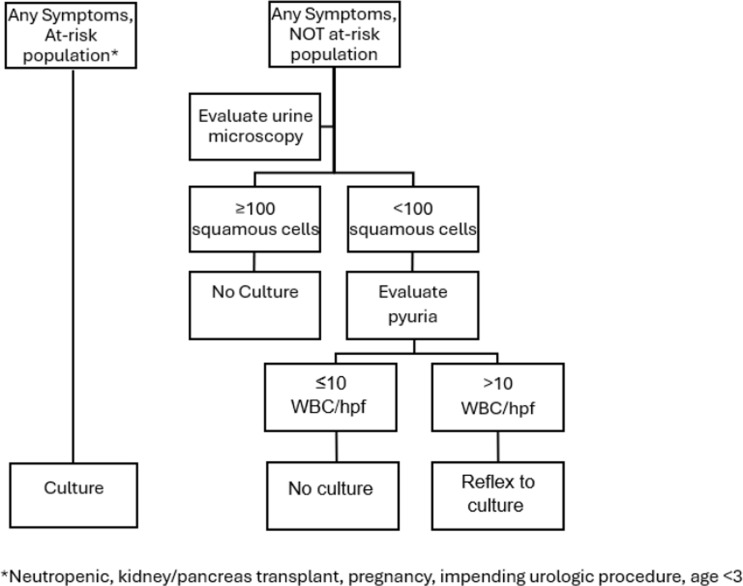
Objective: We introduced a urinary tract infection (UTI) panel requiring symptom documentation and identification of special populations linked to reflex urine culturing and evaluated its impact on catheter-associated UTI (CAUTI) including during the COVID-19 pandemic.
Setting/participants: Tertiary care center inpatients.
Methods: Poisson regression and interrupted time series (ITS) analysis evaluated changes in catheter days (CD), urine cultures (UC), and CAUTI measured by 1,000 CD and patient days (PD). National Health Safety Network standardized infection ratio (SIR) and standardized utilization ratio (SUR) data were analyzed.
Results: UC per 1,000 PD decreased after implementation (pre-panel 36.9 vs 16.6 post-panel vs 14.4 post-panel COVID, all P < .001). CD declined pre-panel versus post-panel (RR 0.37, P < .001) but not from post-panel to post-panel COVID (RR 0.94, P = .88). UTI panel implementation was associated with a 40% decrease in CAUTI rates per 1,000 CD (P < .001). During the COVID-19 pandemic (post-panel COVID), a nonsignificant increase of 13% (P = .61) in CAUTI was noted but remained 32% lower than pre-panel (P = .02). The slope of change using ITS changed from negative to positive but was nonsignificant (P = .26). CAUTI rates per 1,000 PD demonstrated greater reductions (pre- vs post-panel (RR 0.37; 95% CI, 0.29-0.47) and pre- vs post-panel COVID (RR 0.35; 95% CI, 0.26-0.46)). SIRs were unavailable before 2016, but median SIRs post-panel compared to post-panel COVID were similar (1.05 vs 1.56, respectively, P = .067).
Conclusions: Implementation of the UTI panel was associated with a reduction in both UC and CAUTI with the impact maintained despite the COVID-19 pandemic.
期刊介绍:
Infection Control and Hospital Epidemiology provides original, peer-reviewed scientific articles for anyone involved with an infection control or epidemiology program in a hospital or healthcare facility. Written by infection control practitioners and epidemiologists and guided by an editorial board composed of the nation''s leaders in the field, ICHE provides a critical forum for this vital information.






 京公网安备 11010802042870号
京ICP备2023020795号-1
京公网安备 11010802042870号
京ICP备2023020795号-1

 分享
分享
 求助内容:
求助内容: 应助结果提醒方式:
 扫码关注我们
