Michael D Olp, Karina L Bursch, Sarah L Wynia-Smith, Raymundo Nuñez, Christopher J Goetz, Vaughn Jackson, Brian C Smith
{"title":"由溴结构域和端外串联溴结构域构建的多价核小体。","authors":"Michael D Olp, Karina L Bursch, Sarah L Wynia-Smith, Raymundo Nuñez, Christopher J Goetz, Vaughn Jackson, Brian C Smith","doi":"10.1016/j.jbc.2025.108289","DOIUrl":null,"url":null,"abstract":"<p><p>Promoter-promoter and enhancer-promoter interactions are enriched in histone acetylation and central to chromatin organization in active genetic regions. Bromodomains are epigenetic \"readers\" that recognize and bind histone acetylation. Bromodomains often exist in tandem or with other reader domains. Cellular knockdown of the bromodomain and extraterminal domain (BET) protein family disrupts chromatin organization, but the mechanisms through which BET proteins preserve chromatin structure are largely unknown. We hypothesize that BET proteins maintain overall chromatin structure by employing their tandem bromodomains to multivalently scaffold acetylated nucleosomes in an intranucleosomal or internucleosomal manner. To test this hypothesis biophysically, we used small-angle X-ray scattering, electron paramagnetic resonance, and Rosetta protein modeling to show that a disordered linker separates BET tandem bromodomain acetylation binding sites by 15 to 157 Å. Most of these modeled distances are sufficient to span the length of a nucleosome (>57 Å). Focusing on the BET family member BRD4, we employed bioluminescence resonance energy transfer and isothermal titration calorimetry to show that BRD4 bromodomain binding of multiple acetylation sites on a histone tail does not increase BRD4-histone tail affinity, suggesting that BET bromodomain intranucleosome binding is not biologically relevant. Using sucrose gradients and amplified luminescent proximity homogeneous (AlphaScreen) assays, we provide the first direct biophysical evidence that BET bromodomains can scaffold multiple acetylated nucleosomes. Taken together, our results demonstrate that BET bromodomains are capable of multivalent internucleosome scaffolding in vitro. The knowledge gained provides implications for how BET bromodomain-mediated acetylated internucleosome scaffolding may maintain cellular chromatin interactions in active genetic regions.</p>","PeriodicalId":15140,"journal":{"name":"Journal of Biological Chemistry","volume":" ","pages":"108289"},"PeriodicalIF":4.0000,"publicationDate":"2025-03-01","publicationTypes":"Journal Article","fieldsOfStudy":null,"isOpenAccess":false,"openAccessPdf":"https://www.ncbi.nlm.nih.gov/pmc/articles/PMC11930079/pdf/","citationCount":"0","resultStr":"{\"title\":\"Multivalent nucleosome scaffolding by bromodomain and extraterminal domain tandem bromodomains.\",\"authors\":\"Michael D Olp, Karina L Bursch, Sarah L Wynia-Smith, Raymundo Nuñez, Christopher J Goetz, Vaughn Jackson, Brian C Smith\",\"doi\":\"10.1016/j.jbc.2025.108289\",\"DOIUrl\":null,\"url\":null,\"abstract\":\"<p><p>Promoter-promoter and enhancer-promoter interactions are enriched in histone acetylation and central to chromatin organization in active genetic regions. Bromodomains are epigenetic \\\"readers\\\" that recognize and bind histone acetylation. Bromodomains often exist in tandem or with other reader domains. Cellular knockdown of the bromodomain and extraterminal domain (BET) protein family disrupts chromatin organization, but the mechanisms through which BET proteins preserve chromatin structure are largely unknown. We hypothesize that BET proteins maintain overall chromatin structure by employing their tandem bromodomains to multivalently scaffold acetylated nucleosomes in an intranucleosomal or internucleosomal manner. To test this hypothesis biophysically, we used small-angle X-ray scattering, electron paramagnetic resonance, and Rosetta protein modeling to show that a disordered linker separates BET tandem bromodomain acetylation binding sites by 15 to 157 Å. Most of these modeled distances are sufficient to span the length of a nucleosome (>57 Å). Focusing on the BET family member BRD4, we employed bioluminescence resonance energy transfer and isothermal titration calorimetry to show that BRD4 bromodomain binding of multiple acetylation sites on a histone tail does not increase BRD4-histone tail affinity, suggesting that BET bromodomain intranucleosome binding is not biologically relevant. Using sucrose gradients and amplified luminescent proximity homogeneous (AlphaScreen) assays, we provide the first direct biophysical evidence that BET bromodomains can scaffold multiple acetylated nucleosomes. Taken together, our results demonstrate that BET bromodomains are capable of multivalent internucleosome scaffolding in vitro. The knowledge gained provides implications for how BET bromodomain-mediated acetylated internucleosome scaffolding may maintain cellular chromatin interactions in active genetic regions.</p>\",\"PeriodicalId\":15140,\"journal\":{\"name\":\"Journal of Biological Chemistry\",\"volume\":\" \",\"pages\":\"108289\"},\"PeriodicalIF\":4.0000,\"publicationDate\":\"2025-03-01\",\"publicationTypes\":\"Journal Article\",\"fieldsOfStudy\":null,\"isOpenAccess\":false,\"openAccessPdf\":\"https://www.ncbi.nlm.nih.gov/pmc/articles/PMC11930079/pdf/\",\"citationCount\":\"0\",\"resultStr\":null,\"platform\":\"Semanticscholar\",\"paperid\":null,\"PeriodicalName\":\"Journal of Biological Chemistry\",\"FirstCategoryId\":\"99\",\"ListUrlMain\":\"https://doi.org/10.1016/j.jbc.2025.108289\",\"RegionNum\":2,\"RegionCategory\":\"生物学\",\"ArticlePicture\":[],\"TitleCN\":null,\"AbstractTextCN\":null,\"PMCID\":null,\"EPubDate\":\"2025/2/10 0:00:00\",\"PubModel\":\"Epub\",\"JCR\":\"Q2\",\"JCRName\":\"BIOCHEMISTRY & MOLECULAR BIOLOGY\",\"Score\":null,\"Total\":0}","platform":"Semanticscholar","paperid":null,"PeriodicalName":"Journal of Biological Chemistry","FirstCategoryId":"99","ListUrlMain":"https://doi.org/10.1016/j.jbc.2025.108289","RegionNum":2,"RegionCategory":"生物学","ArticlePicture":[],"TitleCN":null,"AbstractTextCN":null,"PMCID":null,"EPubDate":"2025/2/10 0:00:00","PubModel":"Epub","JCR":"Q2","JCRName":"BIOCHEMISTRY & MOLECULAR BIOLOGY","Score":null,"Total":0}
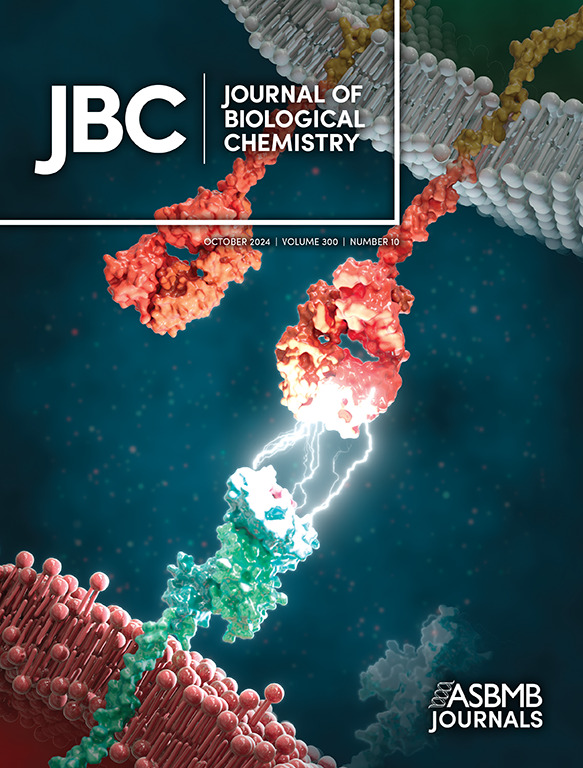
Multivalent nucleosome scaffolding by bromodomain and extraterminal domain tandem bromodomains.
Promoter-promoter and enhancer-promoter interactions are enriched in histone acetylation and central to chromatin organization in active genetic regions. Bromodomains are epigenetic "readers" that recognize and bind histone acetylation. Bromodomains often exist in tandem or with other reader domains. Cellular knockdown of the bromodomain and extraterminal domain (BET) protein family disrupts chromatin organization, but the mechanisms through which BET proteins preserve chromatin structure are largely unknown. We hypothesize that BET proteins maintain overall chromatin structure by employing their tandem bromodomains to multivalently scaffold acetylated nucleosomes in an intranucleosomal or internucleosomal manner. To test this hypothesis biophysically, we used small-angle X-ray scattering, electron paramagnetic resonance, and Rosetta protein modeling to show that a disordered linker separates BET tandem bromodomain acetylation binding sites by 15 to 157 Å. Most of these modeled distances are sufficient to span the length of a nucleosome (>57 Å). Focusing on the BET family member BRD4, we employed bioluminescence resonance energy transfer and isothermal titration calorimetry to show that BRD4 bromodomain binding of multiple acetylation sites on a histone tail does not increase BRD4-histone tail affinity, suggesting that BET bromodomain intranucleosome binding is not biologically relevant. Using sucrose gradients and amplified luminescent proximity homogeneous (AlphaScreen) assays, we provide the first direct biophysical evidence that BET bromodomains can scaffold multiple acetylated nucleosomes. Taken together, our results demonstrate that BET bromodomains are capable of multivalent internucleosome scaffolding in vitro. The knowledge gained provides implications for how BET bromodomain-mediated acetylated internucleosome scaffolding may maintain cellular chromatin interactions in active genetic regions.
期刊介绍:
The Journal of Biological Chemistry welcomes high-quality science that seeks to elucidate the molecular and cellular basis of biological processes. Papers published in JBC can therefore fall under the umbrellas of not only biological chemistry, chemical biology, or biochemistry, but also allied disciplines such as biophysics, systems biology, RNA biology, immunology, microbiology, neurobiology, epigenetics, computational biology, ’omics, and many more. The outcome of our focus on papers that contribute novel and important mechanistic insights, rather than on a particular topic area, is that JBC is truly a melting pot for scientists across disciplines. In addition, JBC welcomes papers that describe methods that will help scientists push their biochemical inquiries forward and resources that will be of use to the research community.




 京公网安备 11010802042870号
京ICP备2023020795号-1
京公网安备 11010802042870号
京ICP备2023020795号-1

 分享
分享
 求助内容:
求助内容: 应助结果提醒方式:
 扫码关注我们
