{"title":"加过氧化氢酶的黑磷纳米片增强神经修复中的雪旺细胞反应。","authors":"Junjie Shen , Guoping Jia , Qinghe Wu , Huizhen Yang , Yifei Jiang , Xubo Wu , Yimin Chai , Chunfu Zhang , Jia Xu","doi":"10.1016/j.jconrel.2025.02.017","DOIUrl":null,"url":null,"abstract":"<div><div>Peripheral nerve injuries (PNI) present a significant clinical challenge due to the complex cellular and molecular activities that hinder functional recovery. Schwann cells (SCs), the principal glial cells in the peripheral nervous system, play a vital role in neural repair by transitioning into a repairing phenotype capable of supporting axonal regrowth. However, these regenerative properties fade over time, leading to poor clinical outcomes. To address this issue, we engineered a black phosphorus nanosheet (BPNS) functionalized with catalase (BPNS@CAT) to modulate SC activity and enhance nerve regeneration. In vitro experiments demonstrated that BPNS@CAT reduced ROS levels, regulated the angiogenic and immunomodulatory functions of SCs. Mechanistically, we identified that BPNS@CAT activated the JAK/STAT pathway, which is crucial for SC-mediated repair processes. To validate its therapeutic potential, a BPNS@CAT-GelMA/PCL hydrogel scaffold was fabricated and applied in a rat sciatic nerve-crush model. The scaffold enhanced axonal regeneration, restored nerve function, and improved sensory, motor, and emotional behaviors. Our study broadens the range of BPNS applications in SC-based nerve repair and pave the way for future applications of BPNS in translational medicine.</div></div>","PeriodicalId":15450,"journal":{"name":"Journal of Controlled Release","volume":"380 ","pages":"Pages 579-598"},"PeriodicalIF":11.5000,"publicationDate":"2025-04-10","publicationTypes":"Journal Article","fieldsOfStudy":null,"isOpenAccess":false,"openAccessPdf":"","citationCount":"0","resultStr":"{\"title\":\"Black phosphorus nanosheets fortified with catalase to enhance Schwann cell responses for neural repair\",\"authors\":\"Junjie Shen , Guoping Jia , Qinghe Wu , Huizhen Yang , Yifei Jiang , Xubo Wu , Yimin Chai , Chunfu Zhang , Jia Xu\",\"doi\":\"10.1016/j.jconrel.2025.02.017\",\"DOIUrl\":null,\"url\":null,\"abstract\":\"<div><div>Peripheral nerve injuries (PNI) present a significant clinical challenge due to the complex cellular and molecular activities that hinder functional recovery. Schwann cells (SCs), the principal glial cells in the peripheral nervous system, play a vital role in neural repair by transitioning into a repairing phenotype capable of supporting axonal regrowth. However, these regenerative properties fade over time, leading to poor clinical outcomes. To address this issue, we engineered a black phosphorus nanosheet (BPNS) functionalized with catalase (BPNS@CAT) to modulate SC activity and enhance nerve regeneration. In vitro experiments demonstrated that BPNS@CAT reduced ROS levels, regulated the angiogenic and immunomodulatory functions of SCs. Mechanistically, we identified that BPNS@CAT activated the JAK/STAT pathway, which is crucial for SC-mediated repair processes. To validate its therapeutic potential, a BPNS@CAT-GelMA/PCL hydrogel scaffold was fabricated and applied in a rat sciatic nerve-crush model. The scaffold enhanced axonal regeneration, restored nerve function, and improved sensory, motor, and emotional behaviors. Our study broadens the range of BPNS applications in SC-based nerve repair and pave the way for future applications of BPNS in translational medicine.</div></div>\",\"PeriodicalId\":15450,\"journal\":{\"name\":\"Journal of Controlled Release\",\"volume\":\"380 \",\"pages\":\"Pages 579-598\"},\"PeriodicalIF\":11.5000,\"publicationDate\":\"2025-04-10\",\"publicationTypes\":\"Journal Article\",\"fieldsOfStudy\":null,\"isOpenAccess\":false,\"openAccessPdf\":\"\",\"citationCount\":\"0\",\"resultStr\":null,\"platform\":\"Semanticscholar\",\"paperid\":null,\"PeriodicalName\":\"Journal of Controlled Release\",\"FirstCategoryId\":\"3\",\"ListUrlMain\":\"https://www.sciencedirect.com/science/article/pii/S0168365925001300\",\"RegionNum\":1,\"RegionCategory\":\"医学\",\"ArticlePicture\":[],\"TitleCN\":null,\"AbstractTextCN\":null,\"PMCID\":null,\"EPubDate\":\"2025/2/14 0:00:00\",\"PubModel\":\"Epub\",\"JCR\":\"Q1\",\"JCRName\":\"CHEMISTRY, MULTIDISCIPLINARY\",\"Score\":null,\"Total\":0}","platform":"Semanticscholar","paperid":null,"PeriodicalName":"Journal of Controlled Release","FirstCategoryId":"3","ListUrlMain":"https://www.sciencedirect.com/science/article/pii/S0168365925001300","RegionNum":1,"RegionCategory":"医学","ArticlePicture":[],"TitleCN":null,"AbstractTextCN":null,"PMCID":null,"EPubDate":"2025/2/14 0:00:00","PubModel":"Epub","JCR":"Q1","JCRName":"CHEMISTRY, MULTIDISCIPLINARY","Score":null,"Total":0}
Black phosphorus nanosheets fortified with catalase to enhance Schwann cell responses for neural repair
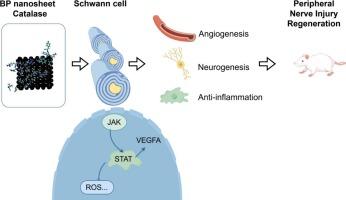
Peripheral nerve injuries (PNI) present a significant clinical challenge due to the complex cellular and molecular activities that hinder functional recovery. Schwann cells (SCs), the principal glial cells in the peripheral nervous system, play a vital role in neural repair by transitioning into a repairing phenotype capable of supporting axonal regrowth. However, these regenerative properties fade over time, leading to poor clinical outcomes. To address this issue, we engineered a black phosphorus nanosheet (BPNS) functionalized with catalase (BPNS@CAT) to modulate SC activity and enhance nerve regeneration. In vitro experiments demonstrated that BPNS@CAT reduced ROS levels, regulated the angiogenic and immunomodulatory functions of SCs. Mechanistically, we identified that BPNS@CAT activated the JAK/STAT pathway, which is crucial for SC-mediated repair processes. To validate its therapeutic potential, a BPNS@CAT-GelMA/PCL hydrogel scaffold was fabricated and applied in a rat sciatic nerve-crush model. The scaffold enhanced axonal regeneration, restored nerve function, and improved sensory, motor, and emotional behaviors. Our study broadens the range of BPNS applications in SC-based nerve repair and pave the way for future applications of BPNS in translational medicine.
期刊介绍:
The Journal of Controlled Release (JCR) proudly serves as the Official Journal of the Controlled Release Society and the Japan Society of Drug Delivery System.
Dedicated to the broad field of delivery science and technology, JCR publishes high-quality research articles covering drug delivery systems and all facets of formulations. This includes the physicochemical and biological properties of drugs, design and characterization of dosage forms, release mechanisms, in vivo testing, and formulation research and development across pharmaceutical, diagnostic, agricultural, environmental, cosmetic, and food industries.
Priority is given to manuscripts that contribute to the fundamental understanding of principles or demonstrate the advantages of novel technologies in terms of safety and efficacy over current clinical standards. JCR strives to be a leading platform for advancements in delivery science and technology.




 京公网安备 11010802042870号
京ICP备2023020795号-1
京公网安备 11010802042870号
京ICP备2023020795号-1

 分享
分享
 求助内容:
求助内容: 应助结果提醒方式:
 扫码关注我们
