Ahmet Yildirim, Mengting Wei, Yuan Liu, Bassel Nazha, Jacqueline T Brown, Bradley C Carthon, Yujin Choi, Lauren Suh, Rohit V Goswamy, Greta R McClintock, Caitlin Hartman, Sarah Caulfield, Jordan Ciuro, Jamie M Goldman, Wayne B Harris, Omer Kucuk, Viraj A Master, Mehmet A Bilen
{"title":"免疫检查点抑制剂治疗晚期肾细胞癌患者的基线炎症生物标志物与临床结果的关联","authors":"Ahmet Yildirim, Mengting Wei, Yuan Liu, Bassel Nazha, Jacqueline T Brown, Bradley C Carthon, Yujin Choi, Lauren Suh, Rohit V Goswamy, Greta R McClintock, Caitlin Hartman, Sarah Caulfield, Jordan Ciuro, Jamie M Goldman, Wayne B Harris, Omer Kucuk, Viraj A Master, Mehmet A Bilen","doi":"10.1177/17588359251316243","DOIUrl":null,"url":null,"abstract":"<p><strong>Background: </strong>Immune checkpoint inhibitors (ICIs) have become the mainstay treatment of metastatic kidney cancer, demonstrating enhanced outcomes and durable responses in select patient subgroups. However, identifying reliable prognostic biomarkers for treatment outcomes remains challenging.</p><p><strong>Objectives: </strong>This study aimed to assess the correlation between baseline inflammatory markers and overall survival (OS), progression-free survival (PFS), and clinical benefit (CB) in metastatic kidney cancer patients receiving ICIs. CB was defined as patients achieving stable disease, partial response, or complete response.</p><p><strong>Design: </strong>Retrospective, single-center study.</p><p><strong>Methods: </strong>A retrospective analysis was conducted on 401 adult patients with advanced kidney cancer treated with ICIs at Emory Winship Cancer Institute between 2018 and 2023. Modified Glasgow Prognostic Score (mGPS), neutrophil-to-lymphocyte (NLR), monocyte-to-lymphocyte (MLR), platelet-to-lymphocyte (PLR), and neutrophil-to-eosinophil ratios (NER) were collected from baseline blood samples.</p><p><strong>Results: </strong>Among 401 patients (median age, 66; 71% male; 21% Black/African American), median follow-up was 43.0 months (95% CI, 36.6-51.4). Patients with mGPS scores of 0 had longer OS than those with a score of 1 (hazard ratio (HR), 0.38; 95% CI, 0.23-0.62; <i>p</i> < 0.001) and 2 (HR, 0.37; 95% CI, 0.20-0.67; <i>p</i> = 0.001), and longer PFS compared to patients with mGPS scores of 1 (HR, 0.66; 95% CI, 0.44-0.98; <i>p</i> = 0.039) and 2 (HR, 0.44; 95% CI, 0.29-0.67; <i>p</i> < 0.001). Low baseline NLR was associated with longer PFS (HR, 0.73; 95% CI, 0.54-0.97; <i>p</i> = 0.032). Low baseline MLR correlated with improved OS (HR, 0.60; 95% CI, 0.44-0.83; <i>p</i> = 0.002) and PFS (HR, 0.73; 95% CI, 0.55-0.97; <i>p</i> = 0.031). Similarly, low baseline PLR was associated with higher CB likelihood (odds ratio (OR), 2.20; 95% CI, 1.31-3.69; <i>p</i> = 0.003), and low baseline NER was linked to improved OS (HR, 0.63; 95% CI, 0.46-0.87; <i>p</i> = 0.004), PFS (HR, 0.67; 95% CI, 0.51-0.88; <i>p</i> = 0.003), and higher CB (OR, 2.04; 95% CI, 1.20-3.46; <i>p</i> = 0.008).</p><p><strong>Conclusion: </strong>Lower levels of systemic inflammatory markers are associated with more favorable clinical outcomes with ICI treatment. Prospective studies are needed for further validation.</p>","PeriodicalId":23053,"journal":{"name":"Therapeutic Advances in Medical Oncology","volume":"17 ","pages":"17588359251316243"},"PeriodicalIF":4.2000,"publicationDate":"2025-02-12","publicationTypes":"Journal Article","fieldsOfStudy":null,"isOpenAccess":false,"openAccessPdf":"https://www.ncbi.nlm.nih.gov/pmc/articles/PMC11815817/pdf/","citationCount":"0","resultStr":"{\"title\":\"Association of baseline inflammatory biomarkers and clinical outcomes in patients with advanced renal cell carcinoma treated with immune checkpoint inhibitors.\",\"authors\":\"Ahmet Yildirim, Mengting Wei, Yuan Liu, Bassel Nazha, Jacqueline T Brown, Bradley C Carthon, Yujin Choi, Lauren Suh, Rohit V Goswamy, Greta R McClintock, Caitlin Hartman, Sarah Caulfield, Jordan Ciuro, Jamie M Goldman, Wayne B Harris, Omer Kucuk, Viraj A Master, Mehmet A Bilen\",\"doi\":\"10.1177/17588359251316243\",\"DOIUrl\":null,\"url\":null,\"abstract\":\"<p><strong>Background: </strong>Immune checkpoint inhibitors (ICIs) have become the mainstay treatment of metastatic kidney cancer, demonstrating enhanced outcomes and durable responses in select patient subgroups. However, identifying reliable prognostic biomarkers for treatment outcomes remains challenging.</p><p><strong>Objectives: </strong>This study aimed to assess the correlation between baseline inflammatory markers and overall survival (OS), progression-free survival (PFS), and clinical benefit (CB) in metastatic kidney cancer patients receiving ICIs. CB was defined as patients achieving stable disease, partial response, or complete response.</p><p><strong>Design: </strong>Retrospective, single-center study.</p><p><strong>Methods: </strong>A retrospective analysis was conducted on 401 adult patients with advanced kidney cancer treated with ICIs at Emory Winship Cancer Institute between 2018 and 2023. Modified Glasgow Prognostic Score (mGPS), neutrophil-to-lymphocyte (NLR), monocyte-to-lymphocyte (MLR), platelet-to-lymphocyte (PLR), and neutrophil-to-eosinophil ratios (NER) were collected from baseline blood samples.</p><p><strong>Results: </strong>Among 401 patients (median age, 66; 71% male; 21% Black/African American), median follow-up was 43.0 months (95% CI, 36.6-51.4). Patients with mGPS scores of 0 had longer OS than those with a score of 1 (hazard ratio (HR), 0.38; 95% CI, 0.23-0.62; <i>p</i> < 0.001) and 2 (HR, 0.37; 95% CI, 0.20-0.67; <i>p</i> = 0.001), and longer PFS compared to patients with mGPS scores of 1 (HR, 0.66; 95% CI, 0.44-0.98; <i>p</i> = 0.039) and 2 (HR, 0.44; 95% CI, 0.29-0.67; <i>p</i> < 0.001). Low baseline NLR was associated with longer PFS (HR, 0.73; 95% CI, 0.54-0.97; <i>p</i> = 0.032). Low baseline MLR correlated with improved OS (HR, 0.60; 95% CI, 0.44-0.83; <i>p</i> = 0.002) and PFS (HR, 0.73; 95% CI, 0.55-0.97; <i>p</i> = 0.031). Similarly, low baseline PLR was associated with higher CB likelihood (odds ratio (OR), 2.20; 95% CI, 1.31-3.69; <i>p</i> = 0.003), and low baseline NER was linked to improved OS (HR, 0.63; 95% CI, 0.46-0.87; <i>p</i> = 0.004), PFS (HR, 0.67; 95% CI, 0.51-0.88; <i>p</i> = 0.003), and higher CB (OR, 2.04; 95% CI, 1.20-3.46; <i>p</i> = 0.008).</p><p><strong>Conclusion: </strong>Lower levels of systemic inflammatory markers are associated with more favorable clinical outcomes with ICI treatment. Prospective studies are needed for further validation.</p>\",\"PeriodicalId\":23053,\"journal\":{\"name\":\"Therapeutic Advances in Medical Oncology\",\"volume\":\"17 \",\"pages\":\"17588359251316243\"},\"PeriodicalIF\":4.2000,\"publicationDate\":\"2025-02-12\",\"publicationTypes\":\"Journal Article\",\"fieldsOfStudy\":null,\"isOpenAccess\":false,\"openAccessPdf\":\"https://www.ncbi.nlm.nih.gov/pmc/articles/PMC11815817/pdf/\",\"citationCount\":\"0\",\"resultStr\":null,\"platform\":\"Semanticscholar\",\"paperid\":null,\"PeriodicalName\":\"Therapeutic Advances in Medical Oncology\",\"FirstCategoryId\":\"3\",\"ListUrlMain\":\"https://doi.org/10.1177/17588359251316243\",\"RegionNum\":2,\"RegionCategory\":\"医学\",\"ArticlePicture\":[],\"TitleCN\":null,\"AbstractTextCN\":null,\"PMCID\":null,\"EPubDate\":\"2025/1/1 0:00:00\",\"PubModel\":\"eCollection\",\"JCR\":\"Q2\",\"JCRName\":\"ONCOLOGY\",\"Score\":null,\"Total\":0}","platform":"Semanticscholar","paperid":null,"PeriodicalName":"Therapeutic Advances in Medical Oncology","FirstCategoryId":"3","ListUrlMain":"https://doi.org/10.1177/17588359251316243","RegionNum":2,"RegionCategory":"医学","ArticlePicture":[],"TitleCN":null,"AbstractTextCN":null,"PMCID":null,"EPubDate":"2025/1/1 0:00:00","PubModel":"eCollection","JCR":"Q2","JCRName":"ONCOLOGY","Score":null,"Total":0}
Association of baseline inflammatory biomarkers and clinical outcomes in patients with advanced renal cell carcinoma treated with immune checkpoint inhibitors.
Background: Immune checkpoint inhibitors (ICIs) have become the mainstay treatment of metastatic kidney cancer, demonstrating enhanced outcomes and durable responses in select patient subgroups. However, identifying reliable prognostic biomarkers for treatment outcomes remains challenging.
Objectives: This study aimed to assess the correlation between baseline inflammatory markers and overall survival (OS), progression-free survival (PFS), and clinical benefit (CB) in metastatic kidney cancer patients receiving ICIs. CB was defined as patients achieving stable disease, partial response, or complete response.
Design: Retrospective, single-center study.
Methods: A retrospective analysis was conducted on 401 adult patients with advanced kidney cancer treated with ICIs at Emory Winship Cancer Institute between 2018 and 2023. Modified Glasgow Prognostic Score (mGPS), neutrophil-to-lymphocyte (NLR), monocyte-to-lymphocyte (MLR), platelet-to-lymphocyte (PLR), and neutrophil-to-eosinophil ratios (NER) were collected from baseline blood samples.
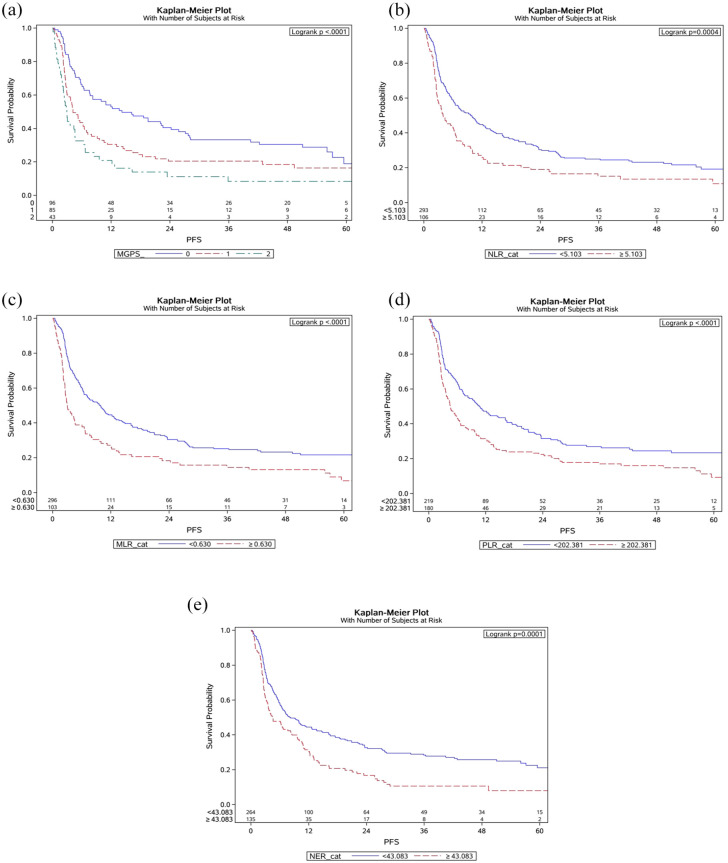
Results: Among 401 patients (median age, 66; 71% male; 21% Black/African American), median follow-up was 43.0 months (95% CI, 36.6-51.4). Patients with mGPS scores of 0 had longer OS than those with a score of 1 (hazard ratio (HR), 0.38; 95% CI, 0.23-0.62; p < 0.001) and 2 (HR, 0.37; 95% CI, 0.20-0.67; p = 0.001), and longer PFS compared to patients with mGPS scores of 1 (HR, 0.66; 95% CI, 0.44-0.98; p = 0.039) and 2 (HR, 0.44; 95% CI, 0.29-0.67; p < 0.001). Low baseline NLR was associated with longer PFS (HR, 0.73; 95% CI, 0.54-0.97; p = 0.032). Low baseline MLR correlated with improved OS (HR, 0.60; 95% CI, 0.44-0.83; p = 0.002) and PFS (HR, 0.73; 95% CI, 0.55-0.97; p = 0.031). Similarly, low baseline PLR was associated with higher CB likelihood (odds ratio (OR), 2.20; 95% CI, 1.31-3.69; p = 0.003), and low baseline NER was linked to improved OS (HR, 0.63; 95% CI, 0.46-0.87; p = 0.004), PFS (HR, 0.67; 95% CI, 0.51-0.88; p = 0.003), and higher CB (OR, 2.04; 95% CI, 1.20-3.46; p = 0.008).
Conclusion: Lower levels of systemic inflammatory markers are associated with more favorable clinical outcomes with ICI treatment. Prospective studies are needed for further validation.
期刊介绍:
Therapeutic Advances in Medical Oncology is an open access, peer-reviewed journal delivering the highest quality articles, reviews, and scholarly comment on pioneering efforts and innovative studies in the medical treatment of cancer. The journal has a strong clinical and pharmacological focus and is aimed at clinicians and researchers in medical oncology, providing a forum in print and online for publishing the highest quality articles in this area. This journal is a member of the Committee on Publication Ethics (COPE).






 京公网安备 11010802042870号
京ICP备2023020795号-1
京公网安备 11010802042870号
京ICP备2023020795号-1

 分享
分享
 求助内容:
求助内容: 应助结果提醒方式:
 扫码关注我们
