Leyla Jabbarli, Miltiadis Fiorentzis, Philipp Rating, Boerge Schmidt, Eva Biewald, Nika Guberina, Dirk Flühs, Norbert Bornfeld, Wolfgang Sauerwein, Martin Stuschke, Nikolaos E Bechrakis, Maja Guberina
{"title":"大葡萄膜黑色素瘤近距离双核素(Ru-106/碘-125)斑块治疗后的功能结局。","authors":"Leyla Jabbarli, Miltiadis Fiorentzis, Philipp Rating, Boerge Schmidt, Eva Biewald, Nika Guberina, Dirk Flühs, Norbert Bornfeld, Wolfgang Sauerwein, Martin Stuschke, Nikolaos E Bechrakis, Maja Guberina","doi":"10.1186/s13014-024-02576-6","DOIUrl":null,"url":null,"abstract":"<p><strong>Objective: </strong>Preservation of visual acuity remains a challenging issue after globe sparing therapy of large uveal melanoma. The aim of our study was analyzing the functional outcome after brachytherapy with bi-nuclide plaques (BBNP), maintaining prognostic factors for legal blindness (LB).</p><p><strong>Methods: </strong>We have analyzed all consecutive patients with large uveal melanoma treated with BBNP at our institution between 01/1999 and 12/2020. The post-treatment follow-up data were screened up to 06/2023. Univariate and multivariate Cox regression analysis was performed to identify predictive factors for development of LB following BBNP.</p><p><strong>Results: </strong>Overall, 570 patients with median age of 65.6 years (interquartile range [IQR]: 54.5-74.0) underwent BBNP. During the median post-treatment follow-up of 30.8 months (IQR: 12.9-57.3), LB was diagnosed in 287 (50.4%) patients. Patients' age (> 67 years, adjusted hazard ratio [aHR] = 1.58, 95%-confidence interval [CI] = 1.24-2.00, p < 0.0001), tumor thickness (> 8.5 mm, aHR = 1.43, 95%-CI = 1.12-1.82, p = 0.004), VA (> 0.5 LogMAR, aHR = 1.59, 95%-CI = 1.25-2.02, p < 0.0001), and ciliary body involvement (aHR = 0.77, 95%-CI = 0.60-0.97, p = 0.029) were confirmed as independent predictors of LB in the final multivariable Cox regression analysis.</p><p><strong>Conclusions: </strong>Approximately a half of patients with large uveal melanoma develop LB around 2.5 years after brachytherapy. Further optimization of treatment strategies, including both therapeutic and preventive measures, has the potential to enhance the functional outcome after episcleral plaque therapy for large UMs.</p>","PeriodicalId":49639,"journal":{"name":"Radiation Oncology","volume":"20 1","pages":"22"},"PeriodicalIF":3.6000,"publicationDate":"2025-02-12","publicationTypes":"Journal Article","fieldsOfStudy":null,"isOpenAccess":false,"openAccessPdf":"https://www.ncbi.nlm.nih.gov/pmc/articles/PMC11823052/pdf/","citationCount":"0","resultStr":"{\"title\":\"Functional outcome after Brachytherapy with bi-nuclide (Ru-106/Iodine-125) plaques in large uveal melanomas.\",\"authors\":\"Leyla Jabbarli, Miltiadis Fiorentzis, Philipp Rating, Boerge Schmidt, Eva Biewald, Nika Guberina, Dirk Flühs, Norbert Bornfeld, Wolfgang Sauerwein, Martin Stuschke, Nikolaos E Bechrakis, Maja Guberina\",\"doi\":\"10.1186/s13014-024-02576-6\",\"DOIUrl\":null,\"url\":null,\"abstract\":\"<p><strong>Objective: </strong>Preservation of visual acuity remains a challenging issue after globe sparing therapy of large uveal melanoma. The aim of our study was analyzing the functional outcome after brachytherapy with bi-nuclide plaques (BBNP), maintaining prognostic factors for legal blindness (LB).</p><p><strong>Methods: </strong>We have analyzed all consecutive patients with large uveal melanoma treated with BBNP at our institution between 01/1999 and 12/2020. The post-treatment follow-up data were screened up to 06/2023. Univariate and multivariate Cox regression analysis was performed to identify predictive factors for development of LB following BBNP.</p><p><strong>Results: </strong>Overall, 570 patients with median age of 65.6 years (interquartile range [IQR]: 54.5-74.0) underwent BBNP. During the median post-treatment follow-up of 30.8 months (IQR: 12.9-57.3), LB was diagnosed in 287 (50.4%) patients. Patients' age (> 67 years, adjusted hazard ratio [aHR] = 1.58, 95%-confidence interval [CI] = 1.24-2.00, p < 0.0001), tumor thickness (> 8.5 mm, aHR = 1.43, 95%-CI = 1.12-1.82, p = 0.004), VA (> 0.5 LogMAR, aHR = 1.59, 95%-CI = 1.25-2.02, p < 0.0001), and ciliary body involvement (aHR = 0.77, 95%-CI = 0.60-0.97, p = 0.029) were confirmed as independent predictors of LB in the final multivariable Cox regression analysis.</p><p><strong>Conclusions: </strong>Approximately a half of patients with large uveal melanoma develop LB around 2.5 years after brachytherapy. Further optimization of treatment strategies, including both therapeutic and preventive measures, has the potential to enhance the functional outcome after episcleral plaque therapy for large UMs.</p>\",\"PeriodicalId\":49639,\"journal\":{\"name\":\"Radiation Oncology\",\"volume\":\"20 1\",\"pages\":\"22\"},\"PeriodicalIF\":3.6000,\"publicationDate\":\"2025-02-12\",\"publicationTypes\":\"Journal Article\",\"fieldsOfStudy\":null,\"isOpenAccess\":false,\"openAccessPdf\":\"https://www.ncbi.nlm.nih.gov/pmc/articles/PMC11823052/pdf/\",\"citationCount\":\"0\",\"resultStr\":null,\"platform\":\"Semanticscholar\",\"paperid\":null,\"PeriodicalName\":\"Radiation Oncology\",\"FirstCategoryId\":\"3\",\"ListUrlMain\":\"https://doi.org/10.1186/s13014-024-02576-6\",\"RegionNum\":2,\"RegionCategory\":\"医学\",\"ArticlePicture\":[],\"TitleCN\":null,\"AbstractTextCN\":null,\"PMCID\":null,\"EPubDate\":\"\",\"PubModel\":\"\",\"JCR\":\"Q2\",\"JCRName\":\"ONCOLOGY\",\"Score\":null,\"Total\":0}","platform":"Semanticscholar","paperid":null,"PeriodicalName":"Radiation Oncology","FirstCategoryId":"3","ListUrlMain":"https://doi.org/10.1186/s13014-024-02576-6","RegionNum":2,"RegionCategory":"医学","ArticlePicture":[],"TitleCN":null,"AbstractTextCN":null,"PMCID":null,"EPubDate":"","PubModel":"","JCR":"Q2","JCRName":"ONCOLOGY","Score":null,"Total":0}
引用次数: 0
摘要
目的:保存大葡萄膜黑色素瘤后的视力仍然是一个具有挑战性的问题。本研究的目的是分析近距离双核素斑块(BBNP)治疗后的功能结果,维持法定失明(LB)的预后因素。方法:我们分析了1999年1月至2020年12月在我院连续接受BBNP治疗的所有大葡萄膜黑色素瘤患者。治疗后随访数据筛选至2023年6月。进行单因素和多因素Cox回归分析,以确定BBNP后LB发展的预测因素。结果:总体而言,570例患者接受了BBNP,中位年龄为65.6岁(四分位间距[IQR]: 54.5-74.0)。在治疗后30.8个月的中位随访期间(IQR: 12.9-57.3), 287例(50.4%)患者诊断为LB。患者年龄(> = 67岁,校正风险比[aHR] = 1.58, 95%可信区间[CI] = 1.24-2.00, p = 8.5 mm, aHR = 1.43, 95%可信区间[CI] = 1.12-1.82, p = 0.004), VA (> = 0.5 LogMAR, aHR = 1.59, 95%可信区间= 1.25-2.02,p)结论:大约一半的大葡萄膜黑色素瘤患者在近距离治疗后2.5年左右发生LB。进一步优化治疗策略,包括治疗和预防措施,有可能提高大型UMs的膜外斑块治疗后的功能结果。
Functional outcome after Brachytherapy with bi-nuclide (Ru-106/Iodine-125) plaques in large uveal melanomas.
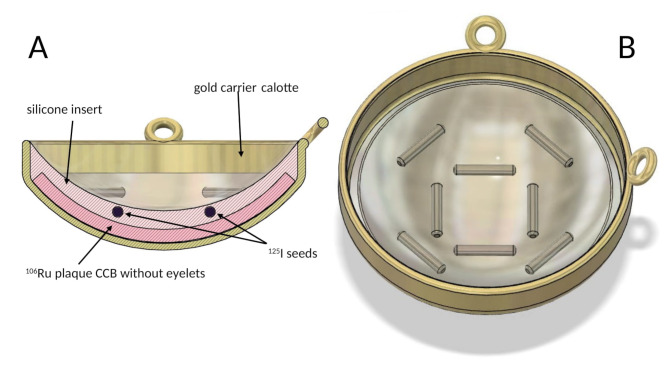
Objective: Preservation of visual acuity remains a challenging issue after globe sparing therapy of large uveal melanoma. The aim of our study was analyzing the functional outcome after brachytherapy with bi-nuclide plaques (BBNP), maintaining prognostic factors for legal blindness (LB).
Methods: We have analyzed all consecutive patients with large uveal melanoma treated with BBNP at our institution between 01/1999 and 12/2020. The post-treatment follow-up data were screened up to 06/2023. Univariate and multivariate Cox regression analysis was performed to identify predictive factors for development of LB following BBNP.
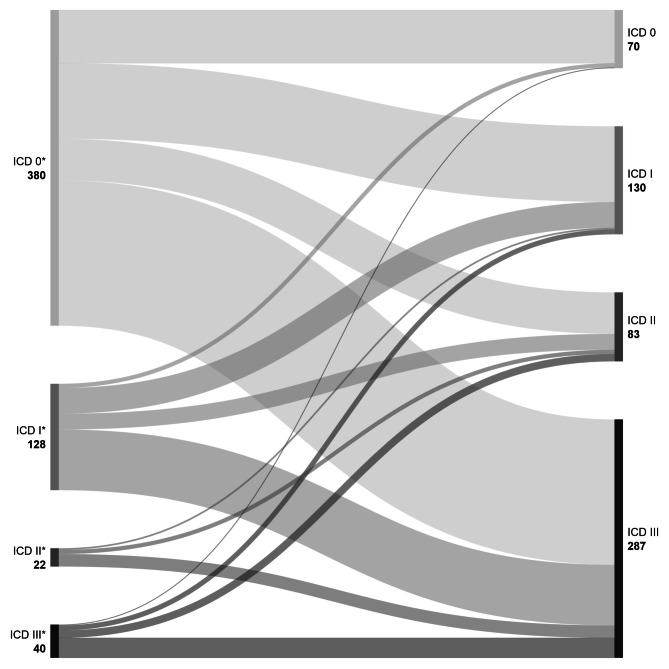
Results: Overall, 570 patients with median age of 65.6 years (interquartile range [IQR]: 54.5-74.0) underwent BBNP. During the median post-treatment follow-up of 30.8 months (IQR: 12.9-57.3), LB was diagnosed in 287 (50.4%) patients. Patients' age (> 67 years, adjusted hazard ratio [aHR] = 1.58, 95%-confidence interval [CI] = 1.24-2.00, p < 0.0001), tumor thickness (> 8.5 mm, aHR = 1.43, 95%-CI = 1.12-1.82, p = 0.004), VA (> 0.5 LogMAR, aHR = 1.59, 95%-CI = 1.25-2.02, p < 0.0001), and ciliary body involvement (aHR = 0.77, 95%-CI = 0.60-0.97, p = 0.029) were confirmed as independent predictors of LB in the final multivariable Cox regression analysis.
Conclusions: Approximately a half of patients with large uveal melanoma develop LB around 2.5 years after brachytherapy. Further optimization of treatment strategies, including both therapeutic and preventive measures, has the potential to enhance the functional outcome after episcleral plaque therapy for large UMs.
Radiation OncologyONCOLOGY-RADIOLOGY, NUCLEAR MEDICINE & MEDICAL IMAGING
CiteScore
6.50
自引率
2.80%
发文量
181
审稿时长
3-6 weeks
期刊介绍:
Radiation Oncology encompasses all aspects of research that impacts on the treatment of cancer using radiation. It publishes findings in molecular and cellular radiation biology, radiation physics, radiation technology, and clinical oncology.





 京公网安备 11010802042870号
京ICP备2023020795号-1
京公网安备 11010802042870号
京ICP备2023020795号-1

 分享
分享
 求助内容:
求助内容: 应助结果提醒方式:
 扫码关注我们
